









- bhavya gada
- No Comments
If you can name the weed, you can usually fix the lawn problem behind it. In Maryland, summer weeds often show up when cool-season grass thins out, soil stays wet, or mulch gets patchy. Many summer weeds start once soil temperatures reach 55°F, and some spread fast through lawns, beds, and patio edges.
Here’s the short version:
- Crabgrass shows up in thin, sunny turf and along hot edges. Use pre-emergent in mid-March to mid-April.
- Yellow nutsedge points to wet soil. Use a sedge-specific herbicide and fix drainage.
- Clover often means low nitrogen or weak turf. Feed the lawn based on a soil test and spot-treat if needed.
- Spurge grows in bare, hot soil and cracks. Pull it early and cover open soil with mulch.
- Dandelion often shows up in thin, compacted turf. Remove the full taproot or use a selective broadleaf herbicide.
A few lawn basics do most of the work:
- Mow cool-season grass at 3–4 inches
- Water about 1 inch per week
- Overseed in late August through September
- Keep mulch at 2–3 inches
- Clean debris out of joints and cracks before weeds root in
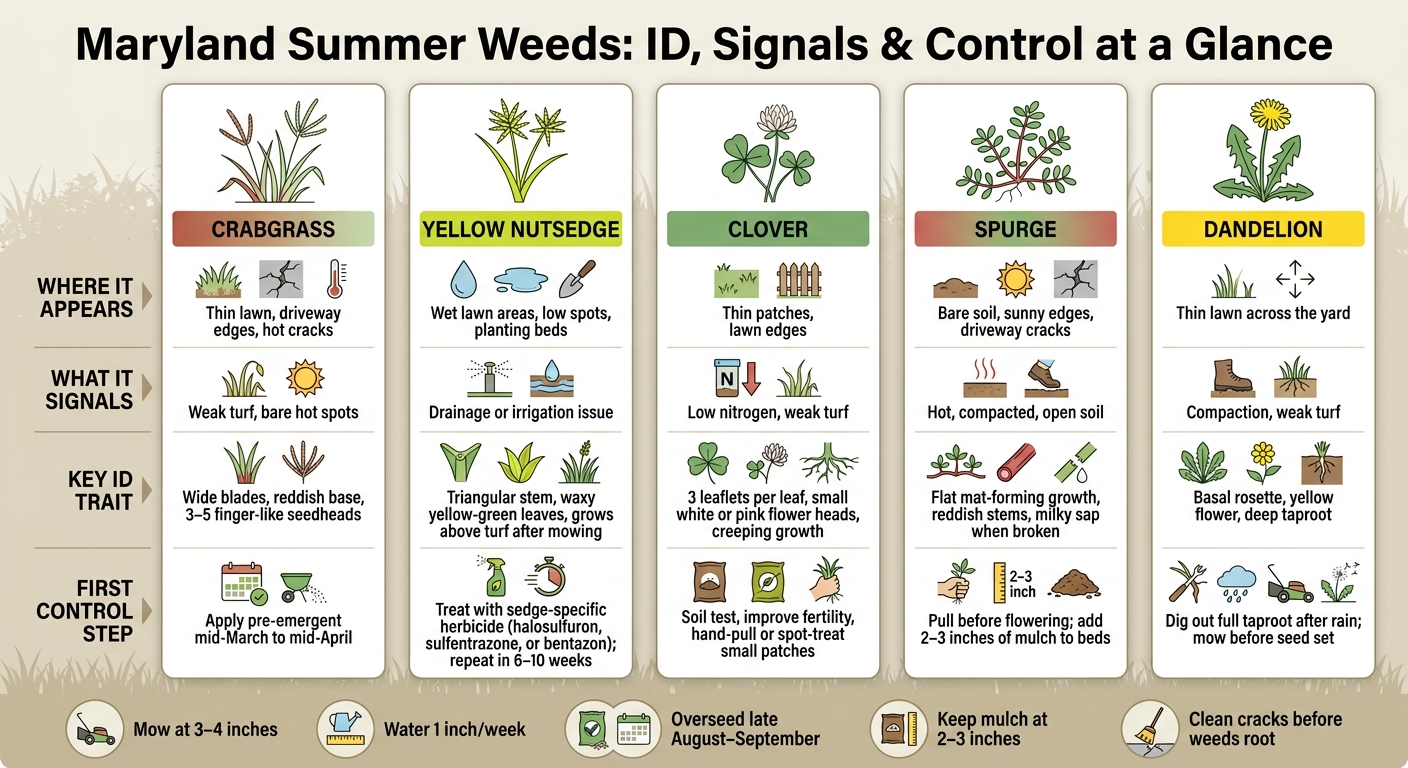
Maryland Summer Weeds: ID, Signals & Control at a Glance
Stop Summer Weeds from Ruining Your Lawn (Crabgrass, Spurge, Nutsedge)
sbb-itb-843f8be
Quick comparison
| Weed | Where I usually see it | What it often means | First thing I’d do |
|---|---|---|---|
| Crabgrass | Thin lawn, driveway edges, cracks | Weak turf, hot bare spots | Apply pre-emergent on time |
| Yellow nutsedge | Wet lawn areas, low spots, beds | Drainage or irrigation issue | Treat with sedge product |
| Clover | Thin patches, lawn edges | Low nitrogen | Test soil, feed lawn |
| Spurge | Bare soil, sunny edges, cracks | Compaction, open soil | Pull early, add mulch |
| Dandelion | Thin lawn across the yard | Compaction, weak turf | Dig out taproot |
In other words: the weed is the clue. I’d use that clue to guide control, then fix the site issue so the same weed doesn’t keep coming back.
Crabgrass and nutsedge: identification and control
Crabgrass and nutsedge don’t respond to the same fix. Crabgrass is a summer annual grass. Nutsedge is a sedge, and it grows in a very different way. Use the table above for a quick ID, then match the weed to the right treatment.
How to control crabgrass in lawns and along hardscape edges
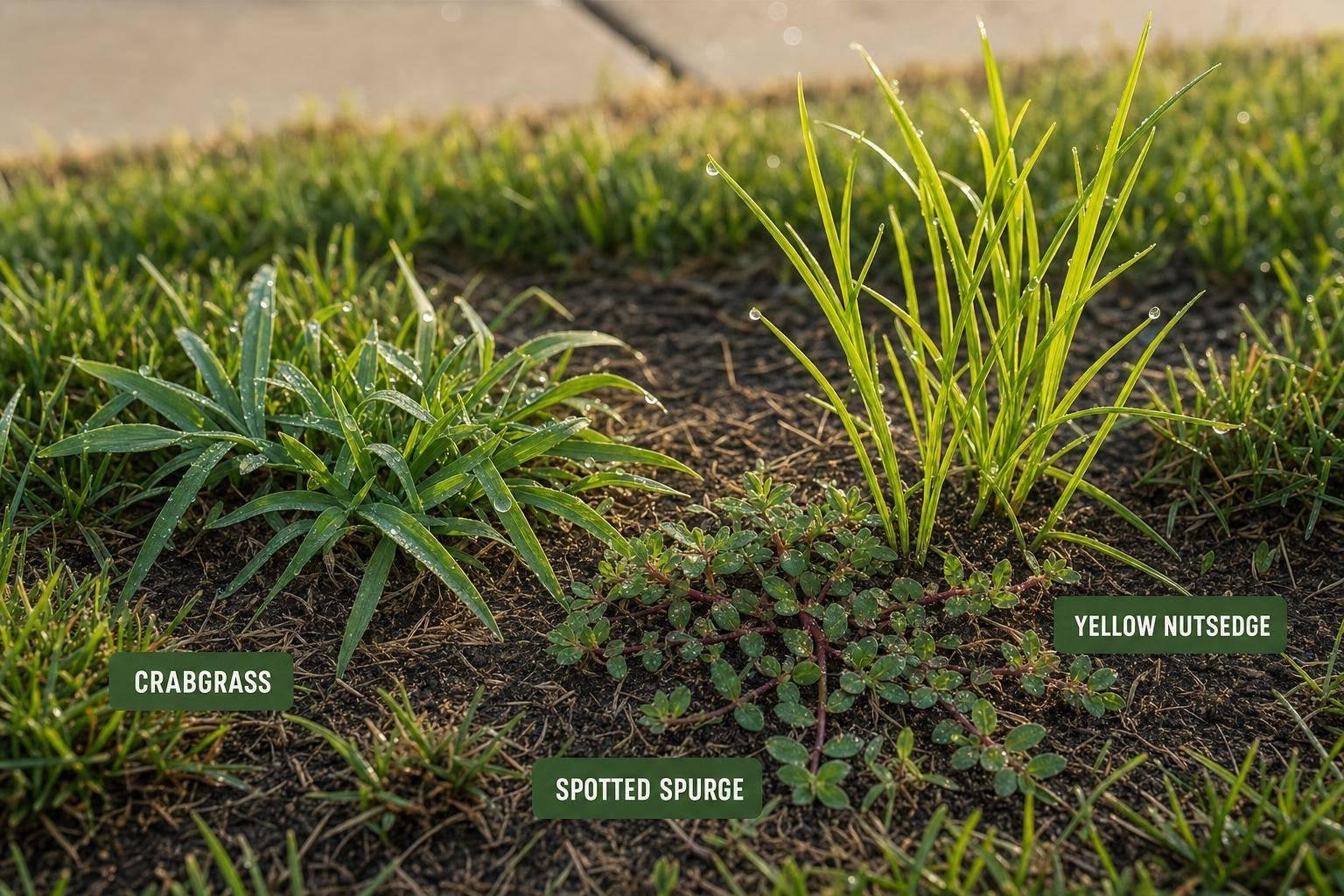
Crabgrass starts from seed each spring, grows through hot weather, and dies after frost. It tends to show up in thin turf, bare patches, and along hot, compacted spots like driveway edges and paver joints. You’ll usually see low, spreading clumps with blades that are wider than fescue or bluegrass. Many plants also have a reddish base. Once it matures, it forms 3–5 finger-like seedheads that spread from one central stem.
The best move is a granular pre-emergent before germination starts, when soil holds near 53–55°F for five straight days. In Maryland, that usually falls between mid-March and mid-April.[3][9][10] Water it in based on the label. If the label permits, apply a second treatment 6–8 weeks later.[3]
If crabgrass is already growing, pull small plants by hand while the soil is moist, or spot-treat young weeds while they’re still actively growing and before they drop seed. Around hardscape edges, clean out soil, sand, and organic debris from paver joints and driveway cracks first. Then pull or spot-treat what’s left. Keeping edge strips mowed at 3–4 inches also helps by shading the soil and cutting down germination.
If the same weed keeps coming back in low, wet areas, you’re often dealing with nutsedge instead.
How to control nutsedge in wet turf and planting beds
Nutsedge calls for a different plan because it spreads below the surface and loves wet soil. One of the easiest ways to spot it is the stem: it’s triangular in cross-section. The leaves are narrow, waxy, and usually a lighter yellow-green than the turf around them. It also tends to pop back up fast after mowing, often standing above the lawn in upright tufts.
Hand-pulling may slow it down, but it usually won’t solve the problem because tubers and rhizomes keep sending up new shoots. For turf, use a sedge-labeled post-emergent herbicide such as halosulfuron, sulfentrazone, or bentazon. Repeat the treatment in 6–10 weeks to catch regrowth.[7][8]
In lightly infested planting beds, dig out the whole plant, including any visible rhizomes and tubers. After that, add 3 inches of mulch to help suppress regrowth.[5][6][7] Long-term control comes down to moisture. Fix grading problems, improve drainage, and adjust irrigation so the soil doesn’t stay wet.
Clover, spurge, and dandelion: broadleaf weed identification and control
Once you rule out grass-like weeds, the next group to check for in a Maryland summer lawn is broadleaf weeds. The basic game plan stays the same: strengthen thin turf, remove small patches early, and spot-treat only when you need to. But each weed also tells you something about the site.
What each weed signals and when to remove it
Clover often points to low nitrogen or thin turf. Start with a soil test. Then fix fertility issues and overseed bare spots. For small patches, hand-pull or spot-treat while plants are still growing well.[12][13][19] If you use dicamba near ornamentals, read the label closely. Misuse can injure nearby trees and shrubs through root uptake.[12][15]
Spurge likes hot, bare, compacted soil. You’ll often see it in full sun near driveways, sidewalk edges, and thin areas of turf. That’s why timing matters so much. Pull it before it flowers and drops seed. When the soil is moist, hand-pull young plants and lift the whole mat from the central root. In beds, add fresh mulch right after removal.[14][16][17]
Dandelion is tougher because of its deep taproot. Mowing flowering plants helps limit seed spread, but the plant only dies if you remove the full root.[11][2] A long, narrow weeding tool works best after rain, when the soil is soft. Try to get the whole root in one pull. If patches keep coming back, you may need repeat spot treatments later in summer.[13]
Use the chart below to match each weed with the site issue it hints at and the fastest next step.
Control method comparison for clover, spurge, and dandelion
| Weed | Key ID trait | What it signals | Best removal timing | Preferred control method | Site notes |
|---|---|---|---|---|---|
| Clover | 3 leaflets per leaf; small white or pink flower heads; creeping growth | Low nitrogen, thin turf | Spring to early summer when patches are small; fall for herbicide plus overseeding | Improve fertility and turf density; hand-pull small patches; spot-treat with a selective broadleaf herbicide when needed | Beds: hand-pull; keep turf dense. |
| Spurge | Flat, mat-forming growth; reddish stems; milky sap when broken | Hot, bare, compacted soil | Before flowering and seed set | Pull young plants by the root; mulch beds; maintain dense turf; use labeled preemergent or selective postemergent control when needed | Beds: pull and re-mulch; edges: keep joints clean. |
| Dandelion | Basal rosette; yellow flower; deep taproot | Thin turf and compaction | Before flowering and seed maturity; also late summer for herbicide | Dig out the full taproot when soil is moist; mow flowering plants before seed set; spot-treat actively growing plants with a selective broadleaf herbicide | Beds: remove taproot; edges: pull early. |
In beds, mulch does most of the prevention work.[18][17][20] In turf, dense growth and proper mowing do the heavy lifting. The next section breaks that down by location.
Control methods by location: lawns, planting beds, and hardscape edges
Where a weed shows up matters just as much as what kind of weed it is. Lawns do best with thick turf. Beds do best with mulch. Cracks along patios and driveways need cleanup and repair. In plain terms: grass weeds call for denser turf, broadleaf weeds call for selective removal, and weeds in joints call for hands-on cleanup.
Lawns: build dense turf and treat selectively
In a Maryland lawn, thick turf is your best defense. Mow cool-season grass at 3–4 inches and never remove more than one-third of the blade at a time.[1] Water deeply, not constantly, for about 1 inch per week total, and do it in the early morning.[1] Fertilize based on a soil test, mostly in fall, with slow-release nitrogen.[22]
Thin or bare spots are often where dandelion, clover, and crabgrass show up first. If you see those weak areas, aerate and overseed in late August through September.[23]
When weeds still push through, skip blanket spraying if you can. Spot-treat broadleaf weeds with a selective herbicide, and use a sedge-selective product for nutsedge while plants are actively growing in summer.[21] Keep broadleaf treatments to two or three applications per year to protect turf health.[4]
Beds and joints need a different plan: mulch, cleanup, and spot removal.
Planting beds and hardscape edges: mulch, cleanup, and targeted removal
In planting beds, 2–3 inches of organic mulch helps block light from reaching weed seeds near the soil surface.[25] Before you add new mulch or refresh old mulch, pull or cultivate the weeds already there. Keep mulch slightly back from plant stems and away from tree trunks.
When small weeds pop up, use light hoeing to take out tiny seedlings before they get established. For larger weeds, hand-pull after rain, when the soil is moist and roots slip out with less trouble.
Along patio edges, walkways, and driveway joints, start with cleanup. Sweep often to remove soil, leaves, and grit from cracks. Pull or dig out rooted weeds, then use shielded spot control only on the weeds themselves. Keep sprays off turf and ornamentals.[24] Use glyphosate only as a shielded spot treatment on calm days and away from nearby plants.[4] After the weeds are cleared, sealing or repairing open joints is the best way to stop the same spots from filling back in.
Prevention and next steps: stopping repeat weed outbreaks
Once you’ve identified the weed and treated it, the next move is prevention. That’s what keeps the same issue from popping back up a few weeks later. In most cases, prevention matters more than removal.
For tall fescue, mow at 3–4 inches. Apply pre-emergent before crabgrass starts to germinate. And spot-treat weeds while they’re still actively growing, before they go to seed.[26]
When weeds keep coming back, there’s usually a site issue behind it. Wet soil, compacted edges, thin turf, and shallow mulch are common culprits. Crabgrass often shows up along thin, sunny edges. Nutsedge usually signals wet soil. Clover and dandelion tend to show up where turf is weak. Deal with the site problem, and repeat outbreaks become much less common.
For recurring drainage, grading, mulching, or lawn-renovation problems in central Maryland, Pro Landscapes MD addresses the site conditions behind repeat weed pressure. These fixes matter most when drainage, grading, or low turf density keeps producing the same weeds.
Key points to remember for Maryland summer weed control
Use these habits to cut down on repeat outbreaks in Maryland landscapes:
- Match the weed to the control method: grass, sedge, and broadleaf weeds each respond differently.
- Use turf, mulch, or edge cleanup based on where the weed is growing.
- Pull or treat weeds before flowering to limit next year’s seed bank.
- Fix wet soil, compaction, thin turf, and mulch gaps at the source.
- Keep up mulch, mowing, cleanup, and spot removal through summer. One treatment usually isn’t enough.
FAQs
How can I tell crabgrass from nutsedge?
Look at the leaves and the way it grows. Crabgrass is a grass, and it spreads low to the ground in thick clumps with wide, flat blades.
Nutsedge is a sedge, not a grass. Its stem is triangular and can feel sharp or V-shaped if you roll it between your fingers. It also tends to shoot up faster, with a glossy, yellow-green color that stands out in the lawn.
Why do the same weeds keep coming back?
Weeds keep coming back because they’re tough, and their seeds can sit dormant in the soil until the timing is right to sprout.
They also do well when a lawn is under stress. Cutting grass too short, compacted soil, thatch buildup, and thin or weak turf all make it easier for weeds to move in and take over.
When should I overseed and use pre-emergent in Maryland?
In Maryland, apply pre-emergent in early spring to help stop weeds before they start.
The timing changes a bit by region:
- Central and southern Maryland: March 15 to April 1
- Northern and western Maryland: April 1 to April 15
For overseeding, fall is the best window. Aim for mid-September to mid-October so the lawn has time to recover and fill in well.
Chat with Us