









- bhavya gada
- No Comments
Even a backyard project can trigger runoff rules in Maryland. If your job disturbs 1 acre or more, federal stormwater permit rules may apply. But many home projects get flagged much sooner under Maryland and county rules, often at more than 5,000 square feet of disturbed soil or more than 100 cubic yards of earth moved.
Here’s the short version: if you’re grading, trenching, adding a patio, building a retaining wall, or changing drainage, I’d treat runoff compliance as part of the job from day one. The main risks are simple: bare soil, water redirected toward a neighbor, and starting work without the right county approvals. In Maryland, that can lead to violation notices, stop-work orders, cleanup costs, and repeat site visits.
What matters most:
- Federal coverage often starts at 1 acre
- Maryland review often starts earlier than federal review
- Small work areas can be added together on one property or under a larger plan
- Stockpiles, slopes, and driveways are common trouble spots
- Inspections, logs, and dated photos help prove the site stayed under control
- Older builder permits usually do not cover later landscape or hardscape work
A few numbers show why counties watch this closely. Stormwater runoff sends about 17% of the Chesapeake Bay’s nitrogen load, 17% of its phosphorus load, and 9% of its sediment load. And in 2024, Maryland issued 4,189 sediment control violation notices and 1,359 stop-work orders.
If I had to sum up the article in one line, it would be this: <u>most residential runoff compliance in Maryland is driven by local grading, erosion, sediment, and stormwater rules – not just EPA acre-based thresholds.</u>
| Topic | Key point |
|---|---|
| Federal trigger | 1 acre or more disturbed, or part of a common plan totaling 1 acre or more |
| Maryland trigger | Often 5,000+ sq. ft. disturbed or 100+ cubic yards moved |
| Work that counts | Grading, patios, driveways, trenching, retaining walls, drains, stockpiles |
| Common mistakes | Exposed soil, bad drainage, missing plans, changing shared storm features |
| Records to keep | SWPPP or runoff plan, inspection logs, maintenance notes, dated photos |
So before work starts, I’d check disturbance area, grading changes, drainage paths, and county permit thresholds first.
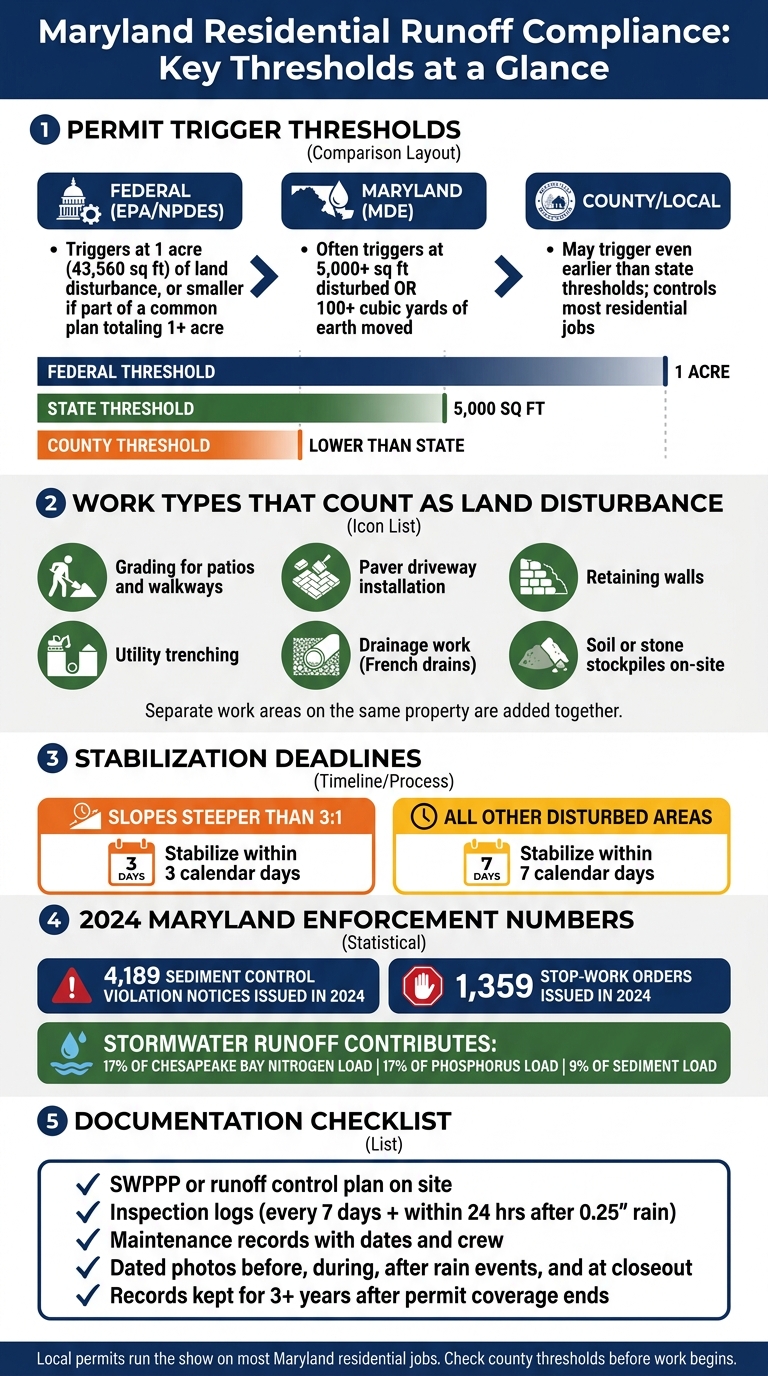
Maryland Residential Runoff Rules: Federal vs. State vs. County Thresholds
NPDES & Stormwater Permits: Everything You Need to Know! | Resource Management Associates
sbb-itb-843f8be
When Federal EPA Rules Connect With Maryland Residential Permits

Federal law requires NPDES coverage when a residential project disturbs 1 acre or more. The same rule can apply to smaller jobs when the work is part of a larger common plan that adds up to 1 acre or more. In Maryland, MDE handles this through its construction stormwater permit, and the operator – usually the contractor – must file an NOI before earth disturbance starts. [11][13][14][12][16] That permit call shapes what happens next: the project may need federal coverage, state review, or both.
Even a half-acre lot can need coverage if it sits inside a subdivision planned to disturb more than 1 acre. [22][11][13][17][18]
What Counts as Regulated Land Disturbance on a Residential Site
On a residential site, land disturbance includes any work that exposes soil or changes grade. That can cover:
- grading for patios and walkways
- paver driveway installation
- retaining walls
- utility trenching
- drainage work such as French drains
- soil or stone stockpiles kept on-site
Separate work areas on the same property are added together. So a few small jobs, taken as one, can push the site past the 1-acre mark. [18][12][15] Once that regulated area is pinned down, the next step is county approval, which often controls the order of work.
How Maryland and County Permits Fit Into the Process
Maryland and county agencies review grading, erosion and sediment control, and stormwater plans before work begins. Many local thresholds sit below the federal standard, which means a residential project may still need county approval even if it does not need NPDES coverage. [3][20][12][15][10][19][23][24]
Why the Original Homebuilder Permit Does Not Cover Later Landscape Work
The original homebuilder permit usually applies only to the first build. Later landscape or hardscape work falls outside that permit if it changes grading, adds impervious area, or alters an existing stormwater control. [16][18][15][10][12][7]
Contractors should check whether the original permit is still active and confirm with the county or MDE before assuming older approvals still apply. After coverage and approvals are in place, the job moves into day-to-day control of exposed soil, runoff, and site records during construction.
Common Runoff Compliance Problems and How to Fix Them
Most residential runoff violations come back to three things: exposed soil, poor drainage, and missing approvals. After permits are set, the day-to-day job is keeping runoff under control on the site itself.
Bare Soil, Stockpiles, and Sediment Leaving the Site
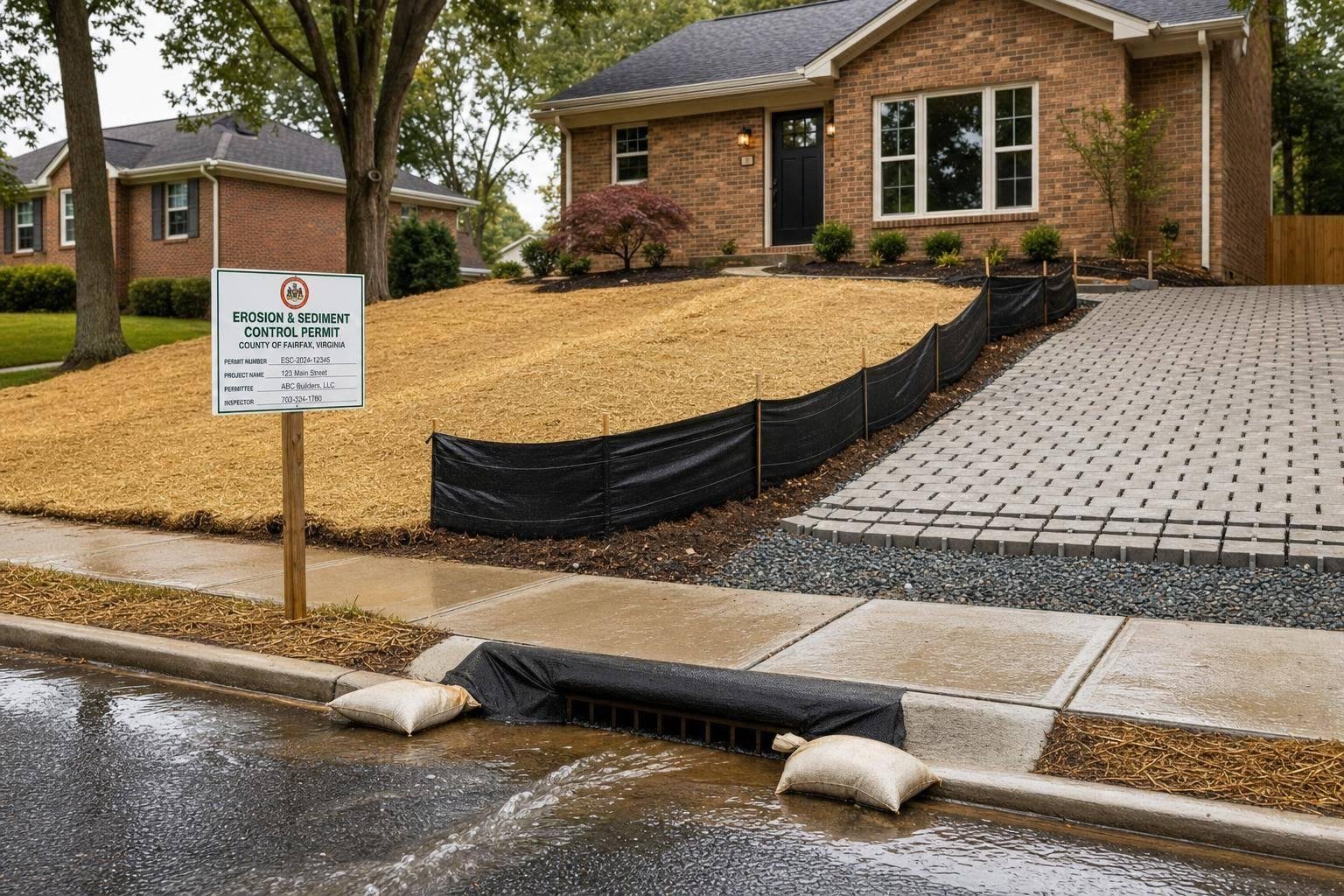
Exposed subgrade and unprotected soil piles are major sources of sediment violations on residential sites. In Maryland, soils can erode fast during rain, and even a small storm can push loose material into curb lines and storm drain inlets.[20][3]
Maryland’s erosion and sediment control standards give clear deadlines for stabilization. Slopes steeper than 3:1 must be stabilized within 3 calendar days, and all other disturbed areas within 7 days.[20] A simple way to handle this is to phase grading so only the area being worked that week stays open.
Stockpiles need the same kind of attention. Keep them away from curb lines and inlet openings, place silt fence on the downslope side, and cover them when work stops or rain is in the forecast.[20][25]
Maryland also requires a stabilized construction entrance at access points. That usually means coarse stone over geotextile fabric, which helps cut down on sediment getting tracked onto public roads.[20][37] If sediment does end up on pavement, clean it with a broom, shovel, or vacuum. Do not wash it into a storm drain.[31][32]
New Patios and Driveways That Redirect Water Toward Neighbors
Hardscape can create the same runoff problem in a different way. Concrete and pavers shed most rainfall as runoff.[28][29][30] If a new patio or driveway is added without careful grading, that water can collect at the property line or move straight toward a neighbor’s foundation. Maryland’s stormwater guidance makes the rule plain: an approved stormwater plan does not allow runoff to be directed onto neighboring property.[2]
The problem usually isn’t the patio or driveway by itself. It’s the path the water takes afterward. Finished grades should move water away from the house and spread it across a vegetated area instead of sending it to one discharge point.
Good fixes include directing impervious surfaces toward:
- vegetated swales
- rain gardens
- permeable pavers that let water soak into the ground instead of running off[26][33][35]
Sizing matters too. Maryland limits on-lot rain garden drainage areas to 2,000 square feet or less for single residential applications, so these systems need to be planned correctly from the start.[33]
Missing Plans, Poor Coordination, and Stop-Work Orders
Starting work without an approved erosion and sediment control plan is one of the fastest ways to end up with a stop-work order.[34][36] It’s easier than many owners think to cross that line, especially when grading, a new patio, drainage work, and a driveway are bundled into one project.
Another common problem is changing subdivision stormwater features without county review. That includes swales, shared ponds, and storm drain inlets.[27][1] If those features are changed without a plan amendment, the result can affect stormwater performance across the whole subdivision and lead to county enforcement.
Before work starts, map the disturbance limits, check whether the total disturbed area hits a permit threshold, and contact the county reviewer if the work touches an existing drainage structure. That pre-construction check can save time, money, and a lot of hassle during the build. Those controls still need to be documented during construction if the site is going to stay in compliance.
How Contractors Document Runoff Control During Site Work
Documentation is the line between a smooth inspection and a compliance mess. When records are organized, photos are dated, and the site plan is current, it becomes much easier to show that runoff controls were planned, put in place, and maintained the right way. Those records also help show what drainage conditions looked like before any work began.
What to Include in a Runoff Control Plan or SWPPP
Once permits are in place, the paperwork needs to show that the site matched the approved plan. That starts with a written runoff control plan before work begins.
The plan should cover the site address, project scope, disturbed area, slopes, drainage features, control locations, grading sequence, stockpile protection, and the final stabilization method.
If federal coverage applies, Maryland’s Construction General Permit requires a formal Stormwater Pollution Prevention Plan (SWPPP). A full SWPPP goes further than a basic runoff control plan. It includes roles, spill prevention steps, BMP details, and inspection procedures. The approved ESC plan and SWPPP should stay on site or be easy to access during the work. [15][9][44]
Inspection Logs, Maintenance Records, and Photo Documentation
During construction, the plan turns into the day-to-day checklist for inspections and maintenance. Maryland guidance calls for a written inspection report after every inspection. That report should include:
- Inspection date
- Inspector name and title
- Weather information
- Project status
- Evidence of sediment discharges
- Controls needing maintenance
- Missing or improperly installed controls
- Photographs
Under Maryland’s Construction General Permit, inspections are usually required at least once every 7 calendar days and within 24 hours after a storm that drops 0.25 inch or more of rain. [18][39] These records must be kept for at least 3 years after permit coverage ends. [40][41]
Maintenance records matter just as much as inspection logs. Every repair or cleanup should be logged with the date, location, and crew. That gives regulators a clear paper trail showing the controls were managed throughout the project.
Dated photos help complete the record. Best-practice guidance recommends taking photos before work starts, during construction, after major rain events, and at closeout. [43][45][46] Those images show how site conditions changed over time. Keep the photo log with the inspection records, and use the same viewpoints each time so the comparison is clear.
Conclusion: Managing Runoff Correctly on Residential Projects
Once permits are in place, the job isn’t over. The last step is keeping your controls working and your records up to date. Federal coverage starts at 1 acre of disturbance. In Maryland, review often kicks in at 5,000 square feet or 100 cubic yards.[6][49][51][52][53]
For most homes, approvals come from Maryland counties and municipalities, not EPA. In plain English, local permits run the show on most residential jobs. And if grading or drainage changes later, you usually need new approval before moving ahead.[8][50]
Paperwork matters here. A current SWPPP or runoff control plan, regular inspection logs, maintenance records, and dated photos are what show the site stayed compliant during construction.[32][42][47]
It also pays to think ahead. Plan drainage and erosion control before work starts so you protect the property, nearby lots, and downstream waters, including streams that flow into the Chesapeake Bay. Maryland’s stormwater guidance leans toward ESD practices like vegetated swales, landscape infiltration, and permeable surfaces to manage runoff close to where it lands.[48][49] That’s usually much easier on the budget than trying to fix things after the fact.
For residential projects that need drainage or grading work in central Maryland, Pro Landscapes MD handles grading, drainage, French drains, stormwater management, and permeable hardscaping for residential projects.
FAQs
Do multiple small projects count together?
It depends. Small projects under 5,000 square feet or 100 cubic yards may not need complex permits on their own. But that doesn’t mean they’re always in the clear. If the work is tied to a larger development plan, local rules may still apply.
Location can change everything. Projects in sensitive areas – such as the Chesapeake Bay Critical Area, wetlands, or floodplains – often need permits no matter the size.
For that reason, it’s smart to check with your local permitting authority for site-specific rules.
How do I know if my county permit is enough?
Often, it isn’t enough on its own. In Maryland, many projects run into both local and state rules.
If construction disturbs 5,000 square feet or more, or moves 100 cubic yards of earth, it will usually need an approved erosion and sediment control plan. If the project disturbs 1 acre or more, it will also usually need a state-level Construction General Permit and a Stormwater Pollution Prevention Plan.
It’s smart to check with your local permitting or environmental authority early, before work gets rolling.
Who is responsible for runoff inspections and records?
For residential construction, the SWPPP needs to clearly spell out who is in charge of inspections, maintenance, and recordkeeping.
In many cases, contractors or crew members handle day-to-day upkeep and routine site checks. That said, some jurisdictions require a qualified inspector, so you can’t just assume any team member can fill that role.
Government agencies may also inspect the site to check compliance. At the end of the day, the property owner or project lead is the one who must make sure responsibilities are assigned and records are kept.
Chat with Us