









- bhavya gada
- No Comments
If I had to sum it up in one line: in Maryland, water does more damage to fire pit walls than fire does.
If you want a fire pit wall to last through wet winters, freeze-thaw swings, humid summers, and open-flame heat, I’d keep it simple:
- Use dense, low-absorption materials for exposed surfaces
- Use fire-rated materials inside the firebox
- Build on a draining, compacted base
- Slope caps and nearby ground so water runs off instead of sitting
- Stay careful with porous stone, standard block, and non-SW brick in exposed spots
The article compares natural stone, brick, concrete block, and pavers based on four things that matter most in central Maryland:
- Water uptake
- Freeze-thaw wear
- Heat handling
- Movement from wet soil and weak base work
A few numbers stand out fast:
- Most fire pit builds use 4 to 6 inches of compacted aggregate base
- The leveling pad is often set about 3 inches below grade
- Surface slope should run about 1/8 to 1/4 inch per foot away from the pit
- Refractory fire brick is often rated around 1,800°F to 2,500°F
The short answer:
I’d use fire brick or a liner inside, then dense stone, SW-grade brick, or a fire-rated block/paver system outside. That setup deals better with moisture, heat, and seasonal shifting than softer, more absorbent materials.
Quick Comparison
| Material | Water resistance | Winter durability | Heat use | Main risk |
|---|---|---|---|---|
| Dense natural stone | High | High | Best for caps and outer walls | Spalling if porous or left saturated |
| SW-grade clay brick | Medium | Good | Fine for outer wall | Face flaking and joint wear |
| Fire brick | High | Good when kept dry | Best for direct flame | Hairline cracks under stress |
| Fire-rated block | Medium to high | Good with drainage | Best as shell with liner | Cracking if used bare near flame |
| Concrete pavers / wall block | Medium | Good if freeze-thaw rated | Fine for surround | Shifting from poor base or trapped water |
Bottom line: if a material holds water, sits on a weak base, or takes direct flame without a liner, it will likely fail sooner in Maryland.
How Maryland Weather Stresses Fire Pit Wall Materials
Maryland weather puts masonry through a lot. Winter brings frequent freeze-thaw swings. Summer brings hard heat. Then you add rain, humidity, and the fire pit’s own heat, and the wall ends up under stress in every season.
Fall and spring moisture can soak into masonry, while the fire pit adds radiant heat plus repeated heating and cooling. So yes, build quality matters. But material choice matters just as much.
Freeze-Thaw Damage Starts With Trapped Moisture
Freeze-thaw damage usually begins with water getting where it shouldn’t. Moisture slips in through joints, hairline cracks, porous surfaces, and caps or backfill that don’t drain well. Once that water freezes, it expands and creates pressure inside the masonry. Over time, repeated freeze-thaw cycles can lead to cracking, spalling, flaking, loose caps, and open joints [6].
The top courses and caps usually fail first because they stay wet longer than the rest of the structure. That’s a big deal in a climate like Maryland’s, where wet cold weather can hang around for months.
Dense, low-absorption materials help lower this risk because they stay below the water saturation point that makes freeze-thaw damage worse [6]. Put simply: the less water a material holds, the better its odds when temperatures bounce above and below freezing.
Summer Heat and Open Flame Add a Second Layer of Stress
Heat creates a different kind of pressure. Masonry expands and contracts as temperatures change, and that movement tends to show up first in joints and where one unit meets another [4]. At first, the damage may seem minor. But repeated heating and cooling can turn small flaws into visible cracks.
The inner fire chamber has the hardest job. It must handle direct flame and fast temperature swings, which is why it needs fire-rated materials like refractory firebrick or a steel insert [5].
The outer wall has a different role. It still needs to stand up to radiant heat, repeated heating and cooling, and drying stress without cracking. A common mistake is picking a material that looks right for the outer surround but can’t do the job inside the fire chamber. That distinction matters, and it sets up the material comparison that follows.
sbb-itb-843f8be
How Stone, Brick, Concrete Block, and Pavers Hold Up in Maryland
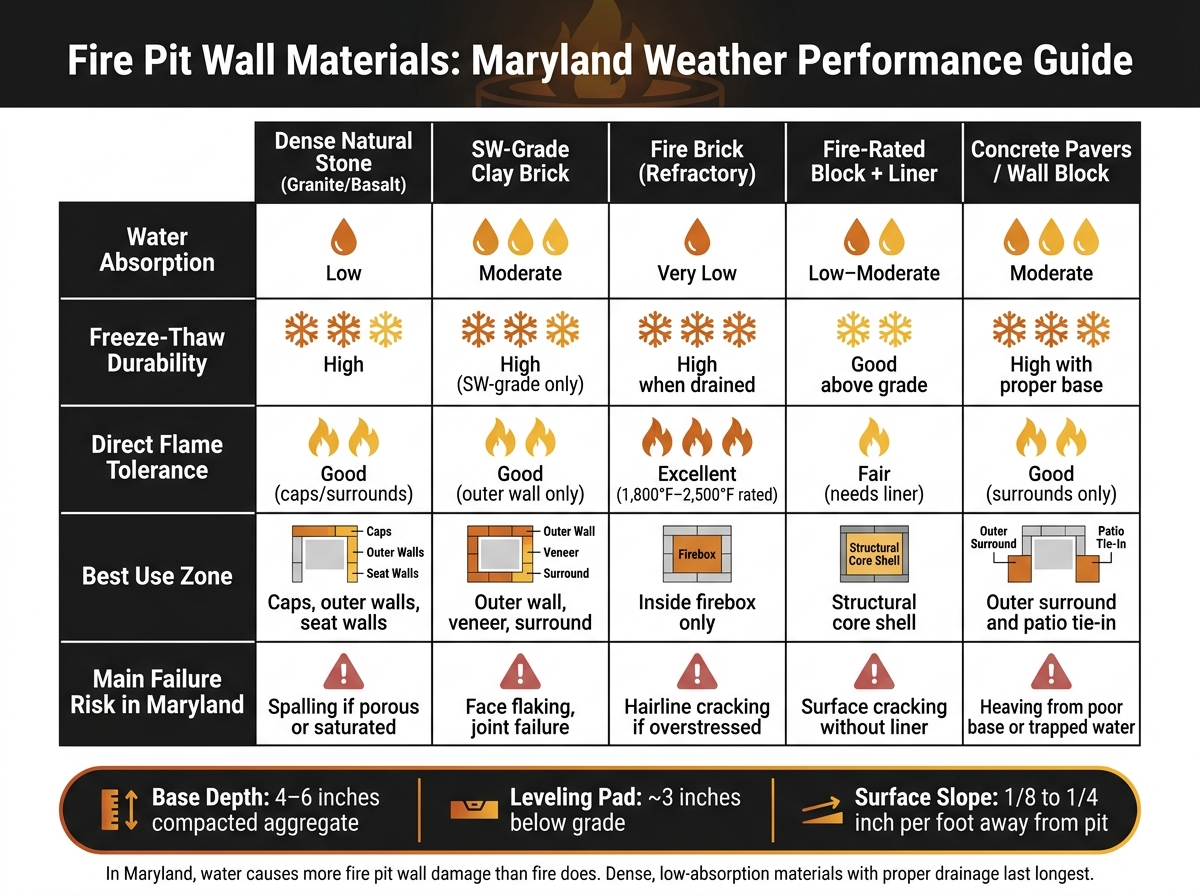
Fire Pit Wall Materials: Maryland Weather Performance Guide
The big split between these materials comes down to water uptake and fire tolerance. In Maryland, that matters a lot. When a material soaks up water and then faces repeated freeze-thaw cycles, damage can show up fast. Add open flame and high heat, and weak spots get exposed even more. So the best material often depends on where it sits: in the firebox, on the cap, around the surround, or near grade where water tends to collect.
Material Comparison: Freeze-Thaw Resistance and Heat Tolerance
Use this quick comparison to line up each material with the level of exposure it can handle.
| Material | Water uptake | Freeze-Thaw Durability | Direct-flame tolerance | Common failure risks in Maryland |
|---|---|---|---|---|
| Dense natural stone (granite, basalt) | Low | High when used above grade with good drainage | Good for caps and surrounds; not ideal as the firebox lining | Spalling caps if the stone is porous or saturated; smoke staining |
| SW-grade clay brick | Moderate | High for SW-grade; poor for non-SW-rated brick | Good as an outer wall; can crack if used as an unlined firebox | Face spalling, flaking corners, mortar joint failure |
| Fire brick (refractory) with outer veneer | Very low | High when kept drained | Excellent; typically rated 1,800°F–2,500°F [8][1] | Hairline cracking if overstressed; outer veneer still weathers |
| Fire-rated block with liner | Low–moderate | Good above grade with drainage; better than standard block | Fair as a structural shell; should be lined with fire brick or a metal ring | Surface cracking if exposed to direct flame; freeze-thaw damage at grade |
| Concrete pavers / retaining wall block | Moderate | High for freeze-thaw-tested products over a proper base | Good for surrounds and outer walls; fire-rated versions only near high heat | Heaving, rocking, and joint opening from poor base; cracking near fire if overheated |
In plain English: freeze-thaw-tested pavers tend to last better through Maryland winters. And ordinary block should stay outside the firebox. Inside the burn area, use a fire-rated block or liner instead.
Where Each Material Works Best
The simplest way to think about it is by zone: firebox, wall, cap, and surround.
Fire brick belongs inside the firebox. It’s made for direct flame and fast temperature swings. Pairing it with an exterior shell of brick, stone, or block gives you a heat-safe interior and a weather-ready outside layer. SW-grade clay brick works well for an outer wall, veneer, or paved surround, but the grade matters. Non-SW-rated brick isn’t built for outdoor freeze-thaw exposure and often flakes or cracks outside [3].
Dense natural stone, especially granite and basalt, is a strong fit for exposed faces, seat walls, and caps. Because it has low porosity, it usually handles Maryland’s wet winters better. By contrast, softer and more porous stones, including some sandstones and river rock, can hold moisture. Once that trapped water gets heated, the stone may crack or even pop [1][7]. That’s why those materials should stay away from direct flame contact.
Fire-rated block works well for the structural core of a pit wall or seat wall, especially when it’s faced with stone or brick veneer. Concrete pavers and retaining wall block are best kept to the outer zones. If part of the build sits close to the fire, add a steel ring or fire-brick liner for protection. Even tough materials can fail when water gets trapped under the wall.
Rain, Drainage, and Base Preparation Help Prevent Early Failure
Material choice matters, but drainage often decides how long a fire pit wall will hold up. In central Maryland, the base and the path water takes can make or break a fire pit surround. Rain and clay-heavy soil tend to hold water, which means moisture can stay trapped around the hidden parts of the build long after the storm is gone.
Poor Drainage Leads to Movement, Loose Caps, and Cracking
When rainwater soaks into the base or builds up behind a wall, it softens the soil that supports the structure and weakens the aggregate layer. Once that base loses strength, the wall starts to shift. That’s when you begin to see cracks, loose caps, gaps, leaning sections, or puddles that keep coming back.
Freeze-thaw cycles make the problem worse. Water caught in joints or bedding layers freezes, expands, then thaws and shrinks back. Over time, that repeated motion loosens cap units and nudges wall blocks out of place. In Maryland’s clay soils, poor drainage and trapped water are leading causes of wall failure. [9]
Build Details That Help Materials Last Longer
A fire pit surround that lasts starts below grade. Most fire pit builds use 4 to 6 inches of compacted aggregate base that extends past the perimeter, with the leveling pad set about 3 inches below grade. [10][11] Open-graded aggregate drains much better than local soil, so water is less likely to sit inside the assembly.
Slope matters just as much as base depth. The area around the fire pit should pitch about 1/8 to 1/4 inch per foot away from the structure so surface water runs off instead of pooling at the wall edge. Downspouts and roof runoff should also be routed away from the fire pit area.
Cap units should sit even and have a slight pitch so water sheds off them. Good joint and edge detailing also helps the system handle small seasonal shifts without turning them into large gaps. Those small build choices help stone, brick, block, and pavers last longer in Maryland weather. Pro Landscapes MD installs fire pits, seat walls, and drainage systems across central Maryland, keeping the base and runoff design aligned.
Best Material Choices for Central Maryland Fire Pit Surrounds
Central Maryland’s wet winters and hot summers can be rough on fire pit walls. Over time, moisture, freeze-thaw cycles, and heat stress wear materials down. That’s why three choices tend to last longer here: dense natural stone, fire-rated block systems, and well-built paver and cap assemblies. The main difference is simple: each one handles water, heat, and movement a little differently.
Choose Dense Materials and Protect Joints and Caps
Capstones and top joints usually fail first because they stay wet the longest. Use full-bed mortar and slope caps away from the opening so water runs off instead of sitting in place. [12][13][14]
Dense natural stone, especially granite and dense bluestone, is a strong pick for outer surrounds because its low porosity helps limit water absorption and freeze-thaw damage. [2][15][16]
Fire-rated block is a solid choice for the structural wall, especially when paired with a steel ring or metal liner. [13][17]
Paver and cap assemblies can also hold up well when they’re built the right way. That means a draining base, tight joints, and caps that stay bonded. Tight joints and solid edge restraint help limit movement and keep water out. [12][13][14]
Here’s the simplest way to compare them.
| Material category | Freeze-thaw performance | Heat tolerance | Main watch point |
|---|---|---|---|
| Dense natural stone (granite, dense bluestone) | Strong when low-absorption stone is specified | Good for outer walls; keep away from direct flame | Avoid porous or layered stone varieties |
| Fire-rated concrete block systems | Good when installed with liner and draining base | Engineered for repeated heat cycling | Fails early without proper base and drainage |
| Paver/cap assemblies | Good with compacted base and tight joints | Suitable for surrounds and patio tie-ins | Loose caps and open joints admit water quickly |
Conclusion: Pick Materials That Handle Water, Heat, and Movement
The best material is the one that sheds water, takes heat, and doesn’t trap moisture. In Maryland, fire pit walls usually break down because of moisture, freeze-thaw pressure, and summer heat. Dense, low-absorption materials help with the moisture side. Fire-rated systems and metal liners help with the heat side. Proper drainage, compacted bases, and well-bonded caps help with movement.
If a material can’t shed water, resist freeze-thaw stress, and handle heat, it’s the wrong fit here. Pro Landscapes MD designs and installs fire pits, seat walls, and drainage systems across central Maryland.
FAQs
What is the best fire pit wall material for Maryland?
Natural stone is often the best pick for a Maryland fire pit wall. It tends to hold up well through freeze-thaw cycles, which matter a lot in a place where water can seep in, freeze, expand, and crack weaker materials.
That said, the stone alone isn’t enough. A fire pit wall also needs a solid base and proper drainage. Gravel backfill and weep holes help move water out, which can cut down on buildup from rain and heavy summer humidity.
Do I need fire brick inside the fire pit?
Yes, putting fire brick inside your fire pit is a smart move.
Regular stone or masonry can crack, chip, or wear down when it’s exposed to intense direct heat. Fire brick is made for that kind of punishment.
It helps protect the materials around it and can improve your fire pit’s safety and lifespan. It also holds up better through Maryland’s seasonal temperature swings and repeated heating and cooling.
How do I stop a fire pit wall from cracking in winter?
The best way to stop winter cracking is proper drainage. In Maryland, freeze-thaw cycles are hard on retaining walls. Water gets trapped, freezes, expands, and that pressure can crack the wall or push it out of place.
A wall needs a clear path for water to escape. Use gravel backfill, add weep holes or perforated pipes to carry water away, and set the wall on a deep, well-compacted base below the frost line. Just as important, keep those drainage openings clear through the winter so the whole system keeps working.
Chat with Us