









- bhavya gada
- No Comments
Retaining walls are more than just barriers – they’re structural systems that must handle soil pressure, water loads, and environmental challenges. Without proper geotechnical testing, these walls risk failure from unseen forces. Here’s why geotechnical testing is critical:
- Soil Analysis: Tests like sieve analysis and Atterberg limits classify soil, ensuring the right materials are used to reduce pressure and improve drainage.
- Strength Testing: Shear strength and bearing capacity tests determine whether the soil can handle lateral forces and the wall’s weight.
- Water Management: Testing identifies soil permeability and designs drainage and storm water management systems to prevent hydrostatic pressure, a leading cause of wall failures.
- Safety Factors: Standards require safety margins to prevent sliding, overturning, and bearing failure, especially under heavy loads or wet conditions.
From soil properties to drainage design, geotechnical testing ensures retaining walls are built to withstand real-world pressures, reducing long-term risks and costs.
Retaining Wall Design Example – By a Professional Engineer
sbb-itb-843f8be
Core Geotechnical Tests for Retaining Wall Projects
Core Geotechnical Tests for Retaining Wall Stability
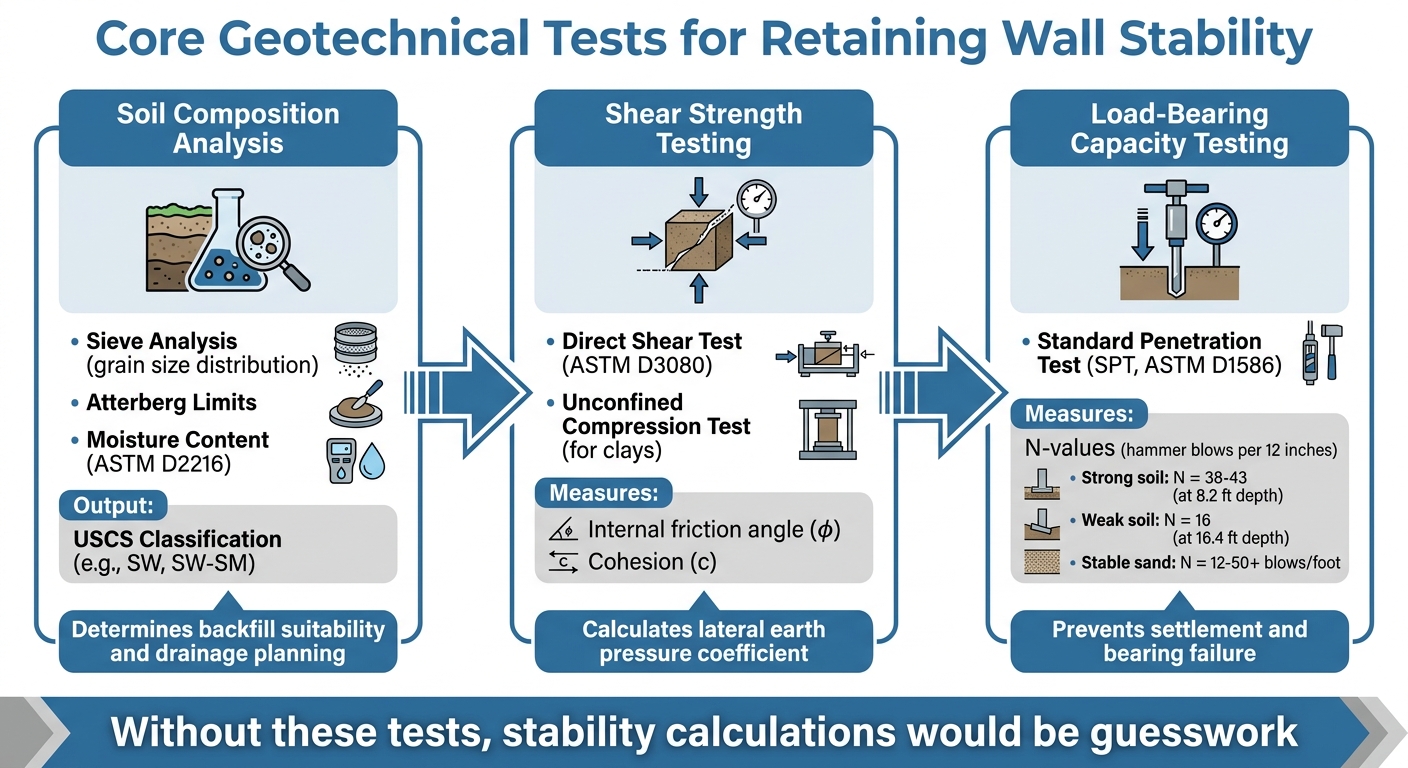
Geotechnical tests are the backbone of retaining wall design. They provide the critical data needed to make informed decisions about slope stability, drainage, and foundation planning. Without these tests, stability calculations would be little more than guesswork. Below are the key tests that ensure a retaining wall can handle the conditions it will face.
Soil Composition Analysis
Before designing a retaining wall, engineers need a clear understanding of the soil’s makeup. This involves tests like grain size distribution (sieve analysis), Atterberg Limits, and moisture content tests (ASTM D2216). The results are used to classify the soil according to the Unified Soil Classification System (USCS). For example, soils might be labeled as SW (well-graded sand) or SW-SM (sand with silt). This classification is crucial for selecting appropriate backfill material and planning drainage.
Why does this matter? The type of soil influences how well it handles water and pressure. Using unsuitable backfill – like clay, which retains water – can dramatically increase lateral pressure on the wall [1]. Soil composition tests help avoid these costly errors before construction begins.
Shear Strength Testing
Shear strength tests, such as the Direct Shear Test (ASTM D3080) and the Unconfined Compression Test for clays, measure key properties like the soil’s internal friction angle (ϕ) and cohesion (c). These values are essential for calculating lateral earth pressure [2][3].
The friction angle, for instance, is used to determine the active earth pressure coefficient, which directly impacts the forces the wall must withstand. Without accurate shear strength data, engineers would be making risky assumptions about the wall’s load-bearing capacity – an oversight that could lead to failure when conditions change.
In addition to soil composition, understanding the soil’s strength ensures the wall can handle lateral forces safely.
Load-Bearing Capacity Testing
The Standard Penetration Test (SPT, ASTM D1586) is a key method for analyzing the soil’s ability to support weight. This test measures soil density by counting the number of hammer blows required to drive a sampler 12 inches into the ground. Higher N-values indicate denser, stronger soil.
For example, a 2025 study in Jazan, Saudi Arabia, revealed SPT-N values of 38 to 43 at a depth of 8.2 feet, but these dropped to an average of 16 at 16.4 feet. This indicated that deeper soil layers were significantly weaker than those near the surface [2]. Information like this is critical for determining whether the soil can support the wall’s weight, as well as any additional loads from nearby structures or driveways.
In stable sand layers, SPT values typically range from 12 to over 50 blows per foot, with higher numbers reflecting stronger, denser soil [2]. These results help ensure the wall won’t experience uneven settling or bearing failure, where the soil beneath collapses under the load.
Together, these tests provide the foundation for designing retaining walls that can stand up to real-world conditions.
Using Geotechnical Data in Retaining Wall Design
Once test results are in, engineers move from raw data to actionable design strategies. Geotechnical testing provides critical insights into how soil, water, and structural components interact. This process goes beyond simply applying formulas – it’s about understanding how these elements function together as one cohesive system.
Jaspreet Singh, P.Eng., from SoilEng, explains: "Retaining walls are not just masonry, concrete, or block assemblies. They are geotechnical systems that depend on soil strength, wall geometry, water management, loading, embedment, and site-wide stability" [1].
Slope Stability Analysis
Geotechnical data plays a key role in evaluating the stability of the entire ground mass, not just the retaining wall itself. This global stability check is especially important for walls built on or near slopes. Even if a wall meets local stability criteria for sliding and overturning, the larger slope could still fail due to rotational or translational movements [1].
Soil properties such as the angle of internal friction, cohesive strength, and density are essential for calculating the lateral earth pressure a wall must resist. These parameters also help determine whether the slope can handle additional loads, like those from driveways or patios – commonly referred to as surcharge loads [1]. Incorporating these factors ensures that both the wall and the surrounding area can safely bear the applied forces.
In colder regions like Ontario, frost depth becomes another critical consideration. Without adequate embedment or proper moisture control, freeze-thaw cycles can cause the wall to shift or crack over time [1].
Drainage Design and Water Management
"Water is often the single biggest difference between a wall that lasts and a wall that fails" [1].
Geotechnical tests help identify the soil’s permeability and determine whether backfill will allow water to drain freely or trap moisture. Clay-rich soils are flagged as problematic due to their tendency to retain water, while granular soils are preferred for their ability to drain efficiently [1].
The test results also reveal the critical water height – the point where accumulated water pressure can destabilize the wall. This data informs the design of drainage systems, including perforated drain pipes, filter fabrics, and discharge paths.
A cautionary example: In July 2003, a 24.3-foot-high segmental retaining wall in Seoul, Korea, collapsed during monsoon rains. Post-failure analysis revealed that the wall wasn’t designed for saturated soil conditions, with safety factors dropping below 1.0 [2].
Another incident occurred in Texas, where a 27-foot-high cantilever retaining wall failed after heavy rainfall. Blocked weep holes caused a buildup of hydrostatic pressure, leading to total collapse [2].
| Feature | Granular Backfill (Preferred) | Clay Backfill (High Risk) |
|---|---|---|
| Drainage Speed | High / Free-draining | Low / Retains water [1] |
| Lateral Pressure | Predictable / Lower | High / Increases when wet [1] |
| Frost Sensitivity | Lower | Higher (prone to movement) [1] |
| Failure Risk | Low (with proper drainage) | High (due to hydrostatic pressure) [1] |
Proper drainage is crucial to quickly remove water and prevent hydrostatic pressure buildup [1].
Foundation and Structural Design
Geotechnical data also guides critical structural decisions. Soil bearing capacity tests determine the necessary width and depth of a wall’s footing to prevent settlement or bearing failure [1] [2]. For weaker soils, wider and reinforced foundations are often required to distribute loads evenly.
This data also influences decisions about wall thickness, reinforcement needs (such as geogrid), and additional features like shear keys. According to the Saudi Building Code (SBC-303), retaining walls must have a minimum thickness of 11.8 inches and meet safety factor requirements of at least 2.0 for overturning, 1.5 for sliding, and 3.0 for bearing capacity [2]. When groundwater levels are high, adjustments like increasing wall mass or adding specialized drainage are necessary to meet these safety margins [2].
Shear strength tests provide friction angle and cohesion values, which are used to calculate the active earth pressure coefficient. This directly impacts the forces the wall must withstand, as even small displacements can lead to significant pressure changes [4]. Following safety factors and local codes ensures the wall’s durability and stability over time.
Construction Best Practices and Inspections
Turning geotechnical data into a stable, long-lasting structure depends heavily on construction practices. Even the most precise engineering can fall short if key steps are skipped or corners are cut during the building process. In fact, many retaining wall failures stem from poor execution rather than flawed designs.
Construction Process Steps
To ensure a retaining wall performs as intended, several critical steps must be followed:
- Foundation Preparation: The foundation must rest on solid, natural soil. In areas with freeze–thaw cycles, the embedment depth protects the foundation from seasonal movement and adds sliding resistance [1].
- Backfill Selection: Using granular, free-draining material for backfill reduces lateral pressure. Avoid using site spoil, as it can clog drainage systems and increase pressure beyond design limits [1].
- Compaction: Proper compaction is essential. A 2006 Minnesota DOT study revealed that lateral forces during backfill compaction could double the vertical stress, underscoring the need for careful execution [4].
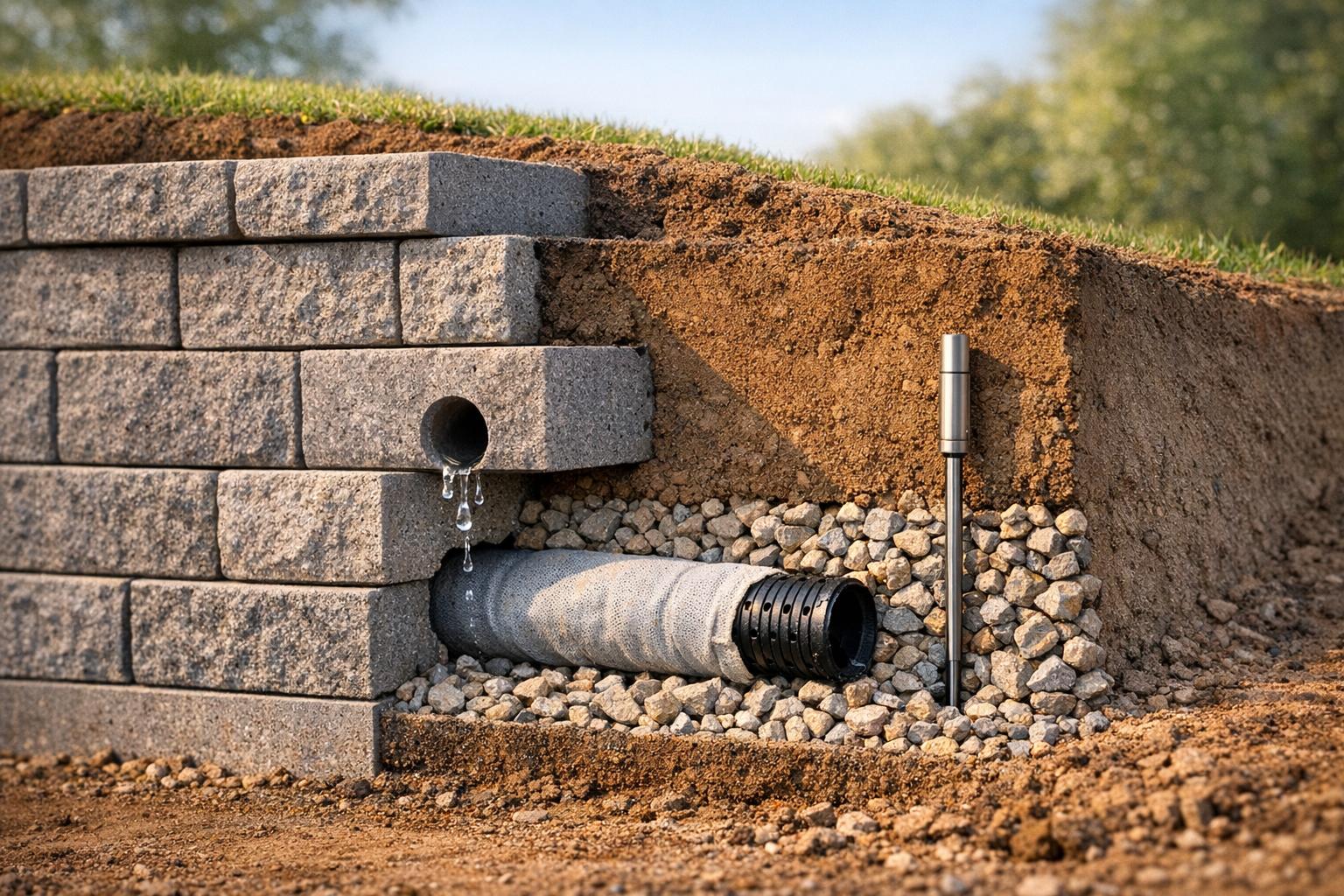
- Drainage System: A functional drainage system, including perforated pipes, filter fabric, and a clear discharge path, helps minimize hydrostatic pressure [1].
Each step builds on geotechnical insights, directly contributing to the wall’s stability and performance.
| Construction Step | Geotechnical Focus | Common Failure if Ignored |
|---|---|---|
| Excavation | Reaching solid natural soil | Excessive settlement or tilting |
| Embedment | Frost protection and base friction | Seasonal movement or sliding |
| Backfilling | Use of free-draining material | High hydrostatic pressure; drainage clogging |
| Compaction | Achieving design density | Unpredictable soil behavior; settlement |
| Drainage | Relieving hydrostatic pressure | Wall rotation or catastrophic collapse |
On-Site Testing During Construction
Field testing ensures that construction aligns with geotechnical design parameters. Inspectors verify that the foundation is placed on the correct soil type, avoiding weak organic materials or uncontrolled fill. Compaction testing confirms that backfill layers meet specified density requirements, which is crucial for reducing settlement risks and maintaining proper drainage [1].
Monitoring during construction can catch problems early. For instance, the Minnesota study found that active earth pressure can develop after the wall shifts by as little as 0.1% of the backfill height [4]. Inspectors also check that drainage components are installed correctly and monitor equipment loads to ensure they don’t exceed design limits [1].
Final Inspection and Certification
Final inspections tie everything together, confirming that the construction matches the design intent. A licensed engineer conducts this review, verifying that the wall meets safety and design standards. This step is especially critical for walls near property lines or those supporting heavy loads.
During the inspection, engineers assess the wall’s bearing capacity, looking for any soft zones or organic materials that could lead to uneven settlement. They also ensure that drainage systems have reliable discharge paths and check embedment depth to confirm frost protection and sliding resistance. These evaluations address any hidden vulnerabilities, ensuring the structure is ready to perform as designed [1].
Conclusion
Key Takeaways
Extensive geotechnical research highlights the essential factors that influence retaining wall stability. These structures rely on the interplay of soil strength, water pressure, and geometry, making their long-term performance dependent on understanding critical parameters like internal friction, cohesion, and bearing capacity.
Among these, water management emerges as the most crucial element. Proper testing ensures drainage systems are correctly sized and positioned to prevent hydrostatic pressure buildup. This pressure not only increases lateral forces but also weakens the soil’s shear strength. Additionally, the data guides the selection of backfill materials, favoring free-draining granular options over moisture-retaining clay, which can exert unpredictable pressure.
Testing is vital to avoid structural issues such as sliding, overturning, bearing failure, and global instability [1][2]. Industry standards recommend safety factors of at least 2.0 for overturning, 1.5 for sliding, and 3.0 for bearing capacity [2]. These safety margins accommodate soil variability, construction tolerances, and environmental changes like freeze-thaw cycles, which are particularly relevant in regions like Maryland.
Proper geotechnical testing not only ensures durability but also reduces long-term costs. As Singh aptly notes:
"The most expensive walls are often the ones that were treated as simple landscaping features when they were actually structural site elements" [1].
By applying geotechnical analysis, retaining walls become durable, reliable structures that safeguard properties effectively.
How Pro Landscapes MD Ensures Quality Retaining Wall Installations

At Pro Landscapes MD, these principles are the foundation of every retaining wall project. Serving central Maryland – including Howard County, Montgomery County, Carroll County, Frederick County, Prince George’s County, and Baltimore County – the company integrates geotechnical expertise into every phase of construction, from site assessment to final verification.
The team conducts thorough evaluations of soil conditions, groundwater levels, and site-specific challenges, such as Maryland’s freeze-thaw cycles. This information shapes the design of drainage systems, ensuring components like perforated pipes, filter fabric, and granular backfill work together to prevent hydrostatic pressure. They prioritize materials based on soil testing results, choosing free-draining aggregates over clay to reduce lateral pressure and enhance stability.
Pro Landscapes MD also accounts for surcharge loads from nearby structures, driveways, and other pressure sources that are often overlooked in standard landscaping projects. Their construction process includes rigorous protocols for foundation preparation, embedment depth, backfill compaction, and drainage installation, with each step verified against design specifications. This meticulous approach ensures that geotechnical insights translate into retaining walls that perform reliably, serving communities from Ellicott City to Potomac, Bethesda to Columbia.
FAQs
Do I need a geotechnical test for my retaining wall?
Before constructing a retaining wall, conducting a geotechnical test is strongly advised. This test examines key factors such as soil properties, groundwater levels, and the conditions beneath the surface – all of which directly influence the wall’s stability. Skipping this step can lead to problems like soil movement or settlement, which could compromise the structure.
Geotechnical evaluations also help address concerns like water infiltration. By understanding these conditions, you can design a retaining wall that’s not only sturdier but also longer-lasting.
What soil types make retaining walls more likely to fail?
Loose or sandy soils, particularly clean sand, tend to increase the likelihood of retaining wall failure. These types of soil provide less stability and are more susceptible to sliding or overturning, especially when groundwater levels are elevated. Conducting thorough geotechnical testing is crucial to detect these risks and maintain the stability of the wall.
How can I tell if my retaining wall has a drainage problem?
Signs that your retaining wall might have drainage issues include water pooling behind the structure, the appearance of white deposits (efflorescence) from moisture, visible cracks, leaning or bulging, and noticeable soil erosion. These problems typically stem from inadequate drainage, which can gradually weaken the wall’s stability.
Chat with Us