









- bhavya gada
- No Comments
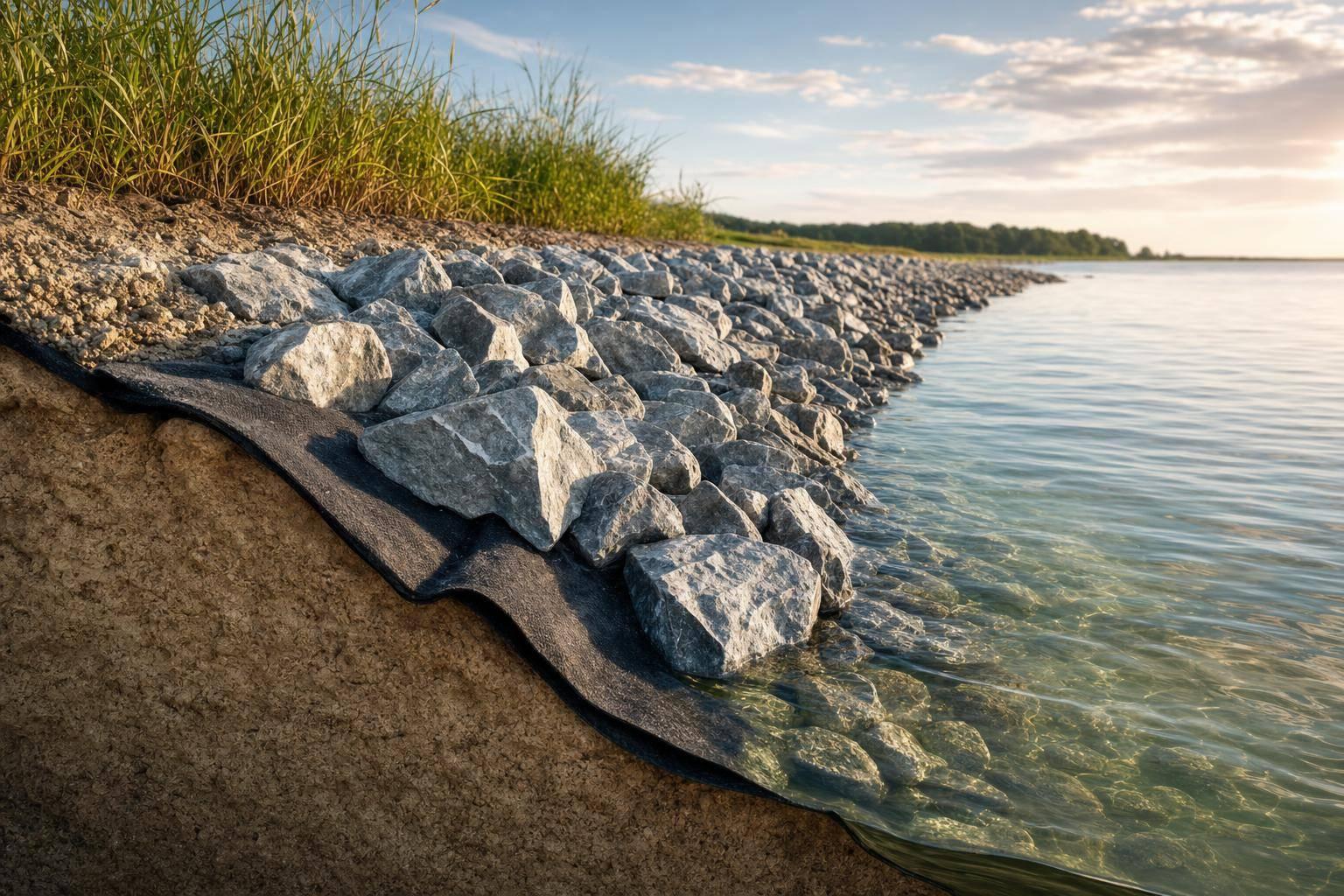
If riprap sits right on soil, the shoreline is more likely to settle, wash out, and fail. I’d sum it up this way: the stone protects the surface, but the fabric under it helps keep the bank from falling apart underneath.
Here’s the short version in plain English:
- Geotextile fabric goes under riprap to keep soil from washing out while still letting water pass through.
- On Maryland shorelines, that matters because banks face tides, waves, boat wake, storm surge, soft soils, and sea level rise.
- Nonwoven needle-punched fabric is usually the better pick for shoreline riprap because it drains better and handles rock placement better than woven fabric.
- Basic install rules matter: 2:1 to 3:1 slopes, 12–20 inch overlaps, an anchor trench at the top, stone placed from the toe upward, and stone drop heights under 3 feet.
- Standard shoreline jobs often use 300–500 gsm fabric, while heavier armor may need 500+ gsm.
- Fabric should not sit in the sun too long; many products have a 14–30 day UV exposure limit.
- After storms, I’d check for stone movement, exposed fabric, and toe erosion right away.
One stat in the article stands out: Poplar Island dropped from 1,100 acres to 4 acres by the early 1990s before large restoration work began. That shows how fast shoreline loss can happen in Maryland.
How to install riprap and have a good defining line between yard and riprap.
sbb-itb-843f8be
Quick comparison
| Topic | Best short answer |
|---|---|
| What the fabric does | Separates soil from stone, filters water, and helps stop piping |
| Best fabric type for most Maryland riprap | Nonwoven needle-punched |
| Main risk without fabric | Hidden soil loss under the rock |
| Standard fabric weight | 300–500 gsm |
| Heavier shoreline armor | 500+ gsm |
| Usual slope range | 2:1 to 3:1 |
| Standard overlap | 12–20 inches |
| High-wave overlap | Up to about 3 feet or sewn seams |
| Main upkeep check | Look for exposed fabric, moved stone, and toe washout |
If I were to boil the full article down to one point, it would be this: riprap works better when the fabric, slope, stone size, drainage, and upkeep all work together.
How Geotextile Fabric Improves Riprap Performance
Erosion Resistance, Drainage, and Longer Lifespan
Geotextile fabric helps riprap hold up better by stopping washout, cutting down on settlement, and helping the shoreline system last longer. It filters water, keeps soil and stone apart, relieves groundwater pressure, and spreads the load of heavy rock over a larger area. Each job supports slope stability. That matters even more on Maryland shorelines, where waves hit again and again and water levels can change fast.
Soil retention is the biggest advantage. When waves force water through the gaps between riprap stones, fine soil can slip out from underneath the rock. The fabric holds that soil in place while still letting water pass through. That keeps the base from falling apart during wave action and heavy rain. Without fabric, soil loss under the stone creates hidden voids. Over time, those voids make the rocks above sink, shift, and lose their position.
Hydrostatic pressure can also become a major issue after heavy rain or sudden water-level swings. Groundwater builds behind the slope, and if it can’t drain out, that pressure can push the bank outward. Geotextile fabric gives water a path to escape without letting soil wash away with it.
The payoff is simple: a shoreline that stays more stable and lasts longer. On soft, tidal shorelines, leaving out the fabric increases the chance of failure.
Riprap With Fabric vs. Riprap Without Fabric
This is why fabric-backed riprap tends to hold up better over time. You can see the gap pretty fast in the way each setup responds to storms and seasonal water changes.
| Feature | Riprap With Geotextile Fabric | Riprap Without Geotextile Fabric |
|---|---|---|
| Erosion Resistance | Retains fine soils while allowing drainage | Soil pipes through stone voids |
| Base Stability | Fabric prevents voids from forming beneath stone | Hidden voids form, leading to sinking and shifting |
| Maintenance Frequency | Minimal stone repositioning needed | Frequent void filling and stone replacement |
| Long-Term Cost | Lower; prevents expensive structural repairs | Higher; can fail quickly during major storms |
The takeaway is pretty clear: the extra cost of geotextile is small next to the repair bills and disruption that come with a failing shoreline system.
Still, results depend on two things: picking the right geotextile and installing it the right way.
Choosing the Right Geotextile and Basic Design Parameters
Once riprap is the protection method, the next job is picking a fabric that fits Maryland’s soils, tides, and stone size.
Woven vs. Nonwoven Geotextiles for Shoreline Riprap
Woven and nonwoven geotextiles do different jobs under riprap. For Maryland shoreline riprap, nonwoven needle-punched fabric is usually the go-to option. It bends more easily and stands up better to puncture, which helps when heavy riprap is dropped into place and when tides keep working the shoreline.
That matters in Maryland because shoreline soils are often fine-grained and can clog more easily.
Woven fabric is more rigid and less permeable. It performs well in tension, but that lower permeability can become a problem in the silty, fine-grained soils common along Maryland shorelines [2][1]. When clogging, or blinding, happens, water pressure can build up behind the slope and shove the riprap layer off the bank [2][1].
| Feature | Nonwoven (Needle-Punched) | Woven |
|---|---|---|
| Primary Function | Filtration, drainage, and cushioning | Reinforcement and load distribution |
| Filtration Performance | High; 3D structure resists clogging | Low; prone to clogging in silty soils |
| Strength Type | High puncture resistance; stretches on impact | High tensile strength; rigid |
| Typical Shoreline Use Case | Standard shorelines, riverbanks, and dikes | Deep marsh or unstable peat subgrades |
| Relative Cost | Standard / moderate | Often lower upfront, but higher failure risk |
Key Specs, Roll Coverage, and Material Cost Ranges
When you’re reading product data sheets, four specs matter most for shoreline riprap:
- Permittivity
- Apparent opening size (AOS)
- Tensile strength
- Puncture resistance
Permittivity tells you how fast water moves through the fabric. That’s a big deal on Maryland shorelines, where tidal swings and storm surge can change water levels fast [2][1].
AOS tells you the largest soil particle that can pass through the fabric. For Maryland’s fine sandy or silty soils, the opening has to be small enough to keep soil in place without choking off drainage [2][1].
For puncture resistance, check the CBR puncture value on the spec sheet. That number helps confirm the fabric can take the stone weight planned for the project [1][2].
Fabric weight is also a handy shortcut. Standard shoreline riprap usually calls for fabric in the 300–500 gsm range, while heavy coastal armor or breakwater work needs 500+ gsm [1]. In most cases, fabric cost is a small part of the total job when compared with the cost of fixing a failed shoreline later. Wide rolls and continuous seams help cut down on weak spots.
Even with the right fabric, problems show up fast if the slope, stone, and embedment are wrong.
Maryland Design Factors: Slope, Stone Size, and Embedment
After fabric selection, the next checkpoint is installation geometry. Maryland shoreline slopes should usually stay between 2:1 and 3:1 (horizontal to vertical). Put simply, for every 2 to 3 feet of horizontal run, the bank drops 1 foot [2]. Go steeper than that and stones are more likely to slide, which puts more stress on the fabric and loosens the riprap layer.
Before laying the fabric, dig an anchor trench at the top of the slope. This holds the top edge in place so the fabric doesn’t creep downward once heavy stone is set over it [1].
Geotextile should also be covered soon after placement. Too much UV exposure weakens the material [2].
| Parameter | Maryland-Appropriate Range |
|---|---|
| Stable Slope Ratio | 2:1 to 3:1 (Horizontal:Vertical) |
| Fabric Overlap (Standard) | 12–20 inches |
| Fabric Overlap (High Wave/Tidal) | Up to about 3 feet, or sewn seams |
| Fabric Weight (Standard Riprap) | 300–500 gsm |
| Fabric Weight (Heavy Armor) | 500+ gsm |
| Max Stone Drop Height | Under 3 feet |
| UV Exposure Limit | 14–30 days maximum |
Installation and Maintenance for Maryland Waterfront Properties
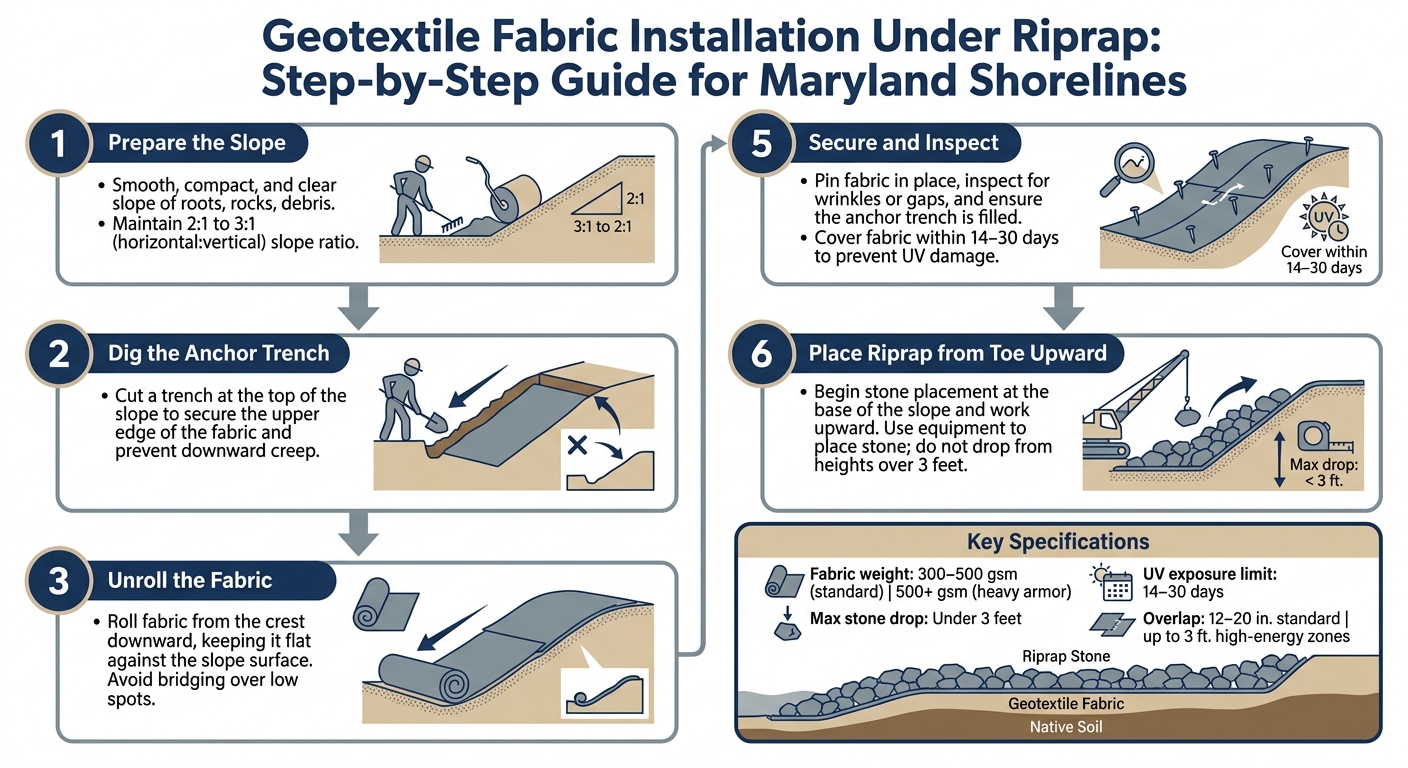
How to Install Geotextile Fabric Under Riprap on Maryland Shorelines
Step-by-Step Installation: From Site Prep to Stone Placement
After you pick the right fabric and slope shape, the install work makes or breaks the system. The fabric has to stay smooth, covered, and firmly anchored. If it doesn’t, the shoreline can start to come apart.
Install geotextile only after the slope is smooth, compacted, and cleared of roots, rocks, and other puncture points.
Unroll the fabric from the crest down the slope so it follows the grade without bridging. It should sit flat against the surface, not stretch across low areas. Overlap nearby panels by 12 to 20 inches, or sew the seams in high-energy areas. Secure the top edge in an anchor trench before placing stone. Then place riprap starting at the toe of the slope and work upward so the fabric stays in place [1][3].
Place stone with equipment; do not drop it [1].
Common Installation Mistakes That Lead to Failure
Most shoreline failures start with hidden soil loss. Fine soil particles wash out through gaps in the riprap when the geotextile is missing, punctured, or overlapped the wrong way [1][3].
Panels should never meet edge to edge. If they do, soil can wash through the gap during tide changes, which can lead to settlement and slope collapse [3].
Exposed fabric is another major problem. Cover exposed fabric quickly [1][2]. Riprap should go down as soon as the fabric is anchored and inspected.
Wrinkles and bridging can cause uneven settlement later on. Press the fabric snugly against the subgrade before pinning it. And if the slope is steeper than about 2:1 to 3:1, fix that before any fabric goes down. Riprap can slide more easily on the smooth geotextile surface [2].
Most failures begin with installation mistakes, not the stone itself.
Inspection and Upkeep After Storms and Seasonal Water Changes
Riprap isn’t a set-it-and-forget-it system. Inspect it after major storms and after ice melt, with extra attention at the toe of the slope, where undercutting often starts first [1][3].
| Inspection Item | Suggested Frequency | Warning Signs | Who Checks It |
|---|---|---|---|
| Stone Displacement | After major storms / Annually | Visible gaps in armor; stones sliding or sinking into mud | Homeowner to monitor; Pro to repair |
| Exposed Fabric | Monthly | Fabric visible between or below stones; UV fraying | Homeowner (immediate action); Pro to cover/repair |
| Toe Erosion | Bi-annually / After ice melt | Undercutting at the base; fabric edge pulling away from bottom trench | Professional |
The big goal is simple: keep the geotextile covered and keep the toe in place. That’s what stops hidden soil loss and helps the riprap last longer. If fabric becomes exposed, cover it right away to limit UV damage and keep the filter layer working.
If the repair issues reach past the shoreline face, the next step is to deal with grading and drainage behind the bank. This often involves broader Baltimore hardscaping projects to ensure the entire landscape remains stable.
Working With Maryland Shoreline and Drainage Professionals
How Shoreline Protection Connects to Yard Drainage and Stormwater Management
Riprap and fabric protect the bank face. But they do not control runoff coming from the yard or roof. And that runoff has a direct effect on shoreline stress.
If yard grading sends water toward the bank instead of away from it, that flow can slam into the top of the slope and speed up erosion. Geotextile fabric allows water to move through it, but it can’t make up for large amounts of unmanaged runoff being funneled straight at the shoreline. Put simply, drainage and shoreline protection need to work together as one system.
That’s why it makes sense to coordinate shoreline protection and drainage planning before work begins.
How Pro Landscapes MD Supports Integrated Erosion and Landscape Solutions

For central Maryland homeowners dealing with both shoreline erosion and yard drainage issues, Pro Landscapes MD can help manage runoff and grading above the shoreline. Serving Howard County, Montgomery County, Baltimore County, and nearby areas, they provide drainage, grading, and shoreline-adjacent landscape support to help properties handle water more effectively.
Once the upland drainage is fixed, the shoreline system has a much better chance of doing its job.
Conclusion: The Key Role of Geotextile Fabric Beneath Riprap
Geotextile fabric can improve riprap performance, but it works best when it’s installed as part of a drainage-aware system that deals with both the bank face and the runoff flowing toward it.
FAQs
Do I need geotextile fabric under riprap?
Yes – geotextile fabric under riprap is important if you want the installation to hold up over time.
It works as a filter and separator between the soil and the stone. That sounds simple, but it does a lot of heavy lifting.
Without fabric underneath, fine soil can wash out through the gaps in the riprap. Once that starts, erosion can build fast, and the stones may begin to sink or shift.
In most cases, nonwoven geotextile is the better pick because it allows for better permeability and filtration. It also adds cushioning during installation, which helps protect the layer beneath the rock.
How do I know what fabric weight my shoreline needs?
The right geotextile fabric weight comes down to your soil conditions, water pressure, and rock size. GSM matters, but it’s only part of the picture. You also need to look at puncture resistance, tensile strength, permeability, and apparent opening size.
For nonwoven riprap jobs, here’s a simple guide:
- 150–300 gsm: light drainage and smaller rock
- 300–500 gsm: standard riverbanks and moderate coastal slopes
- 500+ gsm: large boulders and strong wave action
A heavier fabric can help, sure. But if the material doesn’t match the site, you can still run into trouble. That’s why fabric selection is less about picking the thickest roll and more about matching the specs to the job in front of you.
When should exposed fabric or moved stone be repaired?
Repair exposed geotextile fabric or shifted stone as soon as you notice edge exposure from wave action, slope settlement, gaps in the rock armor, or visible voids where rocks have moved.
Those warning signs usually mean your shoreline protection has been weakened. If you leave them alone, erosion can get worse and the damage can spread.
Chat with Us