









- bhavya gada
- No Comments
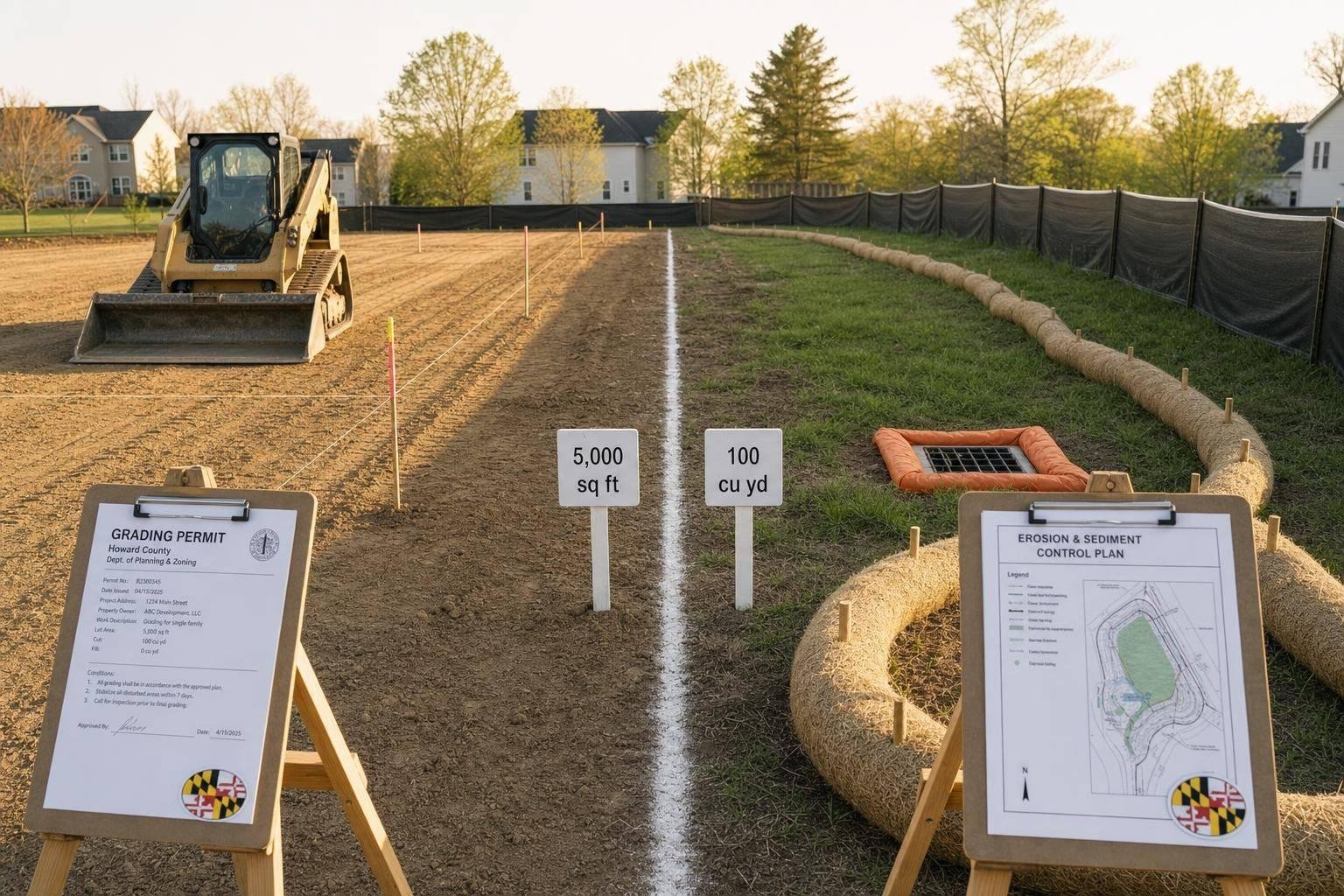
If you disturb 5,000 square feet of ground or move 100 cubic yards of soil in Maryland, you may need both a grading permit and an erosion control review.
I’d boil it down like this:
- A grading permit covers the earthwork
- An erosion control review covers the soil and runoff controls
- In many Maryland counties, erosion control approval must happen first
- Even small jobs can trigger review if they change drainage or sit near streams, wetlands, buffers, or floodplains
That’s why a patio, retaining wall, or yard regrading job can turn into more than “just landscaping.”
Quick Comparison
| Item | Grading Permit | Erosion Control Review |
|---|---|---|
| Main purpose | Allows digging, filling, slope changes, and drainage changes | Approves steps to keep sediment on site |
| Focus | Land shape, soil movement, runoff direction | Silt fence, stone entrance, inlet protection, seeding |
| Common trigger | 5,000 sq. ft. disturbed or 100 cu. yd. moved | Often the same county thresholds |
| Who may review it | County permitting or public works office | Soil conservation district or state/local review office |
| Can small jobs still get reviewed? | Yes, if drainage or site limits are an issue | Yes, even under threshold in some cases |
| Inspections | Grading, drainage, final site condition | Control setup, active work, final stabilization |
For most homeowners, the key point is simple: one approval lets you move dirt, and the other shows how you’ll keep that dirt from washing away. I’d use this article to sort out the triggers, paperwork, and inspection steps before work starts.
sbb-itb-843f8be
Grading permit vs erosion control review: the core difference
Grading Permit vs Erosion Control Review: Maryland Homeowner Guide
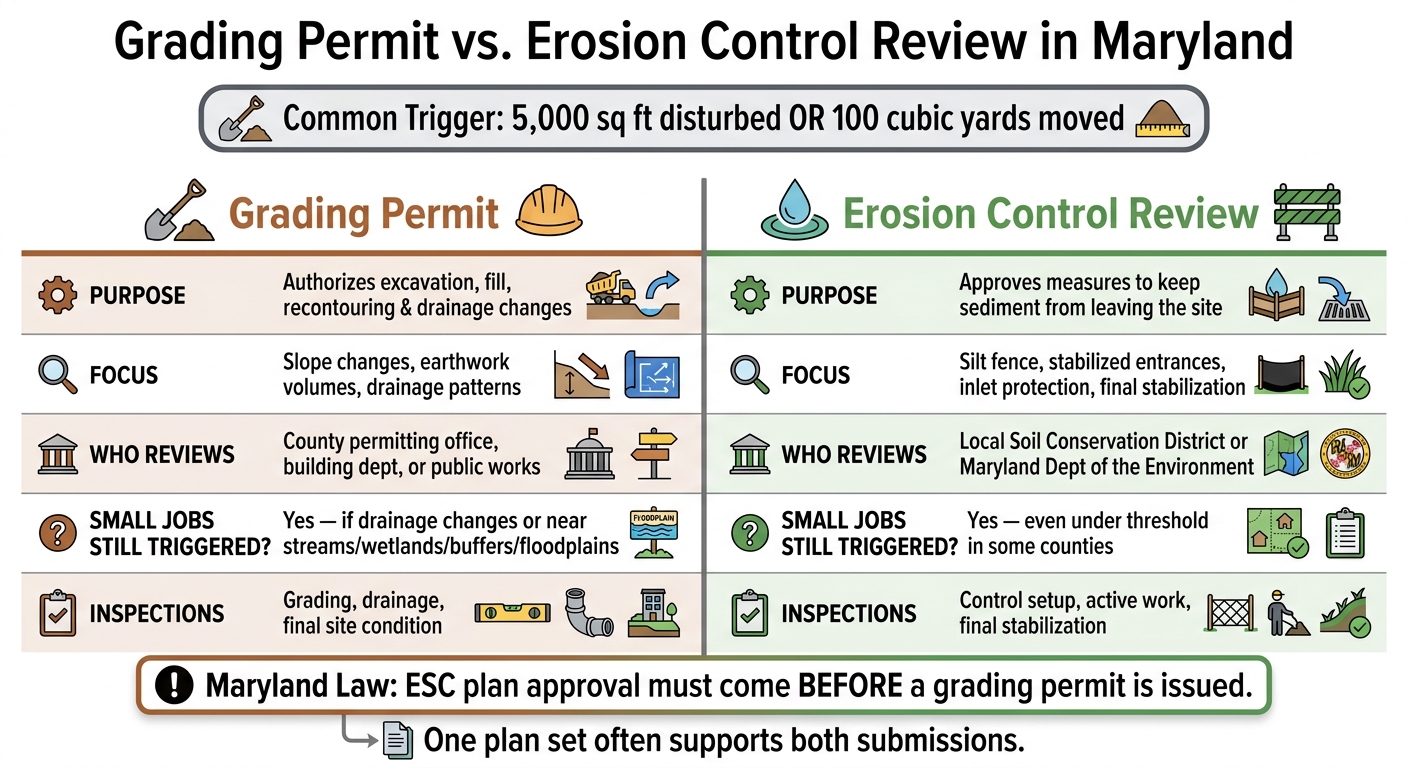
A grading permit lets you do the earthwork. An ESC review signs off on the sediment controls. Put simply: one allows the grading, and the other deals with keeping soil on the site.[17][18][19]
Here’s the quickest way to separate them.
| Grading Permit | Erosion Control Review | |
|---|---|---|
| Purpose | Authorizes excavation, fill, recontouring, and drainage changes | Approves temporary and permanent measures to keep sediment from leaving the site |
| What it regulates | Slope changes, earthwork volumes, and drainage pattern changes | Silt fence, stabilized entrances, inlet protection, erosion control blankets, and final stabilization |
| Typical trigger | Common local disturbance thresholds; smaller work near streams, floodplains, wetlands, or buffers may still be reviewed.[18][20] | Common local disturbance thresholds; smaller work near streams, floodplains, wetlands, or buffers may still be reviewed.[10][14] |
| Who reviews it | County permitting office, building department, or public works department | Local Soil Conservation District or Maryland Department of the Environment |
| Runoff focus | Reviewers may require drainage adjustments if regrading redirects runoff toward adjacent lots | The plan must show sediment-laden runoff stays on-site and does not reach neighboring yards or storm drains |
One patio, retaining wall, or regrading job can need both. That’s because one review controls the earthwork itself, while the other controls runoff and site stabilization.
What a grading permit covers
A grading permit comes into play when your yard work goes past local disturbance thresholds. That might mean digging out for a patio base, placing fill behind a retaining wall, cutting down a high area, or changing the way water moves across the lot.
On small residential lots, those numbers can stack up fast. A patio or retaining wall project with deep base excavation and backfill, or a full-yard regrading job can each push past the common thresholds that trigger a grading permit in many Maryland counties.[18][20]
What an erosion control review covers
An ESC review does not give you permission to do the grading. Its job is to approve the protections used during the work.
Reviewers usually want to see things like:
- Silt fence downslope of disturbed areas
- A stabilized stone construction entrance to cut mud tracking onto the street
- Inlet protection around nearby storm drain grates
- A final stabilization plan, usually permanent vegetation or hardscape, so bare soil isn’t left exposed after the job is done[9][3]
Under Maryland law, you generally can’t clear or grade land without an approved erosion and sediment control plan once you cross the applicable thresholds.[10][14] That approval has to be in place before work starts.
Why the two often apply to the same project
Maryland regulations state that a grading permit may not be issued before ESC plan approval.[16][19] So even though the two reviews do different jobs, they’re often tied together in practice.
For many single-family projects, counties may allow a standard ESC plan instead of a fully engineered custom plan, often for sites up to about 30,000 square feet and 1,000 cubic yards.[4][9][3] That can make the paperwork easier, but it doesn’t skip the review.
Next comes the part most homeowners care about: what actually triggers each review on small residential projects in Maryland.
What triggers each process on small residential jobs in Maryland
In Maryland, the usual trigger points are 5,000 square feet of land disturbance or 100 cubic yards of earth moved. A lot of counties use those same numbers for grading permits and erosion and sediment control review, even though the paperwork, fees, and inspection steps can change from one county to the next.[22][30][9][25][14][11][26][13][29][8][7][4] Once a job goes past either of those limits, the next step is figuring out what that county wants on file and what inspections come with it.
Common thresholds homeowners should watch
Even below those limits, a county may still require erosion and sediment measures on the site. Harford County says this plainly: if a site has less than 5,000 square feet of disturbance, a grading permit is not required, but the owner still must install on-site sediment controls.[24][7][4][29] So yes, a project can stay under the permit cutoff and still need control measures.
Drainage changes can also trigger review by themselves in some places. Baltimore County is a good example. It requires a grading permit when grading changes the direction, volume, distribution, or velocity of surface water onto a neighboring property, even if the disturbed area is under 5,000 square feet.[28][13][8]
Small projects that may still need review
Small regrading jobs, retaining walls, and drainage work can still get pulled into review when they are near streams, buffers, wetlands, floodplains, or steep slopes. In those spots, site conditions can matter just as much as the total disturbed area.[22][23][6] Annapolis shows how this can play out: on waterfront lots, the grading permit threshold is about 2,000 square feet of disturbed area.[5]
There are also limits on when you can use a standard erosion and sediment control plan. In counties such as Howard and Prince George’s, these simpler plans are usually capped at:
- 30,000 square feet of disturbance
- 1,000 cubic yards of earth moved
- Cuts or fills no deeper than 10 feet
- No work inside stated buffers tied to floodplains, streams, or wetlands[9][7]
How local county procedures can differ
This is where things start to split apart county by county. Howard County, Montgomery County, Carroll County, Baltimore County, Frederick County, and Prince George’s County each use their own forms, fees, templates, and inspection steps, even when they start from the same state trigger numbers.[9][25][14][11][26][13][29][8][7][4]
Carroll County is one clear example. It uses a standard erosion and sediment control plan for sites with 5,000 to 30,000 square feet of disturbance, while a designed plan usually is not required below 5,000 square feet.[9][14][7][2]
Those differences tend to show up most once you get into the application process and the inspection schedule.
Paperwork, inspections, and where the two processes overlap
Once you cross the threshold, the process stops being abstract and gets very concrete. Now you’re dealing with forms, plan sheets, approval stamps, and inspection timing.
What goes into a grading permit application
The grading packet starts with the earthwork plan. A grading permit application usually includes a completed application form and a site plan or grading plan drawn to scale. That plan should show property lines, existing structures, and proposed features like patios, walkways, or retaining walls.
The grading plan also needs to show existing and proposed contours, limits of disturbance, runoff direction, and any swales, berms, or drain pipes.
Some jobs need extra documentation. Retaining walls around 4 feet or taller often need engineered structural details. And if a project adds more paved area, it may also need stormwater notes or small-scale practices like dry wells, rain gardens, or permeable pavers, especially in Montgomery County.[18][14]
What goes into an erosion control submission
The ESC submission is about one thing: keeping disturbed soil in place and getting it stabilized on time.
An erosion and sediment control (ESC) submission covers how disturbed soil will be managed from the first day of earthwork through final stabilization. Core items include:
- The work sequence
- Perimeter controls
- Stockpile protection
- Temporary stabilization
- Final stabilization
Many small residential jobs in Maryland use county standard residential ESC templates to make compliance simpler.[15][27]
Inspection checkpoints from start to final stabilization
Once the plans are approved, inspectors check whether the work in the field matches the approved set.
| Inspection Stage | What Inspectors Check |
|---|---|
| Before work starts | Perimeter controls such as silt fence or compost logs installed before any earthwork; construction entrance in place to limit sediment tracking |
| Active grading | Controls intact and functioning after storm events; slopes match the approved plan; disturbed areas stay within the limits of disturbance |
| During drainage installation | Swales, yard drains, and discharge points installed per plan; runoff is not creating problems on neighboring properties |
| Final stabilization | All disturbed soil permanently stabilized with turf, landscaping, or pavement; erosion controls removed only after approval |
Here’s where the overlap comes in: both reviews rely on the same base site plan. That plan usually shows property lines, existing and proposed contours, and limits of disturbance. In practice, one plan set will often support both submissions.[18][14][31]
Conclusion: How to plan a small project and avoid permit surprises
A grading permit covers the earthwork itself. An erosion and sediment control review covers the measures that keep sediment from washing off your property.
Before design or digging begins, check which review applies to your lot. In Maryland, a common trigger is 5,000 square feet of disturbance or 100 cubic yards of earth moved, but county rules and steps still vary.[16][21][22] If work starts before approvals are sorted out, you can run into delays, stop-work orders, and extra repair costs.
Key points to remember before work starts
Before you begin, verify these four items:
- Measure the disturbed area.
- Estimate the amount of soil to be moved.
- Check for drainage changes and any sensitive areas.
- Call the county permitting office and the soil conservation district.
Even small jobs can trigger review if the site is near streams, wetlands, buffers, or floodplains.[12][2] It’s also normal to have inspections before grading starts, during earthwork, and after final stabilization.
That kind of overlap happens all the time on residential projects. In Prince George’s County, for example, the soil conservation district must review and approve the erosion and sediment control plan before a grading permit is issued.[1] If you’re planning yard leveling, drainage fixes, slope reshaping, or retaining walls, Pro Landscapes MD can help spot likely approvals before work begins.
FAQs
Do I need both approvals for one project?
It depends on the scope of your project. In Maryland, land disturbance of 5,000 square feet or more will usually require an erosion and sediment control plan.
If your project also includes stormwater management, like drainage work or water diversion, you’ll often need both approvals. The good news is that you can usually apply for both at the same time.
For smaller projects or sites with unusual conditions, it’s smart to check with local authorities.
What counts as disturbed area or soil moved?
Here, disturbed area or soil moved means soil that gets excavated or filled, then physically shifted during grading or installation work.
That includes the cut-and-fill part of the project, along with any borrow or fill areas where soil is stockpiled or moved on-site. In Maryland, erosion or grading rules often kick in when more than 100 cubic yards of soil are moved.
Who should I call before starting work?
Before you start any grading or erosion control work, contact Pro Landscapes MD at 410-940-9664 to get clear direction on local rules and permit needs. Getting help at the start can keep your project in line with state and county standards and help you avoid delays or compliance problems.
If you have questions about statewide permits, you can also contact a Maryland Department of the Environment representative at 537-3551.
Chat with Us