









- bhavya gada
- No Comments
Yes, you can use a fire pit in Howard County – but only if you follow size, fuel, spacing, and seasonal rules. If you get it wrong, fines can run from $250 to $1,000.
Here’s the short version: small fire pits up to 3 feet wide are usually allowed if you burn clean, dry, untreated wood or charcoal, keep the fire 15 feet from structures and overhead branches, and have water or an extinguisher within 10 feet. If the fire is more than 3 feet and up to 5 feet, you need 50 feet from structures and must call Howard County Communications at 410-313-2929 before lighting it and after it is out.
Before I light a backyard fire in Howard County, I’d check these points first:
- Use: cooking, warmth, or recreation only
- Fuel: dry natural wood or charcoal only
- Do not burn: trash, leaves, grass, yard waste, or construction debris
- Pit size: 3 feet or less is treated differently than over 3 feet to 5 feet
- Clearance: 15 feet for small pits; 50 feet for larger recreational fires
- Safety: adult supervision the whole time
- Tools: water or extinguisher within 10 feet
- Smoke: no dense smoke or neighbor nuisance
- Timing: state air-quality limits are tighter from June 1 through August 31
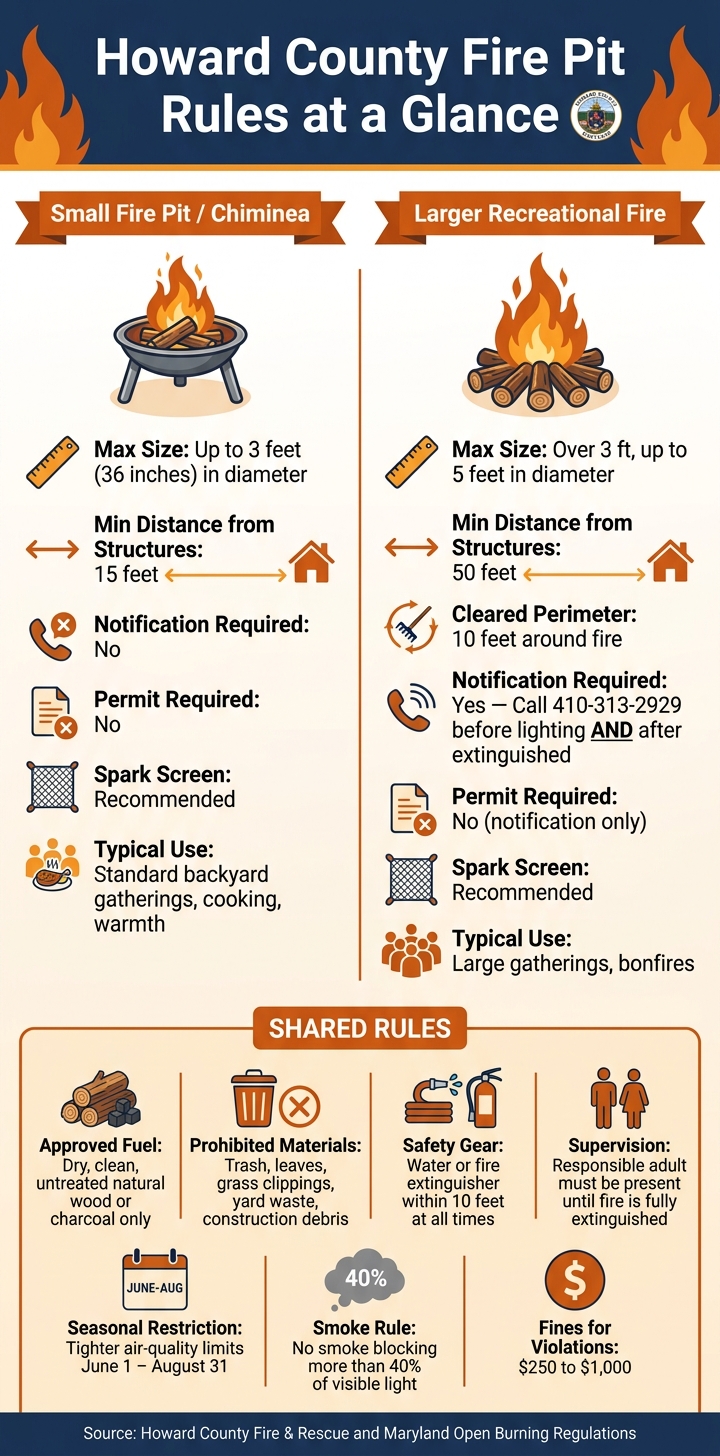
Howard County Fire Pit Rules: Small vs. Large Fire at a Glance
Quick Comparison
| Fire type | Size | Distance from structures | Call required? | Main use |
|---|---|---|---|---|
| Small fire pit / chiminea | Up to 3 ft | At least 15 ft | No | Backyard use |
| Larger recreational fire | Over 3 ft to 5 ft | At least 50 ft | Yes | Larger gatherings |
The bottom line: if your fire is small, clean-burning, watched at all times, and set up with the right clearance, it will usually fit county rules. If it is larger, smoky, or used to burn waste, it can become a problem fast.
sbb-itb-843f8be
Maryland and Howard County Rules That Apply to Backyard Fires
Backyard fires in Howard County have to follow two sets of rules: Maryland open-burning rules and Howard County safety rules.
How Maryland’s Open Burning Rules Apply in Howard County
In Howard County, Maryland’s stricter air-quality rule usually allows open fires without a permit only from September 1 through May 31.[2] From June 1 through August 31, statewide air-quality rules place tighter limits on open burning.[2]
And timing isn’t the only issue. A fire can still break the rules if it puts off dense smoke. In this case, dense smoke means smoke that blocks more than 40% of visible light.[2]
What Howard County Allows and What It Prohibits
So what does that mean in plain English? You can only burn clean, approved materials. Backyard fires are allowed when they follow the safety rules.[2] But using fire as a way to get rid of trash or yard debris is off-limits.
Howard County prohibits burning:
Here’s the quick breakdown:
| Category | Legal | Prohibited |
|---|---|---|
| Materials | Dry, aged natural wood; charcoal | Household trash, plastic, painted or treated lumber |
| Yard waste | Dry kindling | Leaves, grass clippings, branches |
| Purpose | Cooking, warmth, or recreation | Disposal of waste or debris |
There’s one more piece that matters. Even if a fire checks the other boxes, it still isn’t compliant if it creates a nuisance for neighbors or a visibility hazard on nearby roads.[2]
Next, fire size, clearance, and fuel type decide whether a pit meets Howard County’s safety rules.
Fire Pit Size, Setback, and Safety Rules
Once the fuel rules are clear, the next piece is size and placement. That’s what decides whether your fire setup follows Howard County rules. And the line is pretty simple: pits up to 3 feet are handled one way, while larger recreational fires fall under tighter limits.
Rules for Manufactured Fire Pits, Chimineas, and Similar Portable Fire Features
A manufactured fire pit, chiminea, or similar portable fire feature with a burn area no larger than 3 feet (36 inches) in diameter must sit at least 15 feet from structures and overhead branches[3][4].
In plain English, a 3-foot pit needs open space around it. Don’t use it on balconies or under building overhangs. You should also use a spark screen to help keep embers from drifting[3].
If the fire goes past 3 feet, the rules tighten up.
Rules for Larger Recreational Fires Between 3 ft and 5 ft
A burn area larger than 3 feet but no more than 5 feet in diameter is treated as a larger recreational fire[3][4]. In that case, the setback jumps to at least 50 feet from any structure[3][4].
You also need a 10-foot cleared perimeter around the fire[4]. Some of these larger fires also come with time limits[4].
Supervision, Extinguishing Tools, and Approved Fuel
Size and placement matter, but they’re only part of the picture. Every fire must be attended by a responsible adult until it is fully extinguished[1][4]. Keep water or a fire extinguisher within 10 feet at all times[3][4].
Use only the approved fuel listed above.
How to Use a Fire Pit Legally in Howard County
Use this checklist before you light any backyard fire.
A Step-by-Step Check Before Lighting a Fire
Run through these six checks every time before you light up:
- Purpose: Use the fire for cooking, heating, or recreation only. Do not use it to burn trash, yard waste, or debris.
- Setback: Measure the space to the nearest structure or overhead branch. You need at least 15 feet of clearance.
- Size: If the fire is over 3 feet across but no more than 5 feet, call Howard County Communications before lighting.
- Fuel: Burn clean, dry, untreated wood only. Safety gear: Keep water or a fire extinguisher within 10 feet.
- Conditions: Check for burn bans or wind limits before you start.
- Supervision: A responsible adult must stay with the fire until it is fully out.
When You Must Call Howard County Communications
If your fire’s burn area is over 3 feet but no more than 5 feet in diameter, you must give advance notice. Call Howard County Communications at 410-313-2929 before lighting the fire and again after it is fully extinguished.
For standard fire pits that are 3 feet or smaller, no recreational burning permit is required.
Small Fire Pits vs. Larger Recreational Fires: A Side-by-Side Comparison
| Feature | Small Manufactured Fire Pit | Larger Recreational Fire |
|---|---|---|
| Maximum Size | Up to 3 ft (36 in) | Over 3 ft, up to 5 ft |
| Distance from Structures | Minimum 15 ft | Minimum 50 ft |
| Spark Screen | Highly recommended | Recommended |
| Notification Required | None | Call 410-313-2929 before lighting and after extinguished |
| Permit Needed | No | No (notification only) |
| Typical Use | Standard backyard gatherings | Large events, bonfires |
Permanent fire pits need one more review before installation.
Planning a Permanent Fire Pit and Key Takeaways
What to Review Before Installing a Built-In Fire Pit
Permanent fire pits need a site check before you build. Start by measuring the space from nearby structures, fences, property lines, and other flammable materials. Howard County guidance says you need at least 15 feet of clearance, and that same distance applies to overhanging tree branches [3][4].
You also need to check both above and below the site. Don’t place the pit under low-hanging trees or power lines. And before any digging starts, review the area for underground utility lines. For a built-in fire pit, it’s smart to contact the local fire department or fire marshal to see if your design needs a permit or inspection [3][5].
Once the location checks out, the next step is materials.
Use steel, brick, or masonry for the main structure. If you’re building a masonry pit, line the inside with firebrick and fireproof mortar to help protect the outer shell. The burning area should be 36 inches or less [3][4][5].
If you live in a neighborhood with an HOA, read the bylaws before you lock in the design. An HOA may set tighter setback or material rules than the county does, so it’s worth checking early [3].
Conclusion: Key Rules
Even after the fire pit is built, the use rules don’t go away. Before construction, confirm the setback, size, and material rules that apply to your property [3][4].
After installation, follow the same fuel, supervision, and smoke rules each time you use it. Check for active burn bans or local air-quality advisories before lighting any wood-burning fire. If a fire creates a nuisance or unsafe smoke, it can be ordered extinguished [2][4].
Plan the build with care, then stick to the use rules every time.
FAQs
Do gas fire pits follow the same rules?
Yes. Gas fire pits in Howard County have to follow safety rules, but they’re treated a bit differently from wood-burning fire pits.
They need to be at least 15 feet from any building or structure. You also can’t use them on balconies or under overhangs. And while gas fire pits may be exempt from some smoke-related limits or burn bans, they still have to be used according to the manufacturer’s instructions.
How is fire pit size measured?
In Howard County, fire pit size is based on the interior burning area. For a standard residential fire pit, that inside area can’t be more than 3 feet in diameter.
That means you should measure only the space where the fire burns – not the outer edge, stone border, or any decorative surround.
Can HOA rules be stricter than county rules?
Yes. HOA rules can be stricter than Howard County regulations.
Homeowners still need to follow county fire safety laws. But an HOA can add its own rules about a fire pit’s type, size, placement, or design.
So before you install a fire pit, check your HOA covenants and guidelines. That helps you stay compliant with both sets of rules.
Chat with Us