









- bhavya gada
- No Comments
Before I start a patio, driveway expansion, or yard regrading job in Howard County, I need to check one thing first: will this change runoff, grading, or drainage? If the answer is yes, county review may come into play even on a small residential project.
Here’s the short version:
- Small jobs are not always exempt. In Maryland, work under 5,000 sq. ft. of disturbance and under 100 cubic yards of earth moving is often outside full stormwater review, but drainage changes can still trigger county review.
- Projects that often get reviewed include patio or driveway expansions, yard regrading, retaining walls, and new drains, swales, or pipes.
- Site limits matter. Extra rules can apply near wetlands, streams, and 25%+ slopes.
- The county will want clear plans. That usually means a scaled site plan, grades, runoff directions, erosion and sediment controls, and drainage details.
- I can’t start work early. The permit must be issued first, the Pre-Con meeting must happen before earthwork starts, and CID needs at least 48 hours’ notice before site work begins.
- Some jobs need pro help. That is often the case with retaining walls, slope changes, runoff issues, wet yards, or any tie-in to public drainage.
A few numbers stand out right away:
- 5,000 sq. ft.: common land disturbance cutoff tied to full stormwater review
- 100 cubic yards: common earth movement cutoff
- 25 ft / 50 ft / 75–100 ft: common stream and wetland setback distances noted in the guide
- ~30 inches: retaining wall height where drainage and slope concerns often get more attention
- Over 3 feet: walls may trigger added county review
- 10 feet+: walls may need engineering calculations
- 5% slope over the first 10 feet: common grading target away from the house
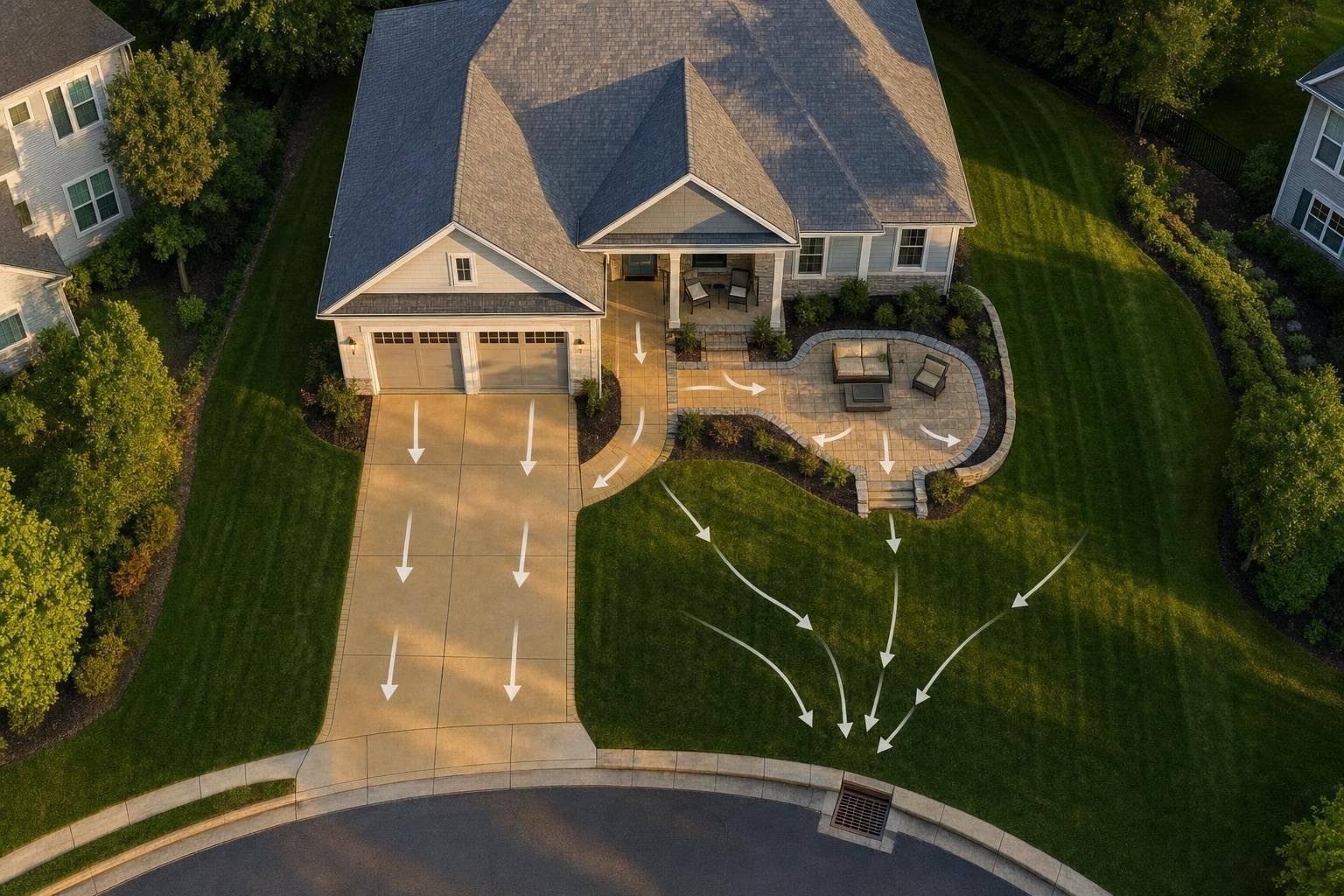
If I want fewer permit comments and fewer redraws, the main move is simple: show the full water path before and after the project. That means where runoff starts, where it goes, and how the finished work keeps water away from the house and neighboring lots.
This guide walks through the trigger points, the review process, the plan details Howard County may ask for, and when it makes sense to bring in a contractor or designer.
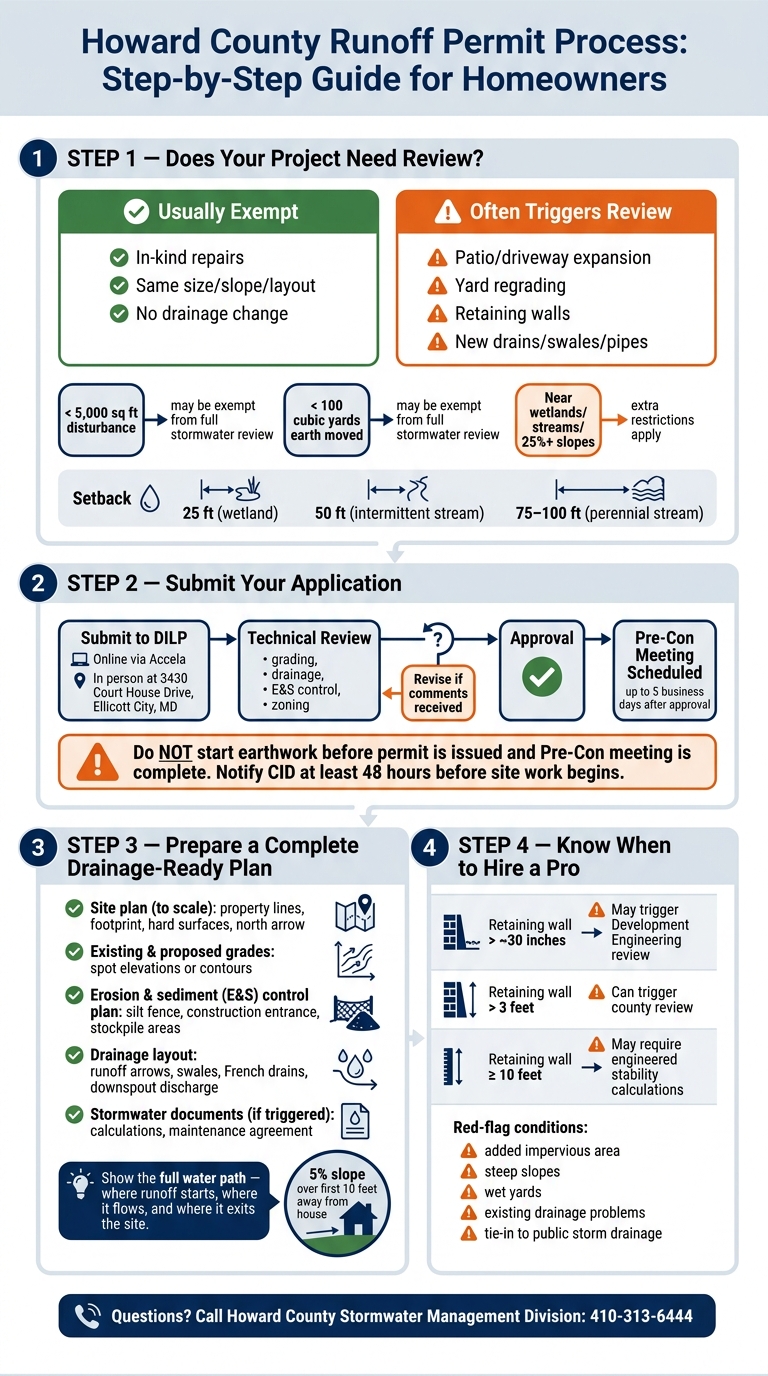
Howard County Runoff Permit Process: Step-by-Step Guide for Homeowners
Step 1: Find Out If Your Project Needs County Review
Before you buy materials or bring in a contractor, check if Howard County wants to review the job first. In Howard County, the Department of Inspections, Licenses and Permits (DILP) handles most home grading work. The main thing to ask is simple: will the project change grading, hard surface area, or drainage?
Most permit calls come down to four things: how much soil you disturb, how much hard surface you add, whether you change where water goes, and whether the work is near a protected or regulated area. In Maryland, projects that disturb less than 5,000 sq ft of land and move less than 100 cubic yards of earth are generally exempt from full stormwater management review.[9] But that doesn’t mean every small job gets a pass. Bigger cut-and-fill work, heavy equipment, or changes to drainage can still push a project into permit territory. If any of that sounds like your job, go into permit intake with your site measurements and a rough sketch.
Projects That Commonly Require Review
A project is more likely to get county attention when it changes your yard’s layout, elevation, or surface type, instead of just fixing what’s already there.
| Project Type | Why It Often Triggers Review |
|---|---|
| Patio or driveway expansion | Adds hard surface that sheds water and increases runoff volume |
| Yard regrading or slope reshaping | Counts as grading under county code and changes the flow path |
| Retaining walls that change slope or drainage | Affects drainage and slope stability, especially at about 30 inches or higher |
| New drainage pipes, swales, or French drains | Can send water toward neighbors or connect to public systems |
By comparison, in-kind repairs that keep the same size, slope, and general layout – like resetting a few loose pavers or patching an existing driveway without making it bigger – are more likely to be treated as maintenance. Those jobs usually do not need review, as long as they do not change drainage patterns.
Property Conditions That Can Add Restrictions
Some site conditions can make the rules tighter. Howard County restricts work near wetlands and streams, including 25 ft of a wetland, 50 ft of an intermittent stream bank, and 75–100 ft of a perennial stream bank, depending on stream classification and zoning.[14][15] Steep slopes of 25% or greater are also protected, and grading usually needs a county exception.[13]
If your yard has a ditch or swale, a low marshy spot, a stream behind the lot, or a steep hillside, check county maps or call DILP before you lock in the design. You can also contact the Stormwater Management Division at 410-313-6444 to ask if your project triggers review.[12] If your lot has any of these limits, pull together the site details now and move to the plan review process.
sbb-itb-843f8be
Step 2: Follow the Howard County Permit and Plan Review Process
Submit your grading application to Howard County’s Department of Inspections, Licenses and Permits (DILP) online through Accela Citizen Access or in person at 3430 Court House Drive, Ellicott City, MD. [3] DILP handles permit intake first. After that, the file moves into technical review for grading, drainage, erosion and sediment control, and zoning compliance.
If reviewers spot problems, they’ll send comments back. Then you’ll need to revise the plans and resubmit them until they satisfy county rules. Once the plans are approved, CID usually needs up to 5 business days to assign the permit and schedule the Pre-Con meeting. [1]
That’s why it pays to send in a complete package from day one.
What to Prepare for Permit Intake and Review
The Pre-Con meeting takes place before any earthwork starts. It gives the inspector a chance to confirm that the site matches the approved plan and that the required controls are in place.
Do not start grading or hardscape installation before the permit is issued and the Pre-Con meeting is complete. The county’s Standard Plan also says you must notify CID at least 48 hours before site work begins. [7]
Plan Materials the County May Request
To cut down on delays, line up your plans with what reviewers check during intake. For patios, driveways, and yard regrading, the county looks closely at how the project changes runoff and slope. In plain terms: they want to know where the water goes before the work and where it will go after.
Here’s what reviewers usually ask for:
| Document | What It Should Show |
|---|---|
| Site plan (to scale) | Property lines, house footprint, existing and proposed hard surfaces, north arrow |
| Existing and proposed grades | Spot elevations or contours showing how water flows before and after construction |
| Erosion and sediment control (E&S) plan | Silt fence locations, construction entrance, stockpile areas, stabilization notes |
| Drainage layout | Runoff direction arrows, swales, French drains, yard inlets, downspout discharge points |
| Stormwater documents (if triggered) | Practice layout, design details, runoff calculations, and maintenance agreement |
An approved E&S plan is required before DILP will issue a grading permit. [16][18] For single-lot residential projects, Howard Soil Conservation District may also charge a review fee. If stormwater management is triggered, any private system will need a maintenance agreement. [2]
At the end of the day, reviewers want a plan that clearly shows water will leave the site in a safe, predictable way.
Step 3: Put Together a Complete Drainage-Ready Submission
Howard County reviewers need to see the full water path, not just the finished design. Your plan should show where runoff starts, where it flows, and how the site stays stable once the work is done.
Start by labeling every runoff path on the same plan set you submit for review.
Drainage Details Reviewers Typically Check
Your plan needs to show that runoff won’t collect near the house, leave the lot, or tie into a public system without approval.
Mark every downspout and its discharge point on the site plan. Reviewers want to see that roof runoff is not directed toward the house or onto a neighboring property.[8][5]
For slopes and grades, show positive slope away from the house, usually about 5% over the first 10 feet.[21] Add arrows so the reviewer can follow the flow from each hard surface to its outlet.
Label all swales, drain pipes, and inlets too. If you’re adding a French drain, include the trench depth, pipe size, slope, and outlet. Show where each pipe or swale ends, and confirm that it discharges into a vegetated area or another approved outlet, not a public storm drain unless the county has approved it.[4][10][5][22]
If the project involves groundwater issues or any connection to public storm drainage, contact Howard County’s Department of Inspections, Licenses and Permits or Development Engineering before you lock in the plan.[3][11][20]
Then line up those drainage details with the type of work you’re doing.
Approval Checklist by Project Type: Patios, Driveways, and Yard Regrading
Use the table below to match the drainage details to the project type.
| Project type | Common review trigger | Likely plan details | County review focus |
|---|---|---|---|
| Patio | Added impervious area or changed runoff direction | Size, location, slope, discharge path, nearby structures | Whether runoff is redirected toward the house or adjacent lots |
| Driveway expansion | Larger paved footprint or changed grading | Existing and proposed layout, grades, drainage path, edge conditions | Impervious increase, drainage impacts, and site access considerations |
| Yard regrading | Soil disturbance or altered flow patterns | Existing and proposed contours, swales, spot grades, stabilization measures | Erosion control and off-site drainage impacts |
For patios, clearly show the footprint dimensions and the pitch away from the house.[8][5]
For driveway expansions, document both the existing and proposed paved area. Show driveway grades clearly, especially where the slope gets steeper.[19] Also show how runoff leaves the driveway edge. In most cases, reviewers want to see it sheet-flow into grass or a swale instead of dumping into one concentrated point.[6][10][4]
For yard regrading, you need the same level of detail, plus a stabilization plan. Include existing and proposed contours, limits of disturbance, and an erosion control sequence, grading timing, and final stabilization.[16][17][11] Reviewers look closely at disturbed soil near property lines or drainage ways. They want to see that those areas are protected before permanent vegetation is in place.
For larger patio, driveway, or regrading jobs, a contractor who knows Howard County drainage rules, such as Pro Landscapes MD, can help pull together the grading, drainage, and stabilization details.
Step 4: Know When to Bring In a Contractor or Designer and Close Out the Plan
Some jobs are simple enough for a homeowner sketch. Others need a pro-built plan from the start.
When Professional Site Planning Can Save Time
If your project includes walls, grading, or drainage changes, this is usually the moment to bring in a professional. The biggest red flag is any work that changes runoff, slope, or drainage patterns. In Howard County, retaining walls over about 3 feet can trigger Development Engineering Division review, and walls 10 feet or higher may need engineered stability calculations from a design professional.[23][19] If a wall supports a driveway or patio, or changes a slope, getting pro help matters even more.
A few site conditions should also push you away from a rough sketch and toward a permit-ready plan:
- Added impervious area
- Steep slopes
- Wet yards
- Existing drainage problems
Why does this matter? Because these issues tend to lead to county comments, redraws, and delays if they aren’t handled early.
A qualified contractor can turn field measurements into a plan set that is ready for permit review. Sending in a coordinated packet instead of a basic sketch can cut down on the most common county comment rounds.[16][11] Pro Landscapes MD can help prepare patio, driveway, retaining wall, drainage, and grading plans for Howard County permits.
After approval, the job shifts from design to inspection and closeout. That means making sure the finished work matches the approved plans, passing any required inspections, and stabilizing all disturbed soil.
Conclusion: Key Steps for a Smoother Howard County Approval
A complete first submittal can speed up approval. Check whether the project changes grading or runoff, look for sensitive site limits early, and put together drainage-ready plans before you submit. Leave room in your schedule for county review, and bring in a professional when walls, slopes, or drainage conditions get more involved.
The basic flow is pretty simple: identify the trigger, prepare complete plans, submit accurate drainage details, and close out the job cleanly. When you do that, the approval process usually comes with far fewer interruptions.
FAQs
How do I know if my project changes runoff?
Check whether your project reduces how much water the site can absorb. Adding impervious surfaces like roofs, driveways, or patios changes runoff patterns.
You should also review drainage paths and slope. If the work disrupts the way water already flows or sends it to new discharge points, it likely changes runoff. Pro Landscapes MD can help assess these site conditions and check them against local standards.
What happens if I start work before permit approval?
In Howard County, you need to secure all required permits and get approval for your erosion and sediment control plan before any soil-disturbing work begins.
Starting too soon can lead to compliance problems, possible fines, project delays, and even a full stop to construction until the issue is corrected.
When should I hire a contractor or designer?
Hire a professional contractor or designer if your project is complex, involves major grading or drainage work, or needs to meet strict local stormwater and erosion control rules.
Howard County standards can be tough to sort through on your own. Getting expert help can cut down on costly mistakes, project delays, and possible fines. Pro Landscapes MD handles site design, drainage installation, and grading to help keep projects compliant.
Chat with Us