









- bhavya gada
- No Comments
Erosion on sloped yards can lead to soil loss, foundation damage, and waterway contamination. Here’s how to tackle it effectively:
- Evaluate Your Yard: Check slope gradient, soil type, and erosion signs like bare patches, exposed roots, or gullies.
- Grading and Terracing: Reshape slopes to slow water flow. Use terraces for steeper areas to create flat, stable sections.
- Install Drainage Systems: Use French drains, dry riverbeds, or check dams to redirect runoff and prevent pooling.
- Plant Vegetation: Choose deep-rooted plants and ground covers to stabilize soil. Add mulch for extra protection.
- Build Retaining Walls: For severe slopes, retaining walls provide structural support and prevent soil movement.
- Regular Maintenance: Inspect after storms, reapply mulch, and address bare spots to keep erosion control measures effective.
Erosion Control Solutions by Slope Steepness Guide
Stop Hillside Erosion Before It Destroys Your Property (3 Proven Fixes)
sbb-itb-843f8be
Assessing Your Yard for Erosion Risks
Before diving into erosion control solutions, it’s important to evaluate your yard’s specific challenges. One key factor is the slope gradient – the steeper the slope, the faster water flows downhill, carrying more energy to erode the soil. As NativeSeed Group explains:
The incline or rise of the slope makes it prone to a faster rate of landslide and erosion[2].
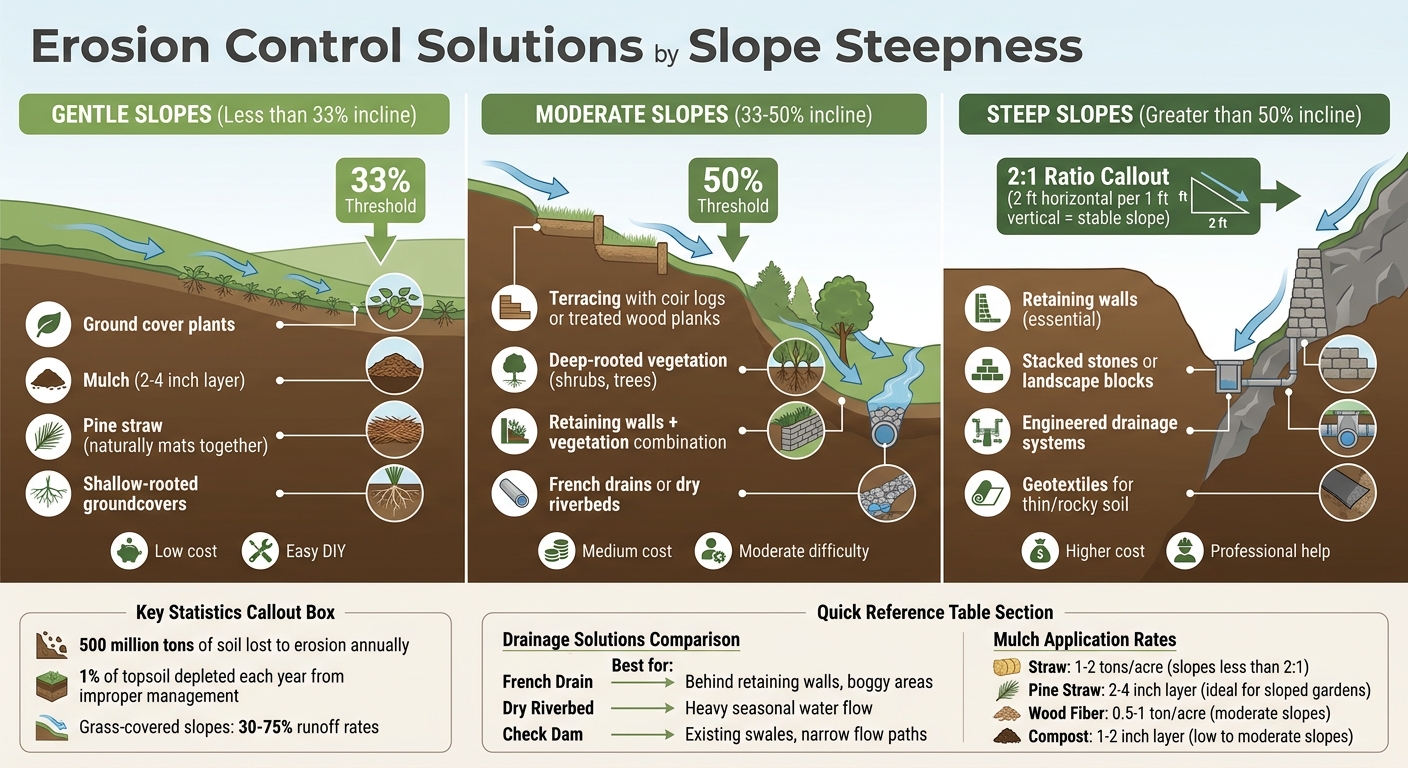
A helpful guideline is the 33% rule: slopes with less than a 33% incline can often be managed with ground cover and mulch, while steeper slopes typically require more robust measures like terracing or retaining walls[2].
Soil type is another critical consideration. Sandy soils are easily washed away, while clay soils resist erosion initially but can lead to runoff problems because they absorb water poorly. To test drainage, try a simple percolation test: dig a 12-inch-deep hole, fill it with water, and observe how quickly it drains. If the water disappears within two hours, your drainage is sufficient. If it takes two days or more, shallow bedrock might be restricting water absorption, increasing the risk of erosion[2].
Signs of Erosion to Look For
Take a walk around your property and look for clues that erosion might already be an issue. Here are some common signs to watch for:
- Bare patches or bald spots: Grass or plants struggling to grow in certain areas often point to poor soil quality or shallow bedrock.
- Exposed tree roots: These can indicate that the topsoil has already been washed away.
- Gullies or channels: These form after heavy rains and show where water runoff is carving through the soil.
- Pooling water: Standing water after storms suggests drainage problems, which can lead to significant soil loss over time.
These signs can help you pinpoint problem areas and understand how water and soil interact on your property.
Understanding Soil and Terrain Characteristics
Beyond visible signs of erosion, the overall layout of your yard plays a big role in its stability. If your property sits at the bottom of a hill or channels runoff from surrounding areas, it’s at higher risk for heavy washouts and debris flow[2]. The depth of bedrock is another important factor. Shallow bedrock can prevent plants from developing deep root systems, which are essential for stabilizing soil. In such cases, you might need to use geotextiles to build up soil layers before planting[2].
Grading and Slope Stabilization Techniques
Once you’ve pinpointed areas at risk of erosion, reshaping the land can help redirect water flow and protect the soil. Grading is a key approach, involving adjustments to the land’s contours to manage water movement. As Geosyntec Consultants describes:
Land grading is the reshaping of the ground surface to planned grades as determined by engineering survey and layout [5].
By either flattening the slope or dividing it into smaller, more manageable sections, you can slow down runoff. This gives water more time to seep into the ground, reducing the risk of soil being washed away [5]. Below are practical grading and terracing strategies to manage runoff effectively on different types of slopes.
Regrading to Improve Water Flow
Using your erosion assessment as a guide, regrade the slope to channel water toward stable drainage areas instead of allowing it to pool or flow uncontrollably. For better stability and easier upkeep, aim for a slope ratio of 2:1 or flatter – this means 2 feet of horizontal distance for every 1 foot of vertical rise or fall [5].
After regrading, enhance the surface by roughening it – such as by creating horizontal grooves or using stair-step grading techniques. You can also install diversions to intercept water before it gains too much speed [5]. Regular inspections, especially after storms, are essential to catch and repair small erosion issues like rills or gullies before they grow into larger problems [5].
Using Terracing for Steep Slopes
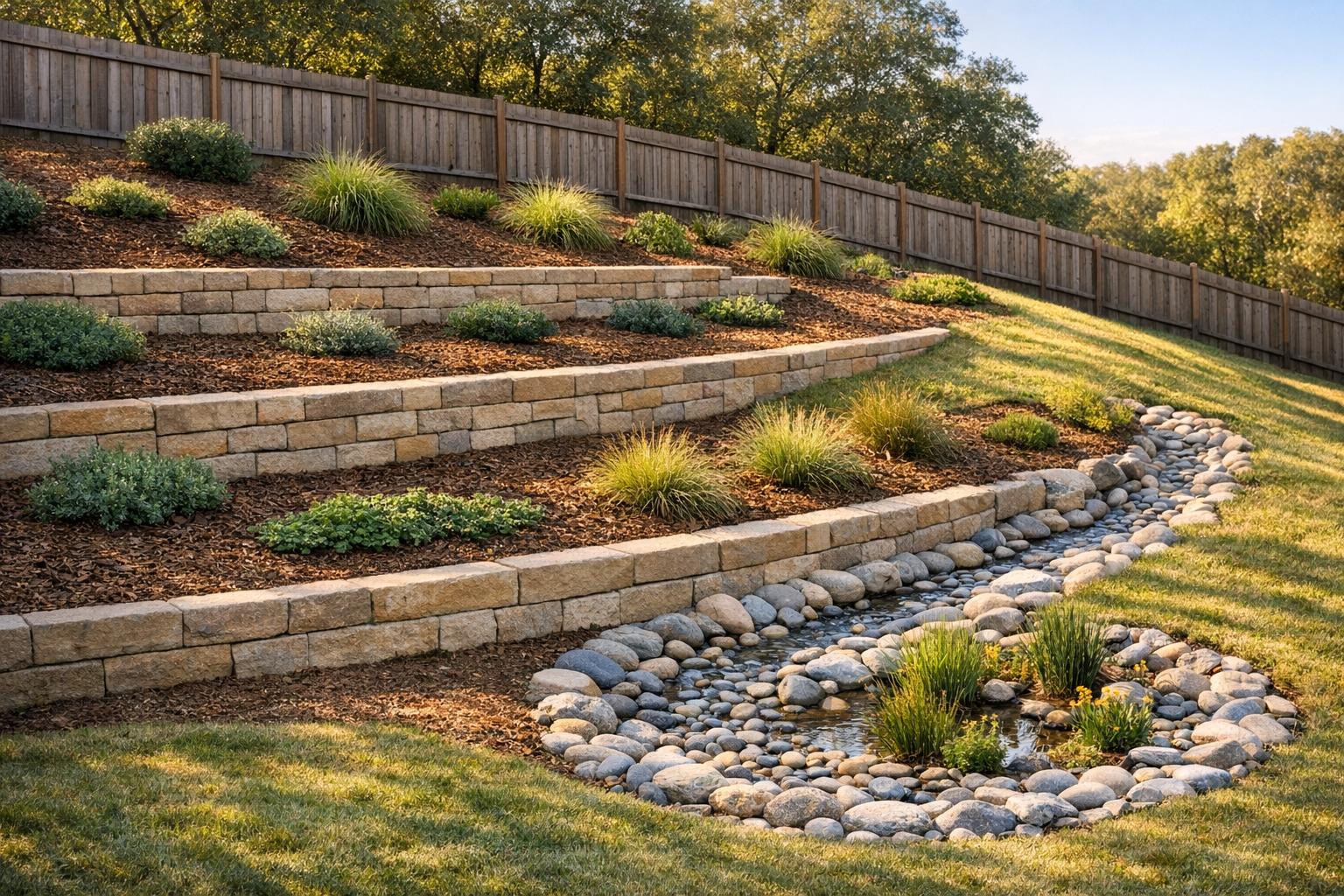
For slopes steeper than 33%, terracing is an effective way to slow down water flow. This method divides the hillside into step-like plateaus, which act as natural speed bumps for runoff. These plateaus allow water to soak into the soil rather than rushing downhill. The choice of materials depends on the slope’s steepness: stacked stones or landscape blocks are ideal for steeper gradients, while coir logs or treated wood planks work well for gentler slopes [4].
Make sure terraces are built horizontally to trap soil and slow water movement [2]. The flat areas created by terracing are excellent for planting deep-rooted vegetation like fruit trees, berry bushes, or herbs, which help anchor the soil [2]. For added drainage support, consider incorporating small dry-stone walls with gravel backfill to relieve water pressure and maintain the terrace structure [2].
| Slope Type | Recommended Material | Primary Benefit |
|---|---|---|
| Gentle Slope | Coir logs, treated wood planks | Affordable and simple to install |
| Steep Slope | Stacked stones, landscape blocks | Durable and excellent soil retention |
| Thin/Rocky Soil | Geotextiles, erosion control blankets | Helps build up soil before planting |
Drainage Solutions for Erosion Control
Once you’ve addressed grading and terracing, managing runoff becomes essential to prevent soil erosion. A well-designed drainage system can significantly enhance slope stabilization by channeling water away from areas prone to damage. The Northern Virginia Soil and Water Conservation District emphasizes:
"Redirecting and capturing runoff will prevent the erosion damage from getting worse." [7]
There are two primary methods to handle runoff: redirecting it with systems like French drains or dry riverbeds and capturing it using features such as rain gardens or dry wells.
Installing French Drains or Dry Riverbeds
To install a French drain, start by marking the desired drainage path and grading the area for proper water flow. Lay down landscape fabric, position a perforated pipe, and surround it with gravel. This setup is particularly effective behind retaining walls or in spots where water tends to collect.
For dry riverbeds, arrange decorative stones along the natural water flow path. Landscape edging, designed with gaps at low points, allows water to escape effectively. Protect downspout outlets with splashguards or stones to avoid erosion. In swales or narrow channels, you can also add check dams made from stone or coir fiber biologs. These help slow water movement, giving the ground more time to absorb it. [7]
Both options work best when integrated with broader stormwater management strategies to protect your yard from erosion.
Stormwater Management Considerations
Drainage systems become even more effective when paired with comprehensive stormwater management, especially in areas with high water flow. For instance, properties in Maryland must follow NPDES, EPA, and local stormwater guidelines, which can influence how your drainage system is designed. Factors like slope steepness, soil absorption rates, and water velocity play a key role in determining the right solution.
In areas with significant water flow, engineered options such as sediment basins or reinforced channels might be necessary. On gentler slopes, simpler measures like vegetative cover or mulching may suffice. Directing water to protected storm drain inlets also helps prevent sediment from clogging municipal systems. [9]
For Maryland homeowners, professional stormwater management services ensure compliance with local regulations while safeguarding your landscape. Pro Landscapes MD provides a range of drainage installation services, including French drains and dry riverbeds, to create long-lasting solutions for erosion control.
| Drainage Solution | Primary Function | Best Use Case |
|---|---|---|
| French Drain | Redirects water via perforated pipe and gravel | Behind retaining walls or in boggy areas |
| Dry Riverbed | Directs surface runoff using decorative stones/gravel | Areas with heavy seasonal water flow |
| Check Dam | Slows water velocity in channels | Existing swales or narrow flow paths |
| Catch Basin | Captures and redirects surface water | Low spots where water pools |
Using Vegetation and Mulching to Prevent Erosion
Besides grading and drainage, using vegetation and mulching offers a long-lasting way to combat erosion on sloped properties. These methods work by anchoring the soil and reducing the impact of rainfall, which helps prevent seeds from being washed away and slows down water runoff [10]. Deep-rooted plants like shrubs and trees secure the soil to the rock layers beneath, while shallow-rooted groundcovers like monkey flowers or sages stabilize the top layer of soil. Native shrubs and trees on slopes help prevent saturation, unlike grass-covered slopes, which can experience runoff rates between 30% and 75% [6]. Choosing the right plants is key for maintaining soil stability over time.
Selecting Erosion-Resistant Plants
Opt for plants with strong, extensive root systems that can hold soil in place on steep slopes. Native plants are especially effective since they’ve adapted to the local environment, including soil and rainfall conditions. Using a mix of plants creates multiple layers of vegetation, which can intercept rainfall at various heights, offering better erosion control than relying on a single groundcover type. Deep-rooted shrubs and trees stabilize the lower soil layers, while groundcovers and perennials protect the surface. This combination, supported by soil microorganisms, forms a natural barrier that holds soil particles together [6]. Avoid shallow-rooted plants like ice plant or turf grass, as they can become heavy and unstable when saturated [6]. After selecting the right plants, applying mulch correctly can further enhance soil protection.
Applying Mulch to Protect Soil
Mulch acts as a shield, absorbing rainfall impact and slowing water as it moves downhill [11][12]. On slopes, pine straw is particularly effective because it naturally mats together, staying in place better than loose wood chips [13]. Spread organic mulch in even layers, 2 to 4 inches deep, to help retain moisture and suppress weeds [13].
On sloped terrain, it’s important to anchor loose mulch to prevent it from being washed or blown away. This can be done by crimping it into the soil, using liquid tackifiers, or installing erosion control netting [10][11][12]. Straw mulch typically lasts about three months, which is usually enough time for permanent vegetation to take root [10][12]. Wes Gibbs, Roadside Manager for Jones County, emphasizes its cost-effectiveness:
Dollar for dollar, straw mulch is the best money spent on erosion control. [11]
Be cautious not to pile mulch against plant stems or tree trunks, as this can lead to rot or attract pests [13]. For steep slopes needing extra reinforcement, try a layering approach: apply a 1-inch layer of shredded mulch, secure it with jute netting using staples (about 1.5 staples per square yard), and then add another 1-inch layer of mulch on top. This "sandwich" method provides immediate soil protection while creating a stable environment for vegetation to grow [6][10]. The table below outlines recommended application rates for different mulch types.
| Mulch Type | Application Rate | Best Use on Slopes |
|---|---|---|
| Straw | 1–2 tons per acre | Best for slopes less than 2:1; requires anchoring [10][12] |
| Pine Straw | 2–4 inch layer | Ideal for sloped gardens; naturally mats together [13] |
| Wood Fiber | 0.5–1 ton per acre | Suitable for hydroseeding on moderate slopes [12] |
| Compost | 1–2 inch layer | Good for nutrient-poor soil on low to moderate slopes [10][11] |
Building Retaining Walls and Structural Controls
When dealing with severe slopes, retaining walls provide much-needed structural support to prevent soil from shifting downhill. While proper grading and drainage can manage runoff effectively, sometimes vegetation and mulch aren’t enough to stabilize steep inclines. That’s where retaining walls come in – they physically hold soil in place, complementing the other erosion control strategies mentioned earlier. For properties with steep grades or significant erosion concerns, these structural solutions are often a necessity.
Designing and Installing Retaining Walls
Retaining walls serve a dual purpose: they reduce the speed of runoff and protect topsoil by creating terraces. These terraces slow down rainwater, preventing it from rushing downhill and carrying soil with it. For slopes steeper than 50%, retaining walls are typically essential [1]. On slopes between 33% and 50%, a combination of retaining walls and deep-rooted vegetation can often provide effective erosion control [1].
One key to ensuring the durability of a retaining wall is managing water buildup behind it. As Brian Dalinghaus, Co-Founder of Dalinghaus Construction, explains:
Proper drainage behind the wall is essential to prevent water buildup and pressure. [1]
To address this, gravel backfill or perforated pipes, such as French drains, are often installed behind the wall. This is especially important in Maryland, where clay-heavy soils retain moisture and can compact, increasing the risk of hydrostatic pressure. Without proper drainage, this pressure can compromise the wall’s structural integrity [1][8]. Additionally, the terraces created by the walls can be used for deep-rooted plantings, further stabilizing the slope.
Incorporating Natural Stone or Pavers
For a solution that’s both practical and visually appealing, natural stone or pavers are excellent choices for retaining walls. These materials not only provide erosion control but also enhance the overall look of the property. They blend seamlessly with existing hardscape features, making the area more accessible while maintaining stability. Pro Landscapes MD specializes in creating retaining walls, garden walls, and seat walls using these materials, serving properties across central Maryland.
To maximize effectiveness, combine structural supports with proper drainage systems and erosion-resistant plantings. Terraced areas behind the walls can be transformed into flower beds or planted with species designed to resist erosion, adding another layer of protection. Regular maintenance is also important – clear drainage outlets, inspect for soil settling, and check for cracks after heavy storms [1][2].
Maintaining Your Erosion Control Measures
Once you’ve installed erosion control systems, keeping them in shape is the key to long-term protection. Without regular care, even the best-designed systems can break down, leaving your property exposed to soil erosion and water damage.
Regular Inspections and Repairs
It’s essential to inspect your erosion control features after heavy rainstorms. Look for signs like displaced mulch, newly formed gullies, or clogged drainage channels [3][2]. Catching these issues early can stop them from turning into bigger problems.
Apart from post-storm checks, schedule soil tests every few months to keep tabs on pH levels and nutrient content. This ensures the soil stays stable enough to support vegetation [3]. If heavy rains have washed away organic mulch (like wood chips, bark, or straw), reapply it to a depth of 2–4 inches [3]. To maintain soil health over time, consider adding a top dressing every one to two years. This helps improve soil structure and makes it more resistant to erosion [3].
Keep an eye on erosion control blankets and geotextiles as they naturally break down. Make sure vegetation has developed strong, deep roots before these materials deteriorate [4][2]. If you notice bare patches on slopes, address them right away – these could signal over-fertilization, poor irrigation, or even shallow bedrock [2].
Adapting your maintenance routine to seasonal changes can also help protect your property.
Seasonal Adjustments for Maryland Climates
Seasonal shifts call for specific strategies to keep your erosion control measures effective. In winter, avoid cutting back spent perennial stems. These stems can trap debris and create a natural mulch layer. As Miri from the University of Maryland Extension explains:
Even though few are evergreen, leaving spent stems uncut for the winter will help catch any fallen leaves and plant debris that will serve as a natural mulch that should help protect the soil. [14]
When spring rolls around, trim back perennials before new growth starts [14]. During times of snow and snowmelt, keep an eye on areas near downspouts to ensure water isn’t carving out channels on slopes [14]. Also, check for signs of wind burn on slope-stabilizing plants [14].
For slopes, arborist wood chips or shredded cedar are excellent mulch options. Miri suggests:
Arborist wood chip mulch might be a material that will resist sliding down the slope (especially once the chips absorb water and begin to decay as fungal growth will knit them together a little) [14]
This "knitting" effect makes wood chips less likely to slide compared to pine bark nuggets. Plan your maintenance activities around key times of the year – apply pre-emergent herbicides and fertilizers in early spring, and get your lawn ready for winter in the fall [3].
Conclusion
To tackle erosion on sloped yards, combine vegetation, drainage solutions, and structural techniques. Tailor your approach: apply mulch and ground cover for gentle slopes, while steeper areas may require retaining walls or terracing to prevent soil loss[2].
Each year, around 500 million tons of soil are lost to erosion, with improper management leading to the depletion of 1% of topsoil annually[2]. This isn’t just a property issue – erosion can clog storm drains, strip soil of essential nutrients, and pollute waterways with sediment.
Addressing these challenges requires a mix of strategies. Choose solutions that fit your yard’s needs, such as installing proper drainage systems like French drains or dry riverbeds, and planting deep-rooted vegetation. As the NativeSeed Group emphasizes:
Stability is key – better soil stability means less erosion[2].
For Maryland homeowners facing steep slopes or erosion concerns, Pro Landscapes MD provides a range of tailored services. These include site assessments, drainage installations (like French drains and dry riverbeds), stormwater management, retaining wall construction, terracing, grading, and vegetation planning to safeguard your property effectively.
FAQs
How do I calculate my slope percentage?
To figure out your slope percentage, start by measuring the vertical rise and the horizontal run of the slope. Then, divide the rise by the run and multiply the result by 100. Here’s the formula:
Slope Percentage = (Vertical Rise ÷ Horizontal Run) × 100
For example, if a slope rises 3 feet over a horizontal distance of 20 feet, the calculation would look like this:
(3 ÷ 20) × 100 = 15%.
Understanding this percentage is especially useful when planning for erosion control.
When should I use a retaining wall instead of plants?
Retaining walls are a go-to solution when you need structural support to stabilize slopes, control severe erosion, or prevent soil from shifting – especially in situations where plants alone can’t do the job. They’re particularly effective for steep or extended slopes, creating flat, usable spaces, managing water runoff, and protecting nearby structures. While plants are great for addressing surface erosion and providing gradual stabilization, retaining walls offer the immediate and strong support needed for more demanding landscapes.
What’s the best way to stop downspouts from causing erosion?
To keep erosion at bay around downspouts, it’s important to guide water away from slopes and other sensitive spots. You can extend your downspouts with pipes or flexible hoses to move water at least 3–4 feet away from foundations and sloped areas. Other helpful options include adding splash blocks, installing French drains, creating dry riverbeds, or regrading your yard to control water flow and prevent runoff damage effectively.
Chat with Us