









- bhavya gada
- No Comments
If you want more bees, butterflies, and hummingbirds in spring, plant for bloom from March to June. In this guide, I’d sum it up like this: pick Maryland natives that match your sun, shade, and soil moisture, then mix trees, perennials, and groundcovers so food is there for pollinators through the full spring season.
Here’s the short version:
- I’d use Eastern Redbud and Serviceberry for early flowers on small trees
- I’d plant Virginia Bluebells, Bloodroot, Spring Beauty, Woodland Phlox, and Wild Geranium in shade
- I’d use Wild Columbine and Golden Ragwort in part shade
- I’d plant Golden Alexanders, Foxglove Beardtongue, and Creeping Phlox in sunnier spots
- I’d place Golden Ragwort, Virginia Bluebells, and Golden Alexanders in moist areas
- I’d use Wild Columbine, Foxglove Beardtongue, Creeping Phlox, Eastern Redbud, and Serviceberry where soil drains well
A few points stand out fast:
- These 12 native plants bloom across about 4 months: March, April, May, and June
- The list covers full sun, part shade, full shade, dry soil, average soil, and moist soil
- Some plants feed early bees with nectar and pollen
- Some fill very narrow roles, like Spring Beauty, which helps support the specialist bee Andrena erigeniae
- Maryland’s 2021 Low-Impact Landscaping Law gives homeowners more room to plant pollinator gardens instead of turf-only yards
Gardening for Pollinators
sbb-itb-843f8be
Quick Comparison
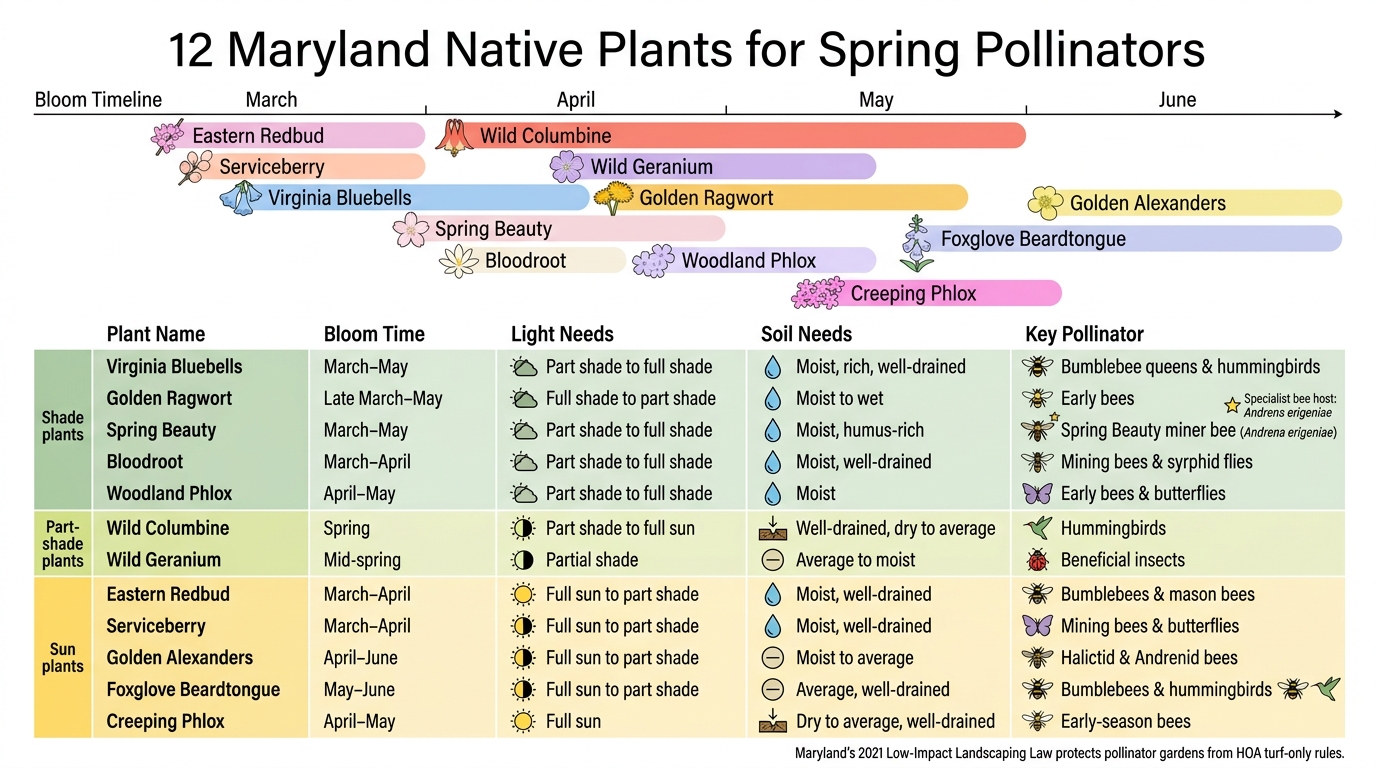
12 Maryland Native Plants for Spring Pollinators: Bloom Time, Light & Soil Guide
| Plant | Bloom time | Light | Soil | Best fit |
|---|---|---|---|---|
| Eastern Redbud | March–April | Full sun to partial shade | Moist, well-drained | Small specimen tree |
| Serviceberry | March–April | Full sun to part shade | Moist, well-drained | Border or woodland-edge tree |
| Virginia Bluebells | March–May | Partial shade to full shade | Moist, rich, well-drained | Under trees, moist shade |
| Wild Columbine | Spring | Partial shade to full sun | Well-drained, dry to average | Paths, borders, wildlife beds |
| Wild Geranium | Mid-spring | Partial shade | Average to moist | Shaded edges, lawn swap areas |
| Golden Ragwort | Late March–May | Full shade to part shade | Moist to wet | Damp shade, groundcover |
| Spring Beauty | March–May | Part shade to full shade | Moist, humus-rich, well-drained | Woodland ground layer |
| Bloodroot | March–April | Part shade to full shade | Moist, well-drained | Woodland shade gardens |
| Woodland Phlox | April–May | Part shade to full shade | Moist | Shady borders and woods |
| Golden Alexanders | April–June | Full sun to part shade | Moist to average | Pollinator beds, rain gardens |
| Foxglove Beardtongue | May–June | Full sun to part shade | Average, well-drained | Sunny borders, meadow-style beds |
| Creeping Phlox | April–May | Full sun | Dry to average, well-drained | Slopes, edges, groundcover |
My take: the main job is not to plant all 12. It’s to choose the ones that fit your yard now. When I match the plant to the spot first, the garden has a much better shot at lasting with less work.
Quick Selection Guide
Use the table below to match your site’s light and drainage with the right plants. In Maryland, plants do better when they fit the site instead of forcing the site to fit the plants.
Start with light and drainage. The plant list below is built around those two things.
| Site condition | Where it fits best |
|---|---|
| Full sun, dry soil | Sunny beds and borders |
| Part shade to shade | Under trees |
| Moist soil, rain gardens | Moisture-prone areas |
Use these site cues to narrow the plant list below.
Under trees, turf often struggles because roots compete hard for water and nutrients. That’s why groundcovers or 2 to 3 inches of mulch are usually a better pick [1].
1. Eastern Redbud
Bloom Time
Eastern Redbud (Cercis canadensis) blooms in March and April, often before the leaves show up. That early bloom is part of what makes it stand out in spring.
Flower Color
Its flowers appear in small pink to purplish-pink clusters. They grow right on the branches and trunk, which makes the tree easy to notice and gives pollinators quick access.
Light Needs
It grows well in full sun to partial shade.
Soil Needs
Eastern Redbud does best in moist, well-drained soil.
Pollinators Supported
This tree offers early nectar and pollen for native bees, including bumblebees and mason bees. That makes it a strong pick for early-season pollinator activity.
Best Landscape Use
Use Eastern Redbud as a specimen tree in lawns, mixed borders, or along woodland edges. It works best in spots where spring color and early pollinator support are a top priority.
2. Serviceberry
Serviceberry adds early white bloom and a softer shape to Maryland spring plantings.
Bloom Time
Serviceberry (Amelanchier spp.) blooms in March or April, making it one of the first nectar sources of the season for pollinators.
Flower Color
Its flowers grow in delicate white clusters and bring a clean, early-spring look to the landscape.
Light Needs
Full sun to part shade.
Soil Needs
Moist, well-drained soil.
Pollinators Supported
Those early blooms help feed mining bees, sweat bees, butterflies, and hoverflies.
Best Landscape Use
Use Serviceberry in mixed borders, along woodland edges, or as a small native flowering tree.
3. Virginia Bluebells
Virginia Bluebells are one of the best early spring native plants for shade in Maryland. Once early bloomers like Eastern Redbud and Serviceberry get things started, Virginia Bluebells add a soft burst of color to the shady layer below.
Bloom Time
Virginia Bluebells (Mertensia virginica) bloom from March through May.
Flower Color
Their flowers start as pink buds and slowly turn blue as they open and mature. That color shift is part of what makes them stand out in a spring garden.
Light Needs
They grow best in partial to full shade. A great spot is under deciduous trees, where they can soak up early spring sunlight before the canopy fills in.
Soil Needs
Virginia Bluebells like moist, rich, well-drained soil with plenty of organic matter. They’re also a good fit for moisture-prone spots in the yard, which makes them handy in places where other plants may struggle.
Pollinators Supported
They offer early nectar for long-tongued bees, including bumblebee queens. They also attract hummingbirds and butterflies.
Best Landscape Use
They work well in woodland gardens, shaded borders, and moist naturalized areas. In plain terms, they look right at home in spots where spring sunlight reaches the ground for a short window before tree cover fills in.
4. Wild Columbine
Wild Columbine brings something a little different to a spring planting: bright flowers, hummingbird traffic, and a lot of freedom in where you can place it.
Wild Columbine (Aquilegia canadensis) is a spring-blooming Maryland native that feeds hummingbirds and other pollinators. [1]
Bloom Time
It blooms in spring and helps fill early-season bloom gaps. [1]
Pollinator Value
Its tubular flowers provide a strong nectar source for hummingbirds. [1]
Light Needs
It grows well in partial shade to full sun. [1]
Soil Needs
It prefers well-drained, rocky or average soil and can handle dry conditions once established. [1]
Pollinators Supported
It supports hummingbirds and native insects. [1]
Best Landscape Use
Use it in pollinator beds, wildlife gardens, and naturalistic native beds. It also works well along paths or driveway edges. [1] It’s a smart pick for spots where spring color and hummingbird activity both count.
5. Wild Geranium
If you have a part-shade spot where grass looks thin or patchy, wild geranium (Geranium maculatum) is a smart pick. It works well in part-shade borders and along lawn edges in Maryland, especially in those in-between areas where turfgrass tends to give up.
Bloom Time
Wild geranium blooms in mid-spring.
Flower Color
Its flowers range from soft rose-pink to lavender-purple.
Light Needs
It does well in partial shade, which makes it a good match for places where turfgrass struggles due to low light. [1]
Soil Needs
It prefers average to moist soil, so it fits nicely into mixed home landscapes.
Pollinators Supported
It supports beneficial insects. [1]
Best Landscape Use
Use it in shaded beds, borders, and as a lawn replacement. [1]
6. Golden Ragwort
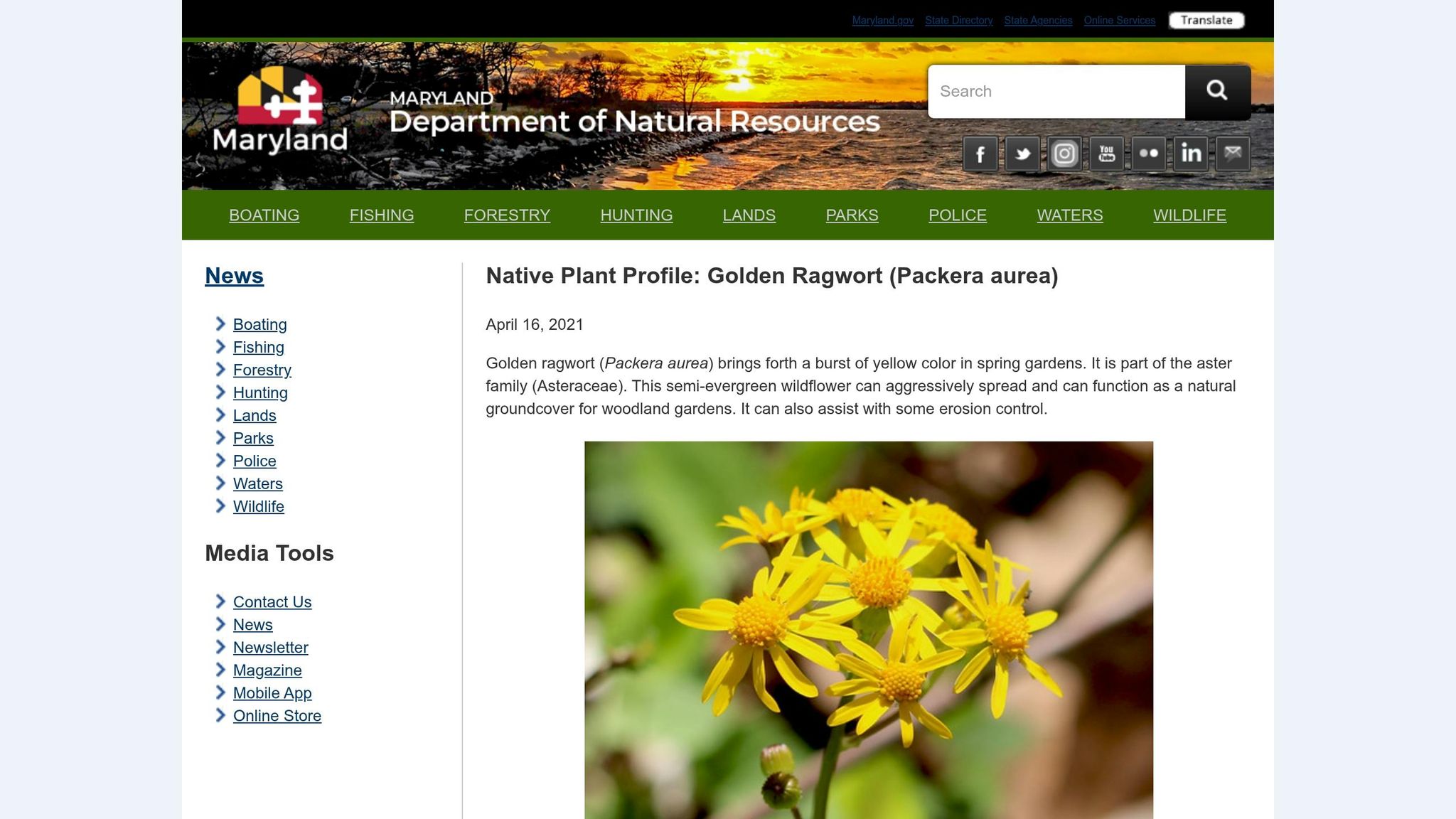
Golden ragwort (Packera aurea) is a great pick for shady, damp areas where spring color can be tough to come by.
Bloom Time
It blooms from late March through May and usually hits its peak in April, which makes it one of Maryland’s earliest native perennials.
Flower Color
The flowers are a bright golden yellow and grow in flat clusters on stems that reach 1 to 2 feet tall.
Light Needs
Golden ragwort does well in full shade to part shade, so it fits nicely in woodland gardens and shaded borders.
Soil Needs
It grows best in moist to wet soil and is especially well suited to poorly drained areas [2]. It can also handle average soil, as long as the ground doesn’t dry out all the way.
Pollinators Supported
Its early flowers give bees a food source as they start to come out after winter.
Best Landscape Use
Plant it in shade gardens, wet low spots, or along woodland edges where drainage is poor. Once it gets settled in, it forms a thick groundcover that helps hold back weeds [1].
7. Spring Beauty
Spring Beauty is another early woodland ephemeral that helps keep the spring bloom going under deciduous trees.
Spring Beauty (Claytonia virginica) is a low-growing spring ephemeral that feeds specialist native bees.
Bloom Time
It blooms from March through May, which helps fill the first pollinator gap of the season.
Flower Color
The flowers are white to pale pink with deep pink veins running through each petal. Those lines work like nectar guides, pointing insects toward the center of the flower.
Light Needs
Spring Beauty does best in part shade to full shade. It grows well beneath deciduous trees before the canopy fills in.
Soil Needs
It grows best in moist, humus-rich, well-drained soil.
Pollinators Supported
This plant is a key pollen source for the Spring Beauty miner bee (Andrena erigeniae), a specialist bee that depends almost entirely on Spring Beauty for pollen. It also offers early-season forage for honeybees, bumblebees, syrphid flies, and early-emerging butterflies.
Best Landscape Use
Use it under deciduous trees, in woodland gardens, or as a spring ground layer. It spreads by seed and corms, so it can slowly fill in over time. By early summer, it goes fully dormant, so it helps to pair it with later-blooming perennials that can take over once Spring Beauty fades. If you’re naturalizing it in a lawn, hold off on mowing until the foliage turns yellow. Its short spring bloom period also makes it a strong match for later-blooming native perennials.
8. Bloodroot
Bloodroot (Sanguinaria canadensis) brings one of the first white flowers to Maryland shade gardens. It has a lot of character for such a small plant: a short bloom period, flowers that offer pollen but no nectar, and seeds that ants help move around. That mix makes it stand out among spring ephemerals.
Bloom Time
Bloodroot blooms from March to April. Each flower often lasts only 1 to 2 days. After pollination, or during windy and rainy weather, the petals can fall fast. So the show is short, but it tends to stick in your memory.
Flower Color
The flowers are pure white, with 8 to 12 petals around a bright yellow cluster of stamens. Beside each bloom, a single deeply lobed gray-green leaf starts to unfurl. That leaf-and-flower pairing gives Bloodroot its own look in early spring.
Light Needs
Bloodroot grows best in part shade to full shade. It fits nicely under deciduous trees, where it can take in early spring sun before the canopy leafs out. That timing is a big part of how the plant does its job each year.
Soil Needs
It prefers moist, well-drained soil rich in organic matter – basically the kind of soil you’d find on a forest floor. Drainage matters most during summer and winter dormancy. If the soil stays too wet, the rhizomes can rot.
Pollinators Supported
Bloodroot provides pollen only – no nectar. Early-season visitors include mining bees (Andrena spp.), sweat bees (Halictidae), and syrphid flies. Its seeds also have a fleshy appendage that draws ants, which carry the seeds back to their nests.
Best Landscape Use
Use Bloodroot in woodland gardens, naturalized shaded edges, or under-tree areas where the soil won’t be disturbed during summer dormancy. By midsummer, the foliage disappears. In spring, though, it helps fill that early woodland layer before slipping out of sight for the season.
9. Woodland Phlox
As early woodland ephemerals start to fade, Woodland Phlox (Phlox divaricata) keeps the spring show going through April and May. This native perennial brings soft color and a light fragrance to shade gardens right when many March bloomers are slowing down.
Bloom Time
Woodland Phlox blooms from April to May.
Flower Color
The flowers are fragrant and five-petaled, with blooms in pastel blue, lavender, or violet. You may also see white-flowered forms.
Light Needs
It grows best in part shade to full shade. That makes it a strong choice beneath deciduous trees, where filtered spring light reaches the ground before the canopy fills in.
Soil Needs
Woodland Phlox prefers naturally moist soil.
Pollinators Supported
Its nectar-rich flowers help feed early bees and butterflies.
Best Landscape Use
Plant Woodland Phlox in woodland gardens, shady borders, and under deciduous trees where spring color is needed. It fits in especially well once the first wave of March flowers starts to fade.
10. Golden Alexanders
Golden Alexanders (Zizia aurea) blooms in Maryland from April through June, so it fills that handy late-spring to early-summer window when many pollinators are out and looking for food. It also marks a shift on this list toward plants that do well in sunnier, more open garden spaces.
Bloom Time
April through June
Flower Color
The flowers are bright yellow and grow in flat yellow umbels.
Light Needs
Full sun to part shade
Soil Needs
Moist, well-drained to average soil
Pollinators Supported
Golden Alexanders is a good early-season source of nectar and pollen for short-tongued bees, including Halictid and Andrenid bees. Syrphid flies and early butterflies visit the flowers too.
Best Landscape Use
Golden Alexanders fits well in pollinator borders, rain gardens, meadow-style plantings, and naturalized areas. It’s also a smart pick for spots where spring color needs to stretch into more open parts of the yard.
11. Foxglove Beardtongue

As spring starts to give way to summer, Foxglove Beardtongue helps keep the nectar supply going in sunny planting beds. Foxglove Beardtongue (Penstemon digitalis) extends the spring bloom season into June with tall spikes of white flowers.
Bloom Time
May through June
Flower Color
The flowers are white and tubular, often marked with delicate purple nectar guides inside the throat.
Light Needs
Full sun to part shade
Soil Needs
Average, well-drained soil. Once established, it handles dry to moist sites.
Pollinators Supported
Its tubular blooms attract bumblebees, honeybees, digger bees, leafcutter bees, hummingbirds, and butterflies.
Best Landscape Use
Plant it at the back of sunny borders, along garden edges, or in meadow-style plantings. Its upright shape works especially well behind shorter plants or lining a sunny edge.
12. Creeping Phlox
After taller spring perennials do their thing, creeping phlox keeps the color down low where it can fill gaps and soften edges. Creeping phlox (Phlox subulata) is a Maryland native groundcover for sunny, well-drained spots, especially slopes, edges, and narrow strips where mowing is a hassle.
Bloom Time
April to May
Flower Color
Pink, purple, or white
Light Needs
Full sun
Soil Needs
Dry to average, well-drained soil
Pollinators Supported
Bees and other early-season pollinators
Best Landscape Use
Plant it on slopes, along drives and walkways, or as a low native groundcover in sunny native borders. Its spreading, close-to-the-ground growth also works well in mixed spring plantings that need color at soil level. Where it works best comes down to sun and drainage, which is a good reminder that the right plant in the right place makes all the difference.
Matching Plants to Your Yard Conditions
Start with the basics: light and soil. That one move will narrow your plant list fast. After that, line those plants up with the conditions in your yard. Maryland yards can change a lot from one spot to the next, so it helps that this list includes picks for shade, part shade, full sun, moist areas, and average soil.
Shade Gardens and Under-Tree Plantings
For spaces beneath deciduous trees, go with Bloodroot, Spring Beauty, Virginia Bluebells, and Wild Geranium. These plants fit that dappled-light, leaf-litter kind of setting well.
Woodland Gardens and Naturalized Edges
If your lawn starts blending into tree cover, Woodland Phlox, Wild Geranium, Bloodroot, and Spring Beauty are a good fit. They work well in looser, less formal plantings. You can also layer these woodland perennials with understory trees like Eastern Redbud or Serviceberry to add more habitat value.
Part-Shade Borders
Wild Columbine, Wild Geranium, and Golden Ragwort do well in mixed light. That makes them a smart pick for foundation beds, side yards, and borders that get morning sun but afternoon shade. Wild Columbine also stands out for attracting hummingbirds [1].
Sunny Beds and Pollinator Borders
For full-sun pollinator beds, use Foxglove Beardtongue, Golden Alexanders, and Creeping Phlox. South-facing areas tend to be hotter and drier, so good drainage matters a lot if you want these plants to settle in well.
Moisture-Prone Spots
Golden Ragwort, Virginia Bluebells, and Golden Alexanders fit places with steady moisture, including rain-garden areas.
Dry to Average Soil
For dry to average, well-drained sites, look at Wild Columbine, Foxglove Beardtongue, Eastern Redbud, and Serviceberry. Once you’ve matched plants to the site, the next move is arranging them for bloom timing and layered coverage.
How to Design a Spring Pollinator Garden in Maryland
Plan for Bloom Succession From March to June
Pick plants that flower at different times from March through June so pollinators can find nectar and pollen all season long. A simple way to do this is to start with early bloomers, then add plants for mid-spring and late spring.
That way, your garden keeps working instead of peaking for a week and going quiet right after.
Mix Trees, Perennials, and Ground-Layer Plants
A good pollinator garden usually has layers. Pair an understory tree with perennials and groundcovers to build habitat that feels more like a living system than a single flower bed.
This mix gives you more food sources, more cover, and a setup that tends to fit Maryland yards better than a flat planting with just one plant type.
Match Plant Layers to Common Home Landscapes
You don’t need a big property to make this work. Small yards can still support pollinators. Start with a 4′ x 4′ area and expand by dividing plants each year [1].
If you’re working with a tighter spot, a narrow native border along a driveway or sidewalk can fit nicely. In a larger backyard, a naturalized edge or no-mow area gives you space for a deeper planting with more layers.
The main thing is to match your layout to the site you already have:
- shade
- part shade
- sun
- soil moisture
Once the layout matches the site, plant selection gets a lot easier.
When to Bring in a Planting and Layout Pro
Some sites are harder than they look. Steep slopes, poor drainage, and large lawn conversions can turn into a lot of trial and error if the layout isn’t planned well from the start.
In those cases, site-specific design can save time and cut down on rework. Pro Landscapes MD can help plan and install native planting layouts for steep slopes, heavy shade, poor soil, or large lawn conversions across central Maryland.
Conclusion
These 12 plants cover Maryland’s spring bloom period from shade to full sun. The backbone of a good Maryland spring pollinator garden is bloom succession, matching plants to the site, and plant variety. Each plant should fit its bloom time, light needs, soil, and job in the landscape.
That mix matters. Gardens with a range of plants tend to bounce back better from pests, disease, and rough weather. And when you combine trees, perennials, and groundcovers, you support more kinds of pollinators over the course of the season.
There’s also a practical point here: Maryland’s 2021 Low-Impact Landscaping Law protects pollinator gardens from HOA turf-only rules. So if you’re planning a garden, start with the conditions you already have, then build out your landscape projects in layers as the seasons change.
FAQs
Which plants bloom first in Maryland spring?
In Maryland, Virginia bluebells are some of the first flowers to show up, usually blooming from late March through April. Spicebush blooms in March and April too, and it helps feed early pollinators like mason bees and mining bees.
By early April, more flowers start to join in, including wild columbine, wild ginger, Golden Alexanders, and serviceberry. These plants offer early-season nectar for pollinators, including emerging bumblebee queens.
What native plants work best under trees?
In Maryland, a few native plants do especially well under trees. Wild ginger works well as a ground cover. Spicebush handles partial shade nicely. And native azaleas fit well along woodland edges. Together, they bring spring blooms, color, and support for pollinators.
When planting under trees, protect the root system with 2 to 3 inches of wood mulch spread out to the dripline. That helps the soil hold moisture and supports better soil health.
How do I choose plants for wet or dry spots?
Watch how water moves through your yard during or after heavy rain. If a low spot stays wet for more than 24 hours, plant moisture-loving natives there, such as swamp milkweed, cardinal flower, blue flag iris, or New York ironweed.
Save dry slopes or raised areas for plants that handle drier soil, like butterfly weed, purple coneflower, or black-eyed Susan. In most cases, the easiest path is to match plants to the conditions you already have.
Chat with Us