









- bhavya gada
- No Comments
If you have a shady spot in a Maryland yard, the fix is simple: match the shrub to the light, soil moisture, and deer pressure. In this list, I’d narrow the best picks this way: mapleleaf viburnum for dry shade, inkberry holly and Virginia sweetspire for wet shade, summersweet and smooth hydrangea for moist beds, and witchhazel, mountain laurel, or blackhaw viburnum for larger background planting. These larger shrubs work well alongside Baltimore hardscaping projects to create privacy and structure.
Here’s the short version:
- Shade matters: part shade is 3–6 hours of direct sun; full shade is under 3–4 hours
- Wet clay spots: try inkberry holly, Virginia sweetspire, spicebush, or summersweet
- Dry shade under trees: go with mapleleaf viburnum
- Foundation beds: look at compact inkberry, sweetspire, summersweet, or smooth hydrangea
- Taller screening: use blackhaw viburnum, witchhazel, or mountain laurel
- Heavy deer pressure: shrubs deer often leave alone include inkberry, mountain laurel, mapleleaf viburnum, and summersweet
The big point: I wouldn’t pick by flowers first. I’d pick by drainage, mature size, and browsing risk, because those three things decide whether the shrub settles in or struggles.
Best Bets: Native Plants for Shade
sbb-itb-843f8be
Quick Comparison
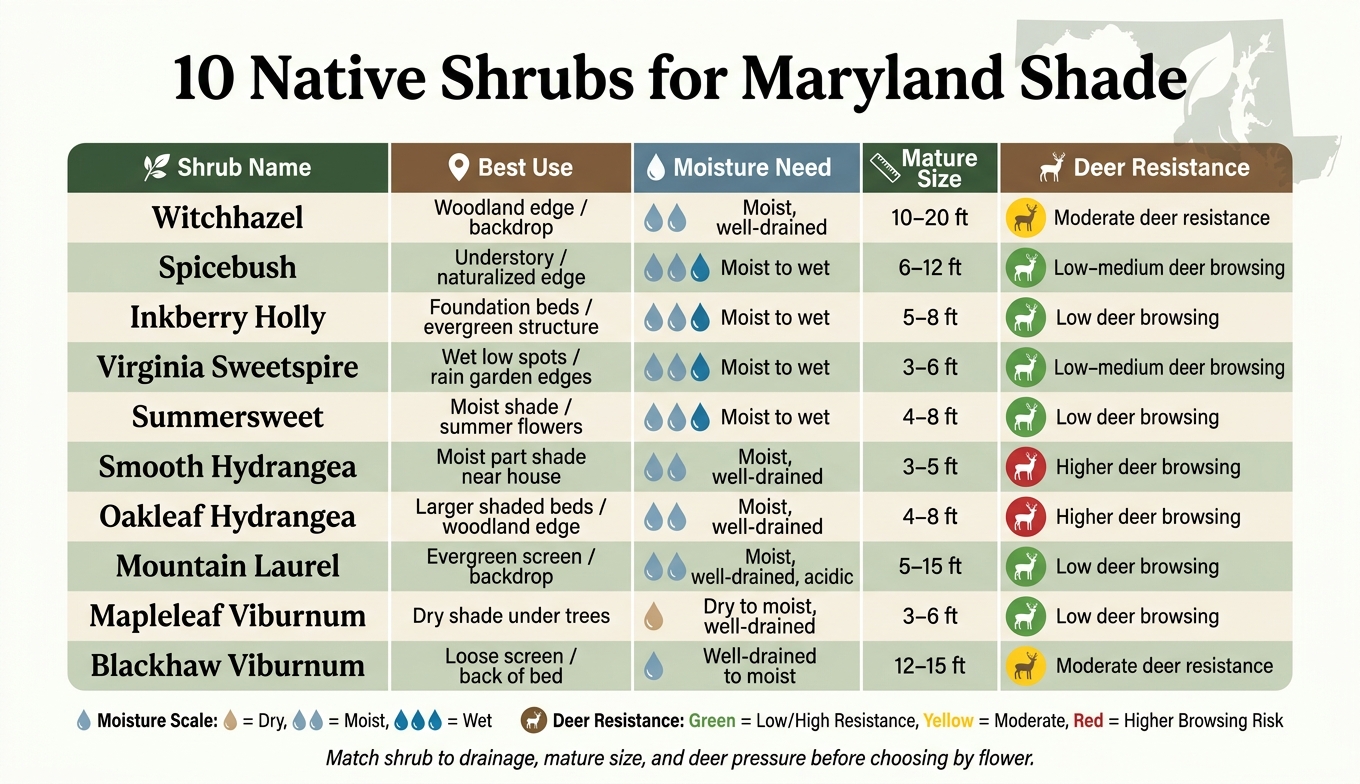
10 Native Shrubs for Maryland Shade: Quick Comparison Guide
| Shrub | Best use | Moisture | Size range | Deer pressure |
|---|---|---|---|---|
| Witchhazel | Woodland edge, backdrop | Moist, well-drained | 10–20 ft | Moderate |
| Spicebush | Understory, naturalized edge | Moist to wet | 6–12 ft | Medium to low browsing |
| Inkberry Holly | Evergreen structure, foundation beds | Moist to wet | 5–8 ft | Low browsing |
| Virginia Sweetspire | Wet low spots, rain garden edges | Moist to wet | 3–6 ft | Medium to low browsing |
| Summersweet | Moist shade with summer flowers | Moist to wet | 4–8 ft | Low browsing |
| Smooth Hydrangea | Moist part shade near house | Moist, well-drained | 3–5 ft | Higher browsing |
| Oakleaf Hydrangea | Larger shaded beds, woodland edge | Moist, well-drained | 4–8 ft | Higher browsing |
| Mountain Laurel | Evergreen screen or backdrop | Moist, well-drained, acidic | 5–15 ft | Low browsing |
| Mapleleaf Viburnum | Dry shade under trees | Dry to moist, well-drained | 3–6 ft | Low browsing |
| Blackhaw Viburnum | Loose screen, back of bed | Well-drained to moist | 12–15 ft | Moderate |
One fast rule I’d use before planting: keep shrubs about half their mature spread away from the house, and test drainage if you have heavy clay. If water sits too long after rain, stick with shrubs that can take wetter soil instead of forcing a dry-site plant into that bed.
What to Know Before Planting Shade Shrubs in Maryland
Before you plant shade shrubs, line up the plant with the site. Light, soil, and drainage will tell you which shrubs make sense near foundations, under trees, or along garden edges.
In much of central Maryland, clay-heavy suburban soils are common, especially in newer developments with compacted subsoil and a thin layer of topsoil.[7][6] That matters because clay tends to drain slowly. After storms, it can stay soggy. In summer dry spells, it can bake hard.[9]
A simple drainage test can save you a lot of hassle later: fill a 12-inch hole twice and see how long it takes to drain. You want that water gone in about 8 hours.[9] If it drains more slowly, pick shrubs that can handle wet soil or mound the bed a bit above grade. Also, skip fine sand. In clay, it can make drainage worse, not better.[9] Compost is the better move – work it into the top 6–8 inches of soil instead.[8]
That’s the basic trade-off:
- Wet-tolerant shrubs fit compacted clay
- Drought-tolerant shrubs fit dry shade under trees
Woodland edges are a different kind of site. Under oaks, maples, and pines, the soil is often acidic and rich in organic matter from years of leaf litter.[1][2] The toughest spot of all is dry shade under mature trees. Roots pull away moisture, and the canopy can block rainfall before it even hits the ground.[1][2]
In those areas, it usually makes more sense to plant at the dripline or along the woodland edge instead of deep under the canopy. Add 2–3 inches of shredded bark or leaf mulch to help hold moisture and buffer the soil.[1][2]
Low spots and swales that stay wet after storms call for shrubs that don’t mind extra moisture. Inkberry holly and Virginia sweetspire can handle wet soil, but they also make it through dry spells.[11][12]
Use these site conditions to narrow the shrub list below.
1. Witchhazel
For deep shade with a little extra payoff in fall, witchhazel is one of Maryland’s best native picks. Hamamelis virginiana is a deciduous shrub or small tree that blooms in late fall and grows well in part shade to full shade. It does best in light or filtered shade rather than heavy, dense shade.
Bloom Season
Witchhazel flowers in late fall into early winter, usually from October through November, and blooms can sometimes last into December.[14][15][17][19][22][23] The yellow, strap-like flowers are fragrant. In freezing weather, the petals curl up, then reopen when temperatures warm back up. In cool conditions, the blooms can stick around for weeks.
Mature Size
Expect witchhazel to reach 10–20 feet tall and wide, so it needs some breathing room. If you need help with installation, consider professional landscaping services. It fits well in a broad bed, a corner planting, or along a woodland edge.
Soil and Moisture Fit
It grows best in moist, well-drained, slightly acidic soil. It can handle short dry spells and brief wet periods, but it doesn’t do well in standing water.[13][16][18][20][23][24][26] Before planting, mix in compost or leaf mold to help with drainage and root growth.
Deer Pressure and Best Placement
Witchhazel is moderately to highly deer-resistant.[25] In places with heavy deer traffic, young plants still need protection. For placement, woodland edges and north- or east-facing beds with morning sun tend to work well. If you want better flowering, skip deep shade.[14][17][21][22]
2. Spicebush
For moist shade and woodland edges, spicebush is one of the best native picks. Spicebush (Lindera benzoin) is a native understory shrub that grows well in part shade to full shade and fits moist woodland-edge sites.[39][38]
Bloom Season
Spicebush blooms in late March into April, often before the leaves appear. The flowers are small, but they show up early, which makes them useful for pollinators looking for nectar at the start of the season.[38][40][35]
Mature Size
At maturity, spicebush usually reaches 6–12 feet tall and wide with a rounded, multi-stemmed shape. Plan for a good amount of room. Give each plant 6–8 feet of space from structures and nearby plants so it doesn’t feel cramped later on.[35][31][41][37]
Soil and Moisture Fit
This shrub does best in moist, well-drained soil. It also handles clay and periodic flooding, which makes it a strong fit for spots that stay damp longer than the rest of the yard. Think rain gardens, low-lying areas, or places near downspouts.[28][29][32][35][34][41]
In deep shade, spicebush can grow a bit looser and may flower less than it does in part shade with steady moisture.[35][34][41]
Deer Pressure and Best Placement
Spicebush is generally deer tolerant, although young plants may get browsed where deer pressure is heavy. A simple wire cage or deer netting during the first 1–2 seasons can help plants get established.[27][36][42]
Placement matters here. Spicebush works especially well along woodland edges, naturalized borders, and the back of shaded beds. It’s usually too large for a narrow foundation strip. But in wider side or back foundation beds, its loose, informal shape can look deliberate instead of messy.[33][30][31][32]
If you want an evergreen shrub for a similar shade setting, the next option is inkberry holly.
3. Inkberry Holly
If you want steady, year-round structure in foundation beds, woodland edges, or damp shady spots, inkberry holly (Ilex glabra) is a solid Maryland native.
Bloom Season
Inkberry holly blooms from late spring into early summer, usually May through June.[10][43][44] The flowers are small and greenish-white, so they won’t steal the show. But they do attract pollinators, which makes this shrub a good pick when wildlife support matters more than flower display. Female plants can also produce black berries that stay on into winter.[43][48][50][51]
Mature Size
Straight-species inkberry holly usually grows about 5 to 8 feet tall and wide, and it may spread over time by suckers.[10][45][49][58] If you need a neater fit near the house or along a path, compact cultivars like ‘Shamrock’ are often a better match.[44][54] Space compact forms 3 to 4 feet apart, and give full-size plants 5 to 8 feet of room.[10][45][49]
Soil and Moisture Fit
Inkberry holly prefers moist, well-drained, acidic soil, with a pH around 4.5 to 6.5.[10][43][44][50][51][52] It does well in wet shade and can also handle clay soil and periodic flooding.[10][43][53][54][55] Once established, it can get through dry spells, but it looks and grows best when soil moisture stays fairly even.[10][46][53] One thing to watch: neutral or alkaline soil can cause the foliage to turn yellow.[10][57][52]
Deer Pressure and Best Placement
In deer-prone Maryland yards, inkberry holly is a smart shrub to look at. Rutgers lists it as deer resistant, and deer rarely cause major damage.[56] Compact cultivars fit nicely in foundation beds and along patio edges, especially if you want a native stand-in for boxwood.[44][47][54] Full-size plants also work well at woodland edges and in understory plantings, where the evergreen foliage keeps the planting from looking bare in winter.[10][43][48][53][55]
If you need a deciduous shrub for the same wet-shade conditions, the next option brings more flower color.
4. Virginia Sweetspire
For shady areas that also hold moisture, Virginia sweetspire (Itea virginica) is a strong pick. It brings white flowers, rich fall color, and handles moist shade and clay soil with less fuss than many shrubs.
Bloom Season
Expect fragrant white flowers from late spring into early summer, usually in May and June.[73][74][75] The blooms hang in drooping racemes about 3 to 6 inches long, so they show up well even in partial shade.[60][61][62][71] Pollinators are drawn to them, and the fragrance is easy to notice when you’re nearby.
Mature Size
Most plants reach 3 to 6 feet tall and wide, though larger specimens can grow 8 to 10 feet.[60][61][62][64][65][70] Virginia sweetspire also spreads slowly by suckers, which means it can take up more space over time.
If you’re working with a smaller bed, compact cultivars make life easier:
- ‘Henry’s Garnet’ stays around 3 to 4 feet tall.[63][69][76]
- ‘Scentlandia’ stays about 2 to 3 feet tall and wide.[63][69][76]
Soil and Moisture Fit
Virginia sweetspire handles a broad mix of soil types. It grows in clay, loam, and sand, and it tolerates heavy clay, flooding, and poorly drained low areas.[59][60][62][63][64][67][72] It does best in moist, slightly acidic soil, around pH 5.0 to 6.5.[61][71]
If your soil leans alkaline, the foliage can turn yellow, so it’s smart to test the soil before planting. Once established, the plant can get through short dry stretches, but it grows best when the soil stays evenly moist. Regular watering during the first season helps it settle in well.[61][62][66][68]
Deer Pressure and Best Placement
Virginia sweetspire is generally deer resistant, and NC State lists it as moderately resistant to deer damage.[59][73] That said, if deer pressure is heavy in your area, young plants may still need short-term protection until they get settled.
Compact cultivars fit nicely in foundation beds on the north or east side of the house, where they can get partial sun without crowding windows.[63][65][69] It also looks great where the arching flower clusters can lean over a path or low wall. Along woodland edges, the species can form natural-looking colonies that help hold soil in place and support wildlife.[60][61][64][67] In shady spots that stay wet, it also works well in rain gardens and low areas.[60][62][67][72]
5. Summersweet
If you need a native shrub for moist shade that still puts on a show in late summer, summersweet (Clethra alnifolia) is a steady pick.
Bloom Season
Summersweet blooms from mid-July through August, and the flowers usually last about 4 to 6 weeks.[86][89] It produces fragrant white flower spikes in upright panicles that measure about 2 to 6 inches long.[86] Bumblebees are especially attracted to the blooms, which makes this shrub a dependable mid-summer pollinator plant.[82]
Mature Size
The straight species usually reaches 4 to 8 feet tall and 4 to 6 feet wide. In rich soil that stays evenly moist, it can grow to 10 to 12 feet over time.[86][87][81] It forms upright, multi-stemmed clumps and spreads slowly by rhizomes. If space is tight, compact cultivars often stay around 2 to 4 feet tall while keeping the same fragrant midsummer bloom.[77][79]
Soil and Moisture Fit
Summersweet does well in wet, acidic soil with a pH of about 4.5 to 6.5.[77][85] It can handle clay, periodic flooding, and low areas with poor drainage. In Maryland clay, mixing composted organic matter into the backfill can help the soil open up a bit without making the root zone dry out too fast.[80][83]
Deer Pressure and Best Placement
University of Maryland Extension and Maryland DNR list summersweet as deer-resistant, and deer rarely browse it.[84][85]
It fits especially well in places like:
- Rain gardens and low spots near downspout outlets
- Woodland edges and understory plantings
- North- or east-facing foundation beds where its 4- to 8-foot height can soften a wall without crowding windows[77][78][80]
If you want a bigger summer-blooming shrub for a similar shady setting, the next option is smooth hydrangea.
6. Smooth Hydrangea
If you want a larger native shrub that keeps the show going into midsummer, smooth hydrangea is a smart pick for moist shade. Smooth hydrangea (Hydrangea arborescens) is a native woodland shrub for moist shade, with creamy white flowers that light up Maryland borders from early summer into midsummer. The blooms start greenish-white, then fade to a soft creamy white.[94][95][96]
Bloom Season
Blooms run from early summer into midsummer. For the best flower display, give it morning sun and afternoon shade.[93][98][101]
Mature Size
The species usually grows 3 to 5 feet tall and 3 to 5 feet wide, forming a rounded, multi-stemmed clump.[93][98][99] It stays compact enough for foundation beds and mixed borders, but it still needs space. Plant it where it can spread a bit without pushing into low windows or narrowing walkways.
Soil and Moisture Fit
Smooth hydrangea does best in moist, well-drained, humus-rich soil with a pH of about 6.0 to 7.5.[92][93][97] It likes steady moisture, with about 1 inch of water per week during active growth.[97] A 2- to 3-inch layer of organic mulch over the root zone helps the soil hold moisture and keeps roots cool through Maryland summers.[93][97][100]
Deer Pressure and Best Placement
Deer pressure is moderate to high, so young plants need protection. Smooth hydrangea blooms on new wood, which means it can bounce back and still flower after browsing if new growth has enough time to develop.[90][91] In areas with heavy deer traffic, fencing or repellents help a lot, especially during the first few years.
This shrub works well in woodland borders, part-shade foundation beds, and moist garden edges. Deep, dry shade under big trees is a poor match, since flowering drops when the plant has to compete for water and light. In plain terms, it fits shaded spots with steady moisture much better than dry, root-packed areas under mature trees.[98][101][102][103]
7. Oakleaf Hydrangea
If you want a larger hydrangea with better fall color and more winter interest, oakleaf hydrangea is the stronger pick. Oakleaf hydrangea (Hydrangea quercifolia) adds bold shape to shaded Maryland yards, with summer blooms, rich fall color, and peeling bark that gives the plant texture in winter. The big appeal isn’t just the flowers. It’s the long stretch of interest through the seasons.[113][114][118]
Bloom Season
Expect large white, cone-shaped flower clusters from late May or June into July, with the main bloom period landing in June and early July.[115][116][111][119] The flowers start white, then shift to pinkish tones and later fade to tan, so the show lasts well past the first bloom. Oakleaf hydrangea blooms on old wood, so if you need to prune for shape, do it right after flowering.[115][117]
Mature Size
In average garden conditions, oakleaf hydrangea grows about 4 to 6 feet tall and wide. Larger cultivars can reach 6 to 8 feet or more.[104][105][106][107][109][110][111] Dwarf types usually stay around 3 to 4 feet, which makes them a better match for smaller foundation beds or spaces under low windows. Give this shrub room to reach its full spread, especially near walls, walkways, or nearby shrubs. It does best when that extra space is paired with soil that stays moist but drains well.
Soil and Moisture Fit
It grows best in moist, well-drained, humus-rich soil that is slightly acidic to neutral.[104][105][106][107][109][110][111] Once established, it handles dry spells better than most hydrangeas, but a 2- to 3-inch layer of mulch over the root zone helps keep moisture steady.[104][105][106][109][110][111] Skip spots that stay soggy or drain poorly.[120][121]
Deer Pressure and Best Placement
Oakleaf hydrangea is not a sure bet in areas with deer pressure. In places with heavy browsing, young plants often need repellents or short-term fencing.[104][106][109] It fits best along woodland edges, in understory beds, and in east- or north-facing foundation beds that get morning sun and afternoon shade.[104][105][106][108][109][112] Because it grows on a bigger scale and holds its shape through all four seasons, it works better as a screen than smooth hydrangea. It’s a good match for broader beds where it has space to spread.
8. Mountain Laurel
For year-round structure in shade, mountain laurel is a standout native pick. Mountain laurel (Kalmia latifolia) is a broadleaf evergreen that helps shady Maryland beds keep their shape through every season.[128][133]
Bloom Season
It flowers from late May through June.[131][134][136][137] Blooms range from white to pink and are often marked with rose or purple. That spring show gives mountain laurel a strong focal point in a shade bed.
Mature Size
Species plants usually grow 5 to 15 feet tall and wide. If you need something smaller, compact cultivars such as ‘Snowdrift’ reach about 5 to 6 feet. Dwarf ‘Elf’ stays around 2 to 3 feet tall and 2 to 4 feet wide.[122][124][125][127][129][130] The main thing is to match the cultivar to the space and prune only lightly.
Soil and Moisture Fit
This is the shrub on the list that asks for the most care when it comes to siting. Mountain laurel needs acidic, humus-rich, cool, moist, and well-drained soil, with a pH of about 5.0 to 6.0.[123][124][126][127][128] If the soil stays wet or leans heavy with clay, root rot can become a problem.[132][135][138]
In Maryland clay, it helps to plant it a bit high rather than level with the ground. Mix in leaf mold or composted bark, then keep 2 to 3 inches of shredded mulch over the root zone. Also skip lime near these beds and go easy on fertilizer.
Deer Pressure and Best Placement
Mountain laurel is one of the more deer-resistant shrubs on this list. Its toxic foliage tends to keep deer away, and Maryland DNR lists it as deer resistant.[88][28]
Use full-size plants as background shrubs or loose screens. Smaller cultivars fit well in north- or east-facing foundation beds and along garden edges.[122][124][125][127][129]
9. Mapleleaf Viburnum
For the driest shaded spots, mapleleaf viburnum is one of the best native shrubs you can plant. Mapleleaf viburnum (Viburnum acerifolium) handles root competition under mature trees better than most natives, which is a big deal in those tough, dry areas where other plants tend to struggle.[139][141][144][147]
Bloom Season
Its flat-topped, creamy white flower clusters open from late April through May. After that, the plant sets blue-black fruits that birds eat.[141][151]
Mature Size
A mature plant usually reaches 3 to 6 feet tall with about the same spread.[141][149][150] It also spreads slowly by suckers, so over time it can form a loose thicket. If you want a more natural mass planting, give each shrub about 4 to 6 feet of space. If you’d rather keep it tighter, thin a few stems lightly after flowering.[141][147]
Soil and Moisture Fit
This shrub grows best in moist, acidic, well-drained soil, but it’s not fussy once established. It can also handle dry, rocky, or poor soils.[139][141][143][144][146] What it doesn’t like is wet ground, so skip waterlogged sites.[141][142] A light layer of shredded leaf mulch can help hold moisture and add organic matter over time.
Deer Pressure and Best Placement
Deer usually leave it alone, and several native plant groups list mapleleaf viburnum as deer resistant.[143][145][152] That makes it a smart choice for woodland edges, even where deer pressure is high.
It fits especially well in places like:
- woodland understory
- north- or east-facing foundation beds
- informal edges where lawn meets woods[139][141][143][148]
One more reason gardeners like it: the fall color can turn pink, red, burgundy, and purple. In a shady area, that kind of color feels like a nice surprise in autumn.[139][140][149]
If you need a taller, denser screen for similar shaded sites, blackhaw viburnum is the next shrub to know.
10. Blackhaw Viburnum
If you need a larger viburnum that can do more screening, blackhaw is a strong pick for the back of a shady bed. Blackhaw viburnum (Viburnum prunifolium) is a large native shrub often found in thickets and along woodland edges. At maturity, it reaches about 12 to 15 feet tall and 6 to 12 feet wide, which gives it enough size to work as a loose privacy screen or a backdrop planting.[156][164][166][169][160]
Bloom Season
Blackhaw blooms from April to May, sometimes into June, with flat-topped clusters of creamy white flowers.[156][165][172] The flowers form on the previous season’s wood, so heavy pruning in late winter can cut down your bloom show.[153][157] After flowering, the shrub produces blue-black fruit that may hang on into fall and winter.[164][165][173]
Mature Size
This shrub has a slow to medium growth rate and an upright, multi-stemmed habit.[154][156][162] You can let it stay dense for screening, or prune it into a small tree with a few main trunks.[153][159] Give each plant at least 6 to 10 feet of horizontal space so it has room to fill out.[155][159][162]
Soil and Moisture Fit
Blackhaw handles clay, loam, and dry soils across a broad pH range, but the ground needs to drain well.[156][163][170] Water it on a regular basis during the first 2 to 3 years. After that, it has better drought tolerance.[163][167][171] A 2- to 3-inch layer of mulch helps the soil hold moisture while the roots get settled in.[159]
Deer Pressure and Best Placement
Deer pressure is moderate. Deer may nibble new growth, but older plants usually do fine once established.[154][155][156][158][161] If deer are a problem in your area, protect young shrubs with wire cages or mesh for the first few seasons.[155][156]
Blackhaw does best in light to partial shade. Good spots include an east- or north-facing foundation bed or the edge of a woodland planting.[153][155][160][168] It will still grow in shadier places, but you’ll usually get fewer flowers if it doesn’t get enough sun.[153][155][160][168]
Maryland Shade Shrubs at a Glance
Use this table for a fast side-by-side look at light needs, soil moisture, mature size, deer pressure, and where each shrub fits best.
| Shrub | Shade Tolerance | Moisture | Mature Size (H × W) | Deer Resistance | Best Placement |
|---|---|---|---|---|---|
| Witchhazel (Hamamelis virginiana) | Part shade to shade | Well-drained to moist | 10–20 ft × 10–15 ft | Moderate | Woodland edge, background |
| Spicebush (Lindera benzoin) | Part shade to shade | Moist to wet | 6–12 ft × 6–10 ft | High | Understory, woodland edge |
| Inkberry Holly (Ilex glabra) | Part shade to shade | Moist to wet | 5–8 ft × 4–6 ft | High | Foundation, rain garden edge |
| Virginia Sweetspire (Itea virginica) | Part shade to shade | Moist to wet | 3–5 ft × 4–6 ft | Moderate | Rain garden, border edge |
| Summersweet (Clethra alnifolia) | Part shade to shade | Moist to wet | 3–8 ft × 3–5 ft | High | Foundation, moist border |
| Smooth Hydrangea (Hydrangea arborescens) | Part shade to shade | Well-drained to moist | 3–6 ft × 3–6 ft | Moderate | Shaded foundation, border |
| Oakleaf Hydrangea (Hydrangea quercifolia) | Part shade to shade | Well-drained to moist | 6–8 ft × 4–8 ft | Low | Corner foundation, woodland edge |
| Mountain Laurel (Kalmia latifolia) | Part shade to shade | Well-drained to moist | 5–15 ft × 3–6 ft | High | Foundation structure, understory |
| Mapleleaf Viburnum (Viburnum acerifolium) | Part shade to shade | Well-drained to dry | 3–6 ft × 3–5 ft | High | Dry shade, understory drift |
| Blackhaw Viburnum (Viburnum prunifolium) | Part shade to sun | Well-drained to moist | 12–15 ft × 6–12 ft | Moderate | Screening, woodland edge |
The pairings below make the next step easier. You can match each shrub to foundation beds, woodland settings, dry shade, wet shade, or screening, depending on the spot you’re working with.
Matching Each Shrub to Foundations, Woods, and Garden Edges
Start with mature spread. A simple rule helps: plant shrubs at least half their mature spread away from the foundation, and leave one full mature spread between plants. That makes it much easier to match each shrub to the space you have, the soil moisture, and the amount of canopy cover overhead.
Best Shrubs for Foundation Beds
For beds near the house, stay with shrubs that mature at about 3–6 feet tall and wide. That size usually fits best along walls, below windows, and in narrow side-yard beds.
Summersweet cultivars like ‘Sixteen Candles’ reach about 3–4 feet tall and 2–3 feet wide, so they fit well under windows or in snug spaces between basement egress wells. Compact inkberry holly forms such as ‘Shamrock’ and ‘Densa’ keep a dense evergreen form at about 4 feet by 4 feet. Smooth hydrangea is a good pick for the shadier sides of foundations, especially where runoff keeps the soil a bit damp.
Space these shrubs 4–5 feet apart and keep them at least 2–3 feet from the foundation wall. One thing trips people up here: brick and concrete can dry the soil faster than nearby beds, so check moisture near those surfaces during dry spells.[175][176][177]
Best Shrubs for Woodland Edges and Understory Planting
Spicebush fits this setting naturally. It is common in Maryland woodland understories, especially in damp woods, so it tends to look right at home beneath canopy trees along a property line.
Oakleaf hydrangea is another strong option for woodland edges. It does well where filtered light and organic soil give it the conditions it likes. Witchhazel also works in this zone, especially as a background shrub or taller screen. Just give it room, since it can grow into a large shrub or even a small tree.[28][30][179][180][14][183][177]
Best Shrubs for Dry Shade Under Trees
Dry shade under mature trees is tough ground. Tree roots compete hard for water, and rainfall often never reaches the soil in full. In these spots, focus on shrubs that can handle both root competition and limited moisture.
Mapleleaf viburnum is the main pick here. It handles dry, rocky, and poor soils better than most native shrubs in this group, and it is well suited to the root competition under mature oaks and maples. Blackhaw viburnum can also work, though it is better for slightly brighter shade with better drainage, such as the edge of a woodland planting. Even shrubs that handle drought still need regular watering while they get established.[4][5]
Best Shrubs for Moist or Wet Shade
Low spots and clay-heavy beds call for shrubs that can stay healthy when drainage slows down. Virginia sweetspire stands out here. It naturally grows in wet places and along streams, tolerates clay and poor drainage, and is one of the steadiest choices for rain garden edges and low areas where other shrubs often struggle.[178][63][62][174]
Summersweet, inkberry holly, and smooth hydrangea also fit this group, though smooth hydrangea is better for soil that stays consistently moist rather than places with standing water.[175][176] If a site stays soggy for long stretches after storms, sweetspire or inkberry is the safer bet than smooth hydrangea.
Regional rain garden plant lists place summersweet and Virginia sweetspire on the perimeter or edge of rain gardens, not in the saturated center.[181][182]
Best Shrubs for Taller Screening and Background Planting
If you need height, blackhaw viburnum, witchhazel, and mountain laurel are the top choices for screening and background planting in shaded yards. Blackhaw viburnum can reach about 8–15 feet, witchhazel can grow up to 20 feet, and mountain laurel can reach 15 feet in ideal conditions.[14][5][176]
In screening areas where shrubs have room to fill in, space these larger plants 6–8 feet apart to build a continuous backdrop. Then place smaller shrubs like spicebush or mapleleaf viburnum in front in a staggered pattern.[3][5][177]
If deer pressure is heavy, keep hydrangeas and summersweet closer to the house and protect them with cages or netting during the first few seasons.
Conclusion
Once you compare bloom time, mature size, soil moisture, and deer pressure, the choice usually gets a lot simpler. The best Maryland shade shrub is the one that matches your light, soil, space, and deer pressure first. After that, you can pick based on blooms, foliage, or wildlife value.
Put moisture-loving shrubs in damp areas, and save larger shrubs for open beds where they have room to grow. These shrubs do more than fill space, too. Spicebush supports pollinators and caterpillars, viburnums feed birds, inkberry gives winter cover, and witchhazel flowers late in the season.
If site conditions are hard to read or just plain tricky, a professional review of your landscape projects can help you avoid expensive plant loss. For spots with drainage issues, heavy deer pressure, or dense shade, Pro Landscapes MD (prolandscapesmd.com) can assess the planting area before installation.
Pick the right native shrub for the site, and shade can become one of the easiest parts of a Maryland landscape to care for.
FAQs
How do I tell if my shade is dry or wet?
Check soil moisture and pay attention to how the area handles water. After it rains, look for signs that water is pooling or draining off fast. North-facing slopes and areas with poor drainage often stay wetter for longer.
It also helps to feel the soil itself. Is it loose, sticky, sandy, or packed down? That texture can tell you a lot about what will grow well there. If you’re not sure what your site is telling you, Pro Landscapes MD can offer guidance based on your landscape’s conditions.
Which native shrub is best for heavy deer pressure?
For heavy deer pressure in shady Maryland yards, native ferns are your best bet. Deer and rabbits usually leave them alone, which means less damage and less upkeep for you.
They also bring a lush, low-maintenance layer to shady spots, adding texture and depth without much fuss.
What native shrubs work best near a foundation?
Near a foundation, soil is often drier than people expect. Roof overhangs can block rainfall, and the house can throw off extra heat. That mix changes what will grow well.
Spicebush and native azaleas are good picks for the partial shade that’s common around homes.
Before you plant, check the site closely. Moisture can vary a lot near a downspout compared with spots tucked under the eaves. A quick look at those wet and dry zones helps shrubs get settled in and grow well.
Chat with Us