









- bhavya gada
- No Comments
If I had to pick one outdoor gym surface for most backyards, I’d choose rubber. It gives the best mix of impact protection, grip, weather resistance, and low upkeep. Turf works best for sleds and agility. Concrete works best as the base under heavy equipment, not as the main workout surface.
If you’re planning for central Maryland, I’d focus on drainage, slip resistance, and freeze-thaw wear first. That matters because this area gets high humidity, heavy rain, winter snow, and temperature swings that can wear out the wrong surface fast.
Here’s the short version:
- Rubber mats/tiles: best all-around pick for lifting, HIIT, and joint comfort
- Synthetic turf: best for sled pushes, footwork drills, and bodyweight training
- Concrete slabs: best for support under racks and machines, but hard and slick by itself
- Best setup for most homes: use rubber + turf over a well-built base
- Typical lifespan: rubber 10–20 years, turf 8–12 years, concrete 20–30 years
- Direct sun matters: turf can reach 140–158°F, and dark rubber can get much hotter than lighter colors
- Base prep matters just as much as the top layer: use 2–4 inches of compacted gravel, a slight slope, and solid drainage
Best Outdoor Gym Flooring? What You Really Need!
Quick Comparison
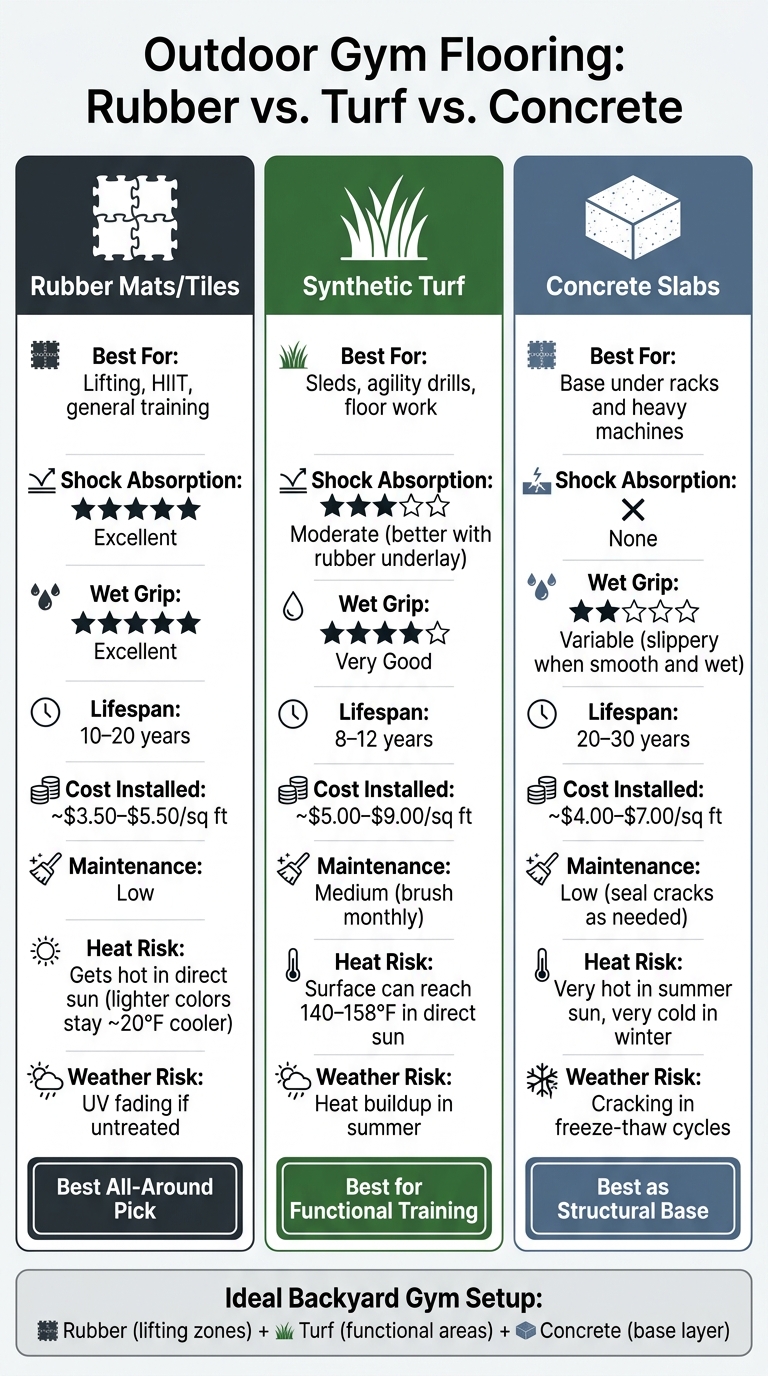
Outdoor Gym Flooring Comparison: Rubber vs. Turf vs. Concrete
| Option | Best For | Cushioning | Wet Grip | Lifespan | Main Downside |
|---|---|---|---|---|---|
| Rubber mats/tiles | Lifting, HIIT, general training | High | High | 10–20 years | Can get hot in sun |
| Synthetic turf | Sleds, agility, floor work | Medium | Good | 8–12 years | Gets very hot in summer |
| Concrete slabs | Base under racks and machines | None | Low to medium | 20–30 years | Hard on joints and slick when wet |
So if you want the short answer: train on rubber, use turf where movement drills make sense, and treat concrete as the support layer underneath.
1. Outdoor Rubber Mats and Tiles
Rubber mats and tiles hit the best middle ground for most outdoor gyms. You get solid impact protection without giving up long-term wear.
Durability
Rubber handles Maryland’s freeze-thaw swings, hot summers, and heavy rain pretty well. Good rubber bends as temperatures shift, which helps prevent cracking and warping. Premium EPDM blends can handle temperatures from -40°F to 176°F [6]. EPDM also stands up to UV exposure better than SBR, so it keeps its color and form longer in direct sunlight [7]. High-quality outdoor rubber tiles usually last 10 to 20 years [7].
That kind of lifespan matters most in areas where stable footing and impact protection come first.
Safety and Comfort
Rubber absorbs impact far better than bare concrete, which gives you no shock absorption at all. For light cardio, 20 mm tiles are usually enough. For lifting zones or places where weights may drop, go with 45 mm to 65 mm [4].
One catch: dark rubber can heat up fast in direct sun. If that matters for your setup, lighter-colored tiles can stay up to 20°F cooler than black rubber [6].
Maintenance
Maintenance is simple, which is a big part of the appeal. A weekly sweep and the occasional rinse with a garden hose will take care of most dust and dirt. Once a year, a pressure wash helps remove ground-in grime and mildew [7]. It also makes sense to check seams once a month so lifted edges don’t turn into trip hazards [1].
Installation
Interlocking tiles are usually the easiest route for DIY installs, with costs around $3 to $10 per square foot. You can place them over concrete, asphalt, or 2 to 4 inches of compacted crushed stone or gravel. Leave expansion gaps near walls and other fixed structures, and let new tiles sit outside for 24 to 48 hours before installation so they can adjust to the temperature [1][6][7].
Rubber is the safest all-around pick, but turf brings a different feel underfoot, along with its own traction and upkeep tradeoffs.
2. Synthetic Turf
Synthetic turf is a strong fit for functional training. It works especially well for sled pushes, sled pulls, agility drills, and bodyweight work, and the perforated backing helps it drain fast after rain [1][5][6]. Compared with rubber, turf gives up a bit of cushioning but makes up for it with better grip for sled work and quick footwork.
Durability
Sports-grade turf usually lasts 8 to 12 years with regular use [4]. If the space will see heavy training, aim for a minimum fiber rating of 12,000 dtex so the surface can handle repeated sled work without wearing down too fast [4]. It also stands up well to UV exposure, moisture, and temperature swings. That matters most in a training area where the surface needs to stay steady session after session.
Safety and Comfort
Turf softens impact better than concrete and gives solid traction for fast, dynamic movement. It also stays slip-resistant when wet [1][5]. For higher-impact training, add a 10–20 mm rubber underlayment beneath the turf for better shock absorption [1][4][6].
Heat is the main catch. In direct sun, turf can hit 140–158°F, which is no joke in Maryland summers [4]. Shade makes a big difference here. A shade canopy or pergola can help cut down that heat buildup in sunny Maryland conditions [1][2].
A 1 to 1.5-inch pile height is a smart target because it helps keep equipment stable and lowers trip risk [6].
Maintenance
Upkeep is pretty simple, but it does matter:
- Weekly sweeping and hosing clear away most debris, while monthly brushing helps keep the fibers from matting [1][4][6].
- A neutral-pH cleaner can help remove sweat residue, and an annual high-pressure cleaning plus inspection of seams and adhesive points helps keep the surface secure [1][4].
- Keep drainage areas clear to avoid water buildup, which can lead to mold and slick spots, and use silica sand infill with secured edges during installation to limit shifting and curling [1].
sbb-itb-843f8be
3. Concrete Slabs and Patios
Concrete is the most permanent flooring pick for a backyard gym. If the slab is poured the right way, it can last 20 to 30 years [4]. It also handles heavy gear well, including power racks, stationary bikes, and rowing machines, without bending or shifting under load [1][4].
Durability
In Maryland’s freeze-thaw climate, concrete can crack if it doesn’t include expansion joints [4]. That detail matters more than many people think. When water gets in, freezes, and expands, small problems can turn into bigger ones fast.
A 2- to 4-inch gravel base helps water drain away and lowers the risk of freeze-thaw damage [4]. For a steady gym floor, the topsoil should be dug out to a depth of 8 to 16 inches before the drainage layer and concrete are put in place [4].
Safety and Comfort
Concrete offers no natural shock absorption [4]. So while it’s great for support, it’s not very forgiving during high-impact workouts or bodyweight sessions. Over time, that harder surface can feel rough on your joints.
A smooth slab also gets slippery when wet [4][3]. A broom finish is a safer option because it gives you more grip. If you already have a slab, slip-resistant additives such as silica sand or polymer grit can be mixed into epoxy or polyurethane coatings to help with traction [4][6].
"Good equipment on a bad floor loses much of its value." – Herkules Fitness [4]
There’s also the comfort issue. Concrete gets very hot in direct summer sun and very cold in winter, which can make year-round training less pleasant [4].
Maintenance
Concrete is one of the lowest-maintenance options for an outdoor gym. Most of the upkeep comes down to sealing small cracks caused by freeze-thaw stress before they spread [4][3]. In shaded spots, occasional anti-moss treatment can also help stop organic growth that makes the surface more slippery [4].
That mix of permanence, traction, and comfort sets up the comparison below.
Pros and Cons of Each Flooring Option
Use the comparison below to line up each flooring type with your needs for safety, grip, lifespan, and upkeep.
The table pulls the main trade-offs into one place.
| Feature | Rubber Mats/Tiles | Synthetic Turf | Concrete Slabs |
|---|---|---|---|
| Shock Absorption | Excellent – joint-friendly | Moderate – best with a rubber underlay for high-impact work | None – hard on joints |
| Slip Resistance | Excellent wet or dry | Very good – drains well, but can become slippery if not maintained | Variable – smooth concrete is slippery when wet; textured finishes grip better |
| Durability | 10–20 years | 8–12 years | 20–30 years |
| Upfront Cost | About $3.50–$5.50 per sq. ft. installed | About $5.00–$9.00 per sq. ft. installed | About $4.00–$7.00 per sq. ft. installed |
| Maintenance | Low – sweep and hose | Medium – brush and rinse | Low – clean and seal cracks as needed |
| Best Use | Weightlifting, CrossFit, HIIT | Agility, sleds, yoga, floor work | Heavy racks and cardio machines |
| Weather Risk | UV fading if untreated | Can get very hot in direct sun | Cracking in freeze-thaw cycles |
If you want the safest all-around pick, rubber comes out ahead. It does the best job of protecting joints and works well across the broadest mix of training styles, from lifting to HIIT.
Synthetic turf has a clear downside: heat. In direct summer sun, surface temperatures can hit 140–158°F [4]. That’s hot enough to change where you place it and whether you need shade. It also needs brushing from time to time so the fibers don’t mat down.
Concrete plays a different role. It’s strong under heavy equipment and works well as a base, but not as a training surface by itself. You get load support, but zero cushioning.
Final Recommendation
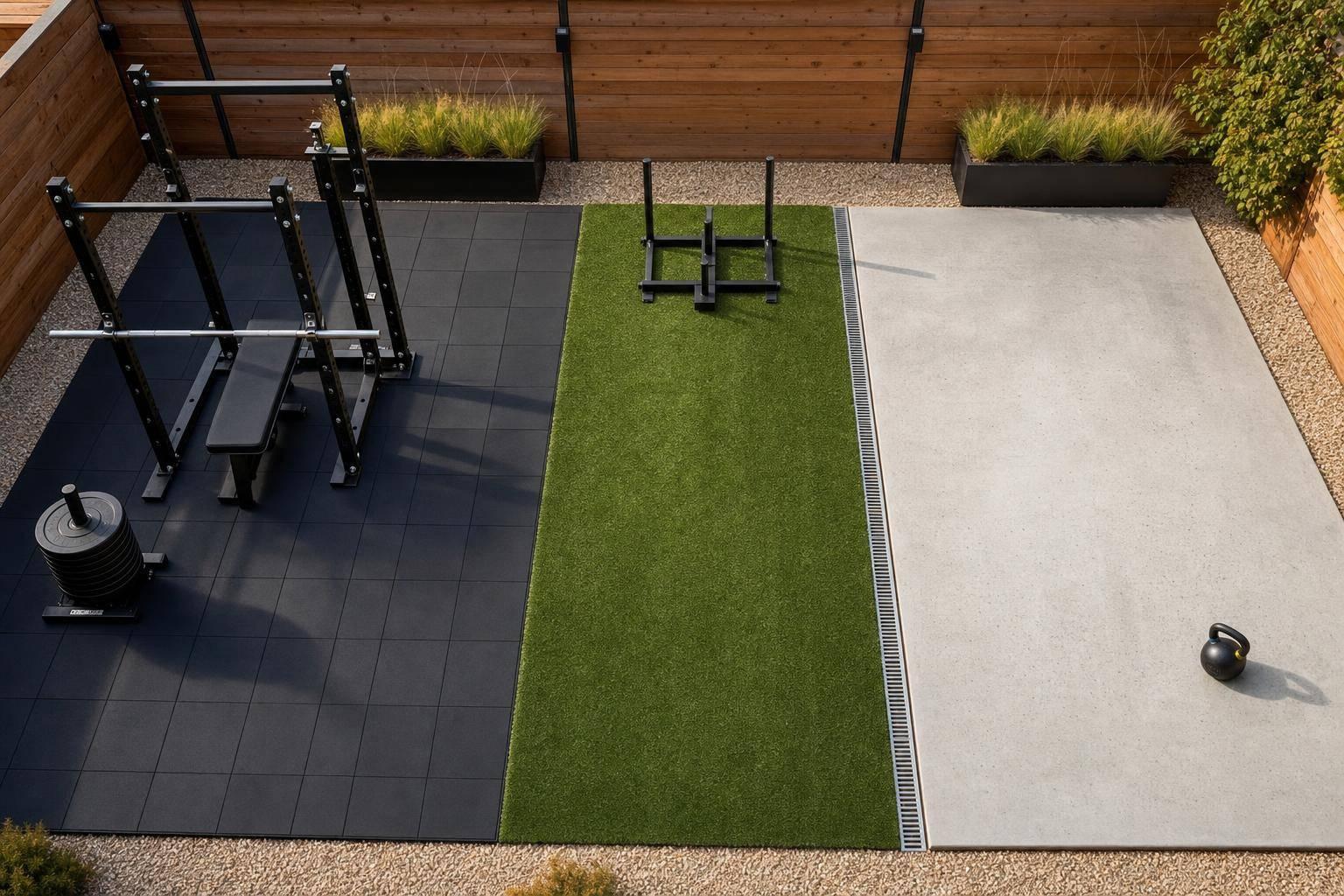
There’s no one flooring material that works for every part of an outdoor gym. Rubber is the go-to pick for lifting and high-impact training. Turf works best for sled pushes, agility drills, and other functional work. Concrete makes sense as a load-bearing base under stationary equipment.
That’s the sweet spot: rubber is the default safest option, turf is the specialist surface, and concrete is the structural base.
For most backyard gyms, a mixed-surface layout makes the most sense. Use rubber in lifting zones, turf in functional training areas, and concrete underneath spots where stability matters most. But that setup only works if the base is built the right way.
Flooring performs well only when it sits on a properly prepared base. That means:
- 2 to 4 inches of compacted gravel
- A slight slope for runoff
- A geotextile membrane to block soil movement
In central Maryland, that prep matters just as much as the top surface. Pro Landscapes MD handles grading, drainage installation, and hardscaping for permanent outdoor gyms across central Maryland.
FAQs
How thick should outdoor gym flooring be?
The right thickness comes down to two things: how hard the space gets used and what type of training happens there.
For general fitness areas, rubber tiles often start at 20 mm. That’s a common starting point for spaces used for everyday workouts and light-to-moderate impact.
High-impact zones need more protection. If the area sits under pull-up bars or in spots where weights might be dropped, 45–65 mm is more common.
For weightlifting spaces, 1-inch rubber tiles are the standard pick. Artificial turf usually performs best at 1–1.5 inches, often paired with a 10–20 mm rubber underlay to add extra cushioning.
What base do I need under rubber or turf?
Install rubber or turf flooring over a level, compacted base so the surface stays stable and lasts longer. Most projects use a firm sub-base like compacted gravel or crushed stone to support the flooring and help water drain properly.
For turf, adding a rubber underlayment can provide extra cushioning and improve safety. Pro Landscapes MD can also help get the site ready with professional grading and land leveling.
How can I keep outdoor gym flooring cooler in summer?
Choose lighter-colored flooring materials. They absorb less heat than dark, black surfaces, so the area stays more comfortable under the sun.
You can also add a shade canopy or tarp cover to block direct sunlight and bring surface temperatures down.
It also helps to pick UV-resistant materials that can handle summer heat without warping or softening.
Chat with Us