









- bhavya gada
- No Comments
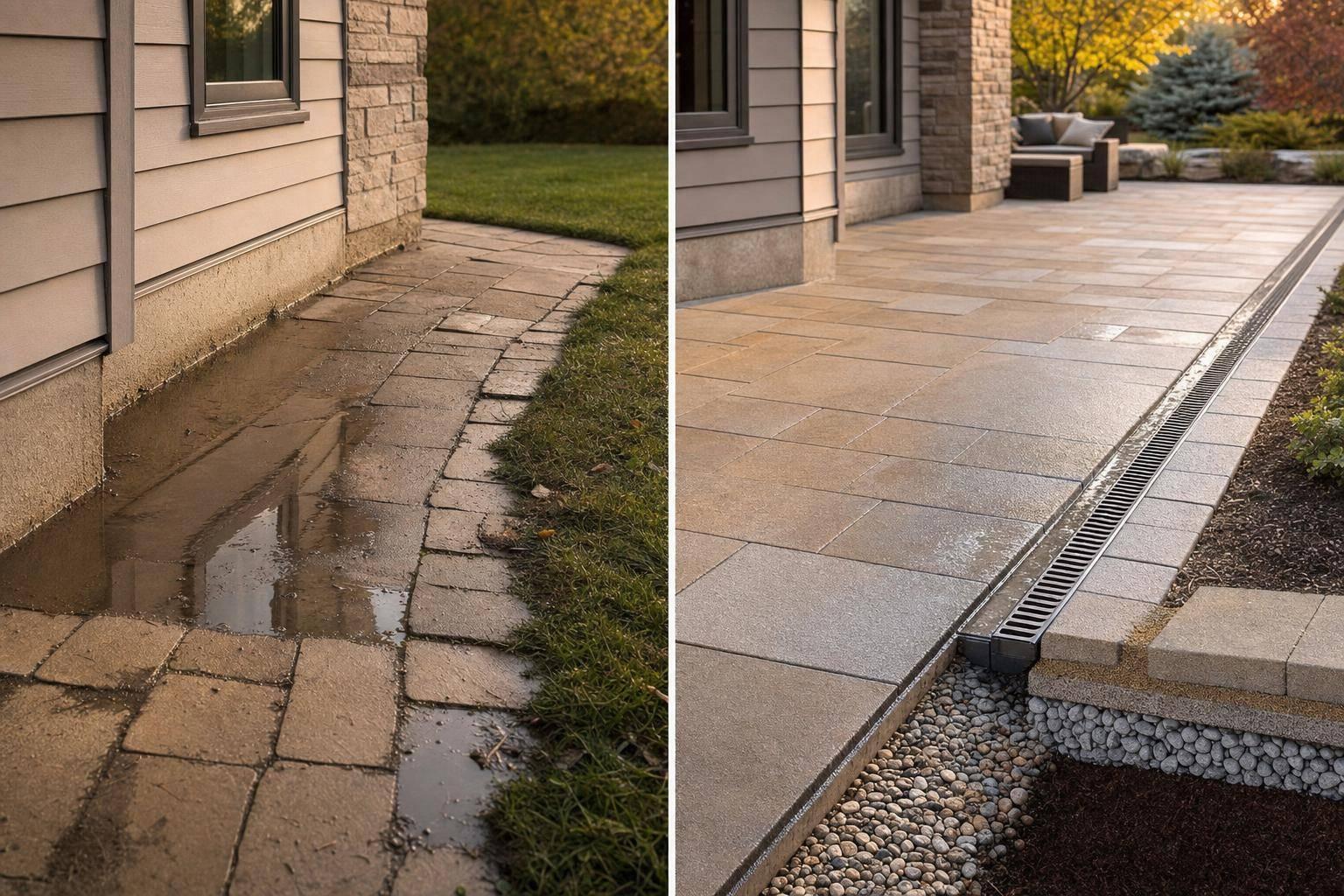
Most patio drainage problems start before the first stone or slab goes down. If the slope is wrong, the base is weak, or runoff has nowhere to go, water can sit for 12 to 24 hours, wash out joints, grow algae, and cut a patio’s life from 30+ years to 10–15 years.
Here’s the short version: I’d make sure the patio slopes 1/8 to 1/4 inch per foot away from the house, sits on a compacted stone base built in 2- to 4-inch lifts, and sends runoff to a clear outlet like a swale, trench drain, catch basin, or dry well. In central Maryland, that matters even more because clay soil drains slowly and freeze-thaw cycles below 32°F can heave and crack a wet patio fast.
If you want the main takeaways up front, they’re simple:
- Bad slope sends water toward the house or leaves puddles behind
- Thin or loose base traps water and leads to settling and frost heave
- Poor runoff planning dumps water where it can’t drain
- DIY patch fixes often miss the full water path
- Early drainage work may cost about $300–$700, while later repairs can run $1,800–$5,500
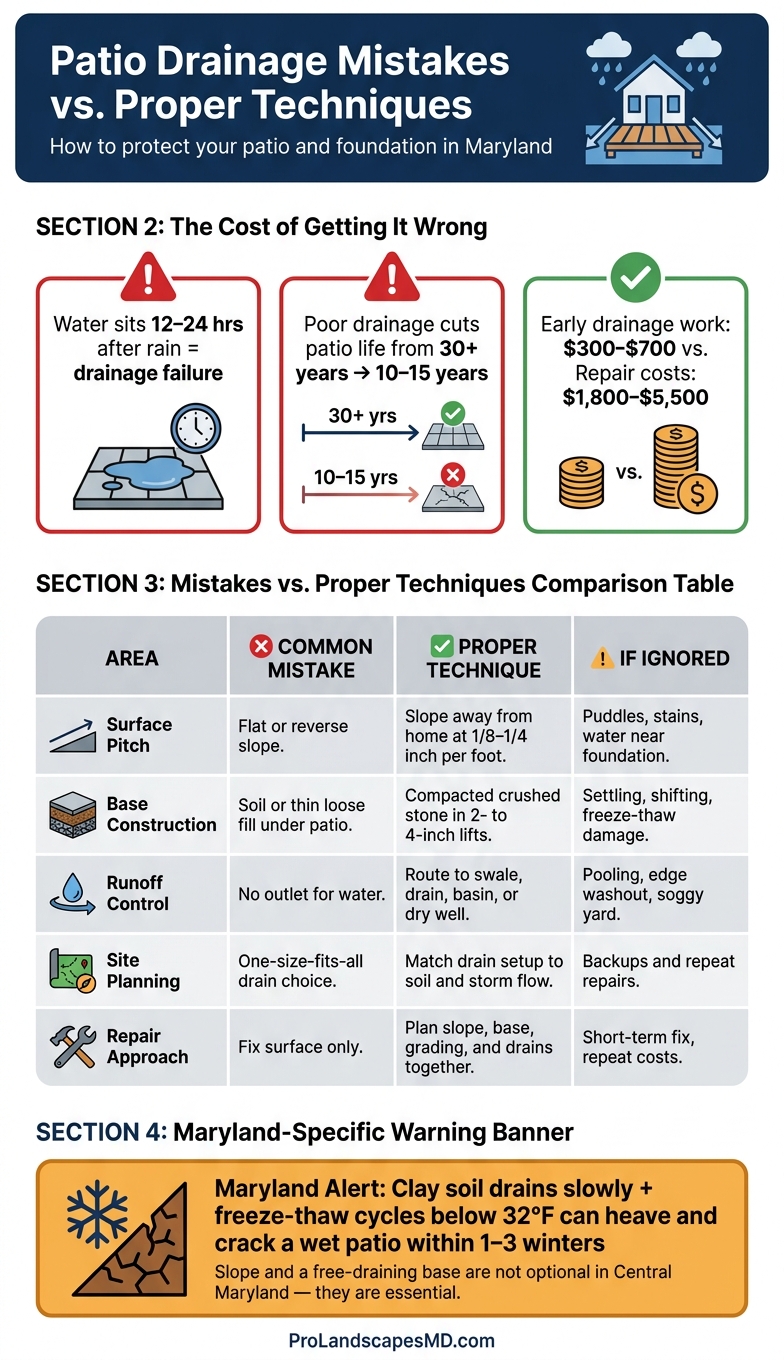
Patio Drainage Mistakes vs. Proper Techniques: Cost & Impact Guide
The #1 Drainage Mistake Destroying Your Landscape
sbb-itb-843f8be
Quick Comparison
| Area | Common mistake | Proper technique | What happens if ignored |
|---|---|---|---|
| Surface pitch | Flat or reverse slope | Slope patio away from home at 1/8–1/4 inch per foot | Puddles, stains, water near foundation |
| Base | Soil or thin loose fill under patio | Compacted crushed stone in 2- to 4-inch lifts | Settling, shifting, freeze-thaw damage |
| Runoff | No outlet for water | Route water to swale, drain, basin, lawn area, or dry well | Pooling, edge washout, soggy yard |
| Site plan | One-size-fits-all drain choice | Match drain setup to soil and storm flow | Backups and repeat repairs |
| Repair approach | Fix surface only | Plan slope, base, grading, and drains together | Short-term fix, repeat costs |
That’s the full issue in plain English: patio drainage is not just about getting water off the surface. It’s about moving water away from the house, through the patio system, and out to a place that can handle it.
Patio Drainage in Maryland: What You Need to Know
Drainage problems do more than leave a few puddles behind. They set up a chain reaction. Water sits, materials loosen, and the patio starts to fail from the top down.
If puddles hang around for hours after rain, that usually points to poor grading. In plain terms: this isn’t just a surface-level eyesore. It’s a build issue.
How Poor Drainage Damages More Than the Patio Surface
When water sits on a patio, the sand between pavers – called joint sand – starts to wash out. Once that happens, the pavers lose support. They begin to rock, shift, and separate. Over time, the edges can wear away too.
Low spots and shaded areas bring another problem. They stay wet long enough for algae and moss to grow, which can make the surface slick and unsafe [5][7].
The damage also doesn’t stop at the patio. Lingering moisture can work its way into foundation walls, door thresholds, and siding. That can lead to basement water intrusion or foundation damage [7][8].
| Drainage Issue | Visible Symptom | Long-Term Consequence |
|---|---|---|
| Insufficient slope | Puddles linger for hours | Surface staining, efflorescence, spalling |
| Reverse slope | Water flows toward the house | Foundation mold, interior water intrusion |
| Missing edge drainage | Water seeps under edges | Saturated base, undermined perimeter |
| Joint washout | Joint sand washes out | Weed growth, shifting pavers, loss of stability |
Why Maryland Soil and Weather Demand Drainage Planning
In Central Maryland, clay-heavy soils drain slowly and keep water near the surface after rain [5][7]. That’s a tough mix for patios.
Winter adds even more stress. When trapped water freezes below 32°F, it expands. That pressure pushes up and out, which can crack concrete and buckle pavers. After repeated freeze-thaw cycles, a poorly drained patio may show visible heaving by the first spring. Within one to three winters, joints can widen and edges can pop loose [4][8].
A proper patio slope should drop 1/8 to 1/4 inch per foot away from the home. That small pitch makes a big difference. In Maryland, slope and a free-draining base aren’t optional – they’re what keep water moving where it should.
With Maryland’s soil and freeze-thaw risks in play, slope and base construction are the next line of defense.
Slope and Base Construction: Mistakes vs. Correct Methods
Two installation choices make or break patio drainage: slope and base construction. Both go wrong all the time. And both are expensive to fix once the patio is already in place.
Flat or Reverse Slope vs. Proper Pitch Away from the Home
A patio can look level and still be too flat to drain well. The standard pitch is 1/8 to 1/4 inch per foot away from the home. If the patio has a reverse slope, the surface tilts toward the foundation. That’s the worst version of this problem because it sends runoff right where you don’t want it.
A flat surface isn’t as damaging, but it still causes trouble. Water sits instead of moving. Stains start to show. Algae can spread. If water stays on the patio for more than 12 to 24 hours after rain, that points to a drainage failure, not just a surface-level appearance issue [8].
A simple hose test can help spot pitch problems before they turn into structural damage.
Slope also has to work with the rest of the space. Doors, steps, and the yard’s grade all matter. Water needs a place to go, whether that’s a lawn, swale, or drain. It’s not enough to send water away from the house if it has nowhere to finish draining.
Slope moves water off the top. The base below keeps that water from causing trouble underneath.
Thin or Uncompacted Base vs. Compacted, Free-Draining Stone Base
Even with the right slope, drainage can still fail if the base traps water. Surface pitch matters, but the base underneath decides whether the patio stays stable over time. When pavers or flagstone go straight over soil, or over a thin layer of loose fill, the patio starts out at a disadvantage.
In Maryland, a weak base can settle and stay wet. That creates the setup for frost heave during winter freeze-thaw cycles [3][5][4]. A proper base uses compacted crushed stone in 2- to 4-inch lifts to get rid of air pockets [6][1].
There’s also a plain cost difference here. Getting slope and base work right during installation usually adds $300 to $700 to the project [2]. Fixing a reverse-sloped concrete patio later, with full tear-out and re-pour, can cost $1,800 to $5,500 [2].
When pitch and base construction are done right, water keeps moving instead of pooling, soaking in, and shifting the patio over time.
Runoff Control and Site Drainage: Mistakes vs. Correct Methods
Slope and base work only when runoff has a safe place to go. Water should move off the patio and reach a drainable outlet, not dump into the lawn and sit there. That’s why runoff control matters just as much as slope.
Directing Runoff Toward the Foundation vs. Grading and Drains That Lead Water to a Safe Outlet
When a patio slopes toward the house, water builds up along foundation walls, siding, and thresholds. That can increase foundation pressure, basement leaks, mold, and the risk of settling [7][5]. The edge of the house is the most sensitive drainage zone. This isn’t just a wet-yard issue. It’s a drainage failure.
The right method sends water away from the structure at 1/8 to 1/4 inch per foot [8]. From there, runoff should be guided to a safe outlet, like a swale, catch basin, trench drain, retaining walls, or a lawn area that can take in the water [2][9].
Ignoring Soil and Stormwater Patterns vs. Choosing the Right Drainage System for the Property
Not every yard needs the same fix. A common mistake is using one standard drain plan for every site. The better move is to match the drainage system to the soil and the way water moves across the property. In Maryland, clay-heavy soil drains slowly, so grading by itself often doesn’t do enough [5].
Once water leaves the patio, the next step is simple: where does it go? That answer changes from one property to the next.
| Drainage Solution | Maryland-Specific Note |
|---|---|
| French Drain | Helps with slow-draining clay soils; runs $20–$35 per linear foot [2][5] |
| Channel (Trench) Drain | Helps cut down on slippery algae growth during Maryland’s humid summers [5] |
| Dry Well | Helps handle heavy runoff from strong Maryland storms [6] |
| Permeable Pavers | Helps limit erosion; needs exact design on sloped yards [6] |
| Swales / Dry Creek Beds | Helps hold edges in place and prevent mulch washout during heavy rain [5] |
Downspouts get missed all the time. They need to extend far enough so roof runoff doesn’t dump extra water into the patio drainage system [5][3].
Professional Planning vs. DIY Guesswork
Once slope, base, and runoff are handled on their own, the next step is making sure they work together. That’s where many drainage problems begin. A drain by itself won’t fix a bad slope or a weak base. Water can still pool, wash out the base, or push back during storms.
A coordinated drainage plan brings patio slope, base prep, yard grading, and stormwater outlets into one setup. Each part supports the next. When one piece is off, the whole patio can start to fail.
Common DIY Drainage Errors That Lead to Repeat Repairs
A lot of DIY drainage issues come from treating one symptom instead of the full system. Here’s how those mistakes usually show up, and what should happen instead.
| Common Mistake | Proper Technique | Impact in Maryland Conditions |
|---|---|---|
| Flat or reverse slope | Slope away from the home | Prevents water from sitting against foundations during heavy rain [1][8] |
| Undersized or dead-end drains | Properly sized drain lines to daylight | Prevents backup in clay soil during high-volume storms [2] |
| Surface-only fixes | Compacted, free-draining stone base | Prevents pavers from shifting during freeze-thaw cycles [1][6] |
| Uncompacted base layers | Layered compaction using a plate compactor | Eliminates air pockets that trap water and cause settling [6][9] |
| Missed low spots | Laser level or string line check during base prep | Prevents micro-depressions that collect algae and create slippery surfaces [1][2] |
That’s why isolated repairs tend to fail sooner than a drainage plan built as one connected system.
Getting drainage right during installation usually costs $300 to $700. Fixing a failed system later can cost $1,800 to $5,500 – and that’s before any added damage to the patio surface or foundation [2].
The gap between a patch job and a patio that holds up comes down to planning from day one. Pro Landscapes MD takes that integrated approach for central Maryland properties.
Conclusion: Key Practices That Keep Patios Dry, Stable, and Long-Lasting
In Maryland, patios last longer when slope, base, and runoff are planned as one system.
FAQs
How can I tell if my patio has the wrong slope?
Watch what happens after it rains. A patio with the right slope should drain in 15 to 30 minutes. If puddles sit there for hours, water gathers near your home’s foundation, or runoff heads back toward the house, the patio likely has a drainage issue.
You can check the slope with a 4-foot level and a tape measure. In most cases, a patio should slope about 1/4 inch per foot away from your home.
What type of drain works best for clay soil?
For clay-heavy soil, which tends to drain poorly, French drains are often the best fit for handling excess groundwater. They use perforated pipes set in gravel to collect subsurface water and move it away from your property.
For surface runoff, trench or channel drains can catch water before it starts pooling on driveways, patios, or other hard surfaces. Pro Landscapes MD may also recommend proper grading and land leveling so water flows toward safe discharge areas.
Can poor patio drainage damage my foundation?
Yes. Poor patio drainage can damage your home’s foundation if the patio slopes the wrong way or sends runoff toward the house.
When water keeps pooling near the structure, it can lead to:
- Foundation cracking or settling
- Basement or crawl space water intrusion
- Mold or mildew growth
Pro Landscapes MD offers drainage solutions like regrading and French drains to move water away from your home.
Chat with Us