









- bhavya gada
- No Comments
If you want the short answer: paver patios usually cost less and are easier to fix, while flagstone patios often cost more and need more labor.
If I were comparing the two in Maryland, I’d focus on three things first:
- Upfront cost
- Base and drainage needs
- Repair costs after a few winters
For a 250-square-foot patio, the article puts the price at about:
- Pavers: $5,000 to $12,000
- Flagstone: $4,000 to $25,000+
That gap is large for one reason: flagstone pricing swings more. The total changes based on the stone type, whether it’s dry-laid or mortared, and how much hand labor the job needs. Pavers are more uniform, so costs are often easier to plan.
Maryland also changes the math. Freeze-thaw weather, drainage work, slopes, soil issues, and tight access can all add cost. In some yards, extras like retaining walls ($4,000 to $10,000) or drainage systems ($2,000 to $6,000) can move the total well beyond the surface material price.
Before I get into the full guide, here’s the quick takeaway:
- Choose pavers if you want more predictable pricing and simpler repairs.
- Choose flagstone if you want natural stone and you’re okay with a much larger price range and more upkeep.
- Do not compare materials alone. Base prep, grading, and drainage often decide the final bill.
Quick Comparison
| Patio Type | Installed Cost (per sq. ft.) | 250 sq. ft. Cost | Repair Ease | Upkeep |
|---|---|---|---|---|
| Pavers | ~$20 to $48 | $5,000 to $12,000 | Easier | Moderate |
| Flagstone | ~$16 to $100+ | $4,000 to $25,000+ | Harder | Higher |
Bottom line: if you want a patio budget you can plan with fewer surprises, I’d lean toward pavers. If the look of natural stone is your top goal, flagstone may still be worth the extra cost.
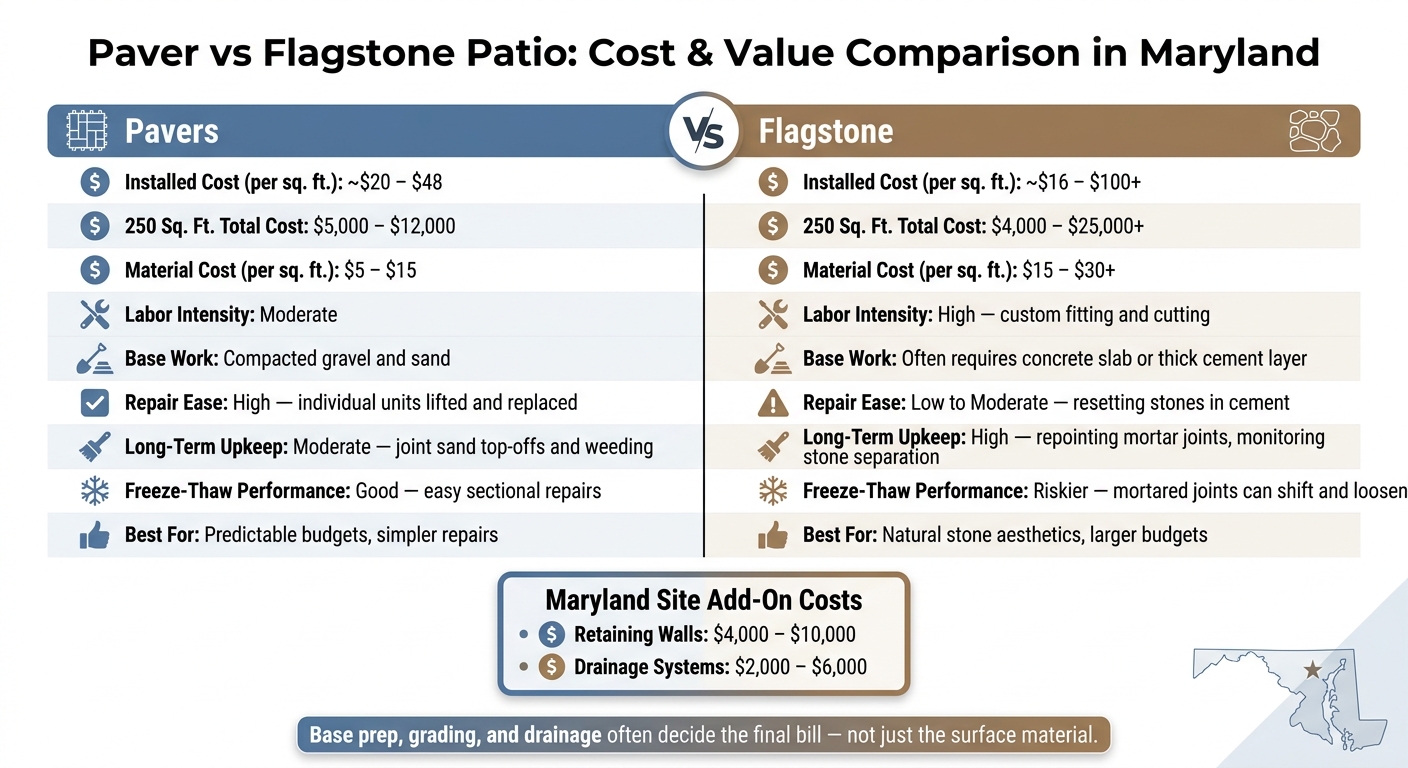
Paver vs Flagstone Patio Cost Comparison (Maryland 2024)
Paver Patio vs Natural Stone Cost?
sbb-itb-843f8be
Paver Patio Costs in Maryland
In Maryland, a premium paver patio usually costs $5,000 to $12,000 installed. Where your project lands in that range comes down to a few big things: the paver you choose, how complex the pattern is, and how much site prep the job needs.[1]
Material and Installation Cost by Paver Type
Premium pavers usually push pricing toward the top end of the range. And pattern choice matters more than many homeowners expect. A simple layout is one thing. A detailed pattern with lots of cuts is another, and that extra labor shows up in the final price.
Edge restraints also add to the starting cost, but they do an important job. They help keep the patio locked in place over time.
Base work and edge restraints often matter just as much as the pavers you see on the surface.
Base Work, Edge Restraints, and Site Conditions
Base work is often the cost driver. If the yard needs regrading, has poor soil, sits on a slope, or offers tight access for crews and equipment, labor and hauling costs can climb fast.
Some sites also need extra support and water control. Retaining walls are often required on tougher properties and usually cost $4,000 to $10,000, while drainage systems can add $2,000 to $6,000.[1][2]
Repair and Maintenance Costs Over Time
One of the main upsides of modular pavers is simpler repair. If part of the patio settles or one paver cracks, crews can often lift and reset only the affected pieces instead of tearing out the whole surface.
That matters in Maryland, where freeze-thaw cycles can be hard on outdoor hardscapes. Being able to fix small sections, rather than replace everything, can help keep long-term costs in check.[3]
Flagstone costs are different because the stone itself, the installation method, and any mortar work all change labor needs and future upkeep.
Flagstone Patio Costs in Maryland
Flagstone patios usually cost more than paver patios in Maryland. The main reason is simple: the stone costs more, and the install takes more work. Compared with modular pavers, flagstone calls for more labor and a higher level of skill. The type of stone, its thickness, and how consistent each piece is can also change both material pricing and install time. [1][3]
Material and Installation Cost by Flagstone Type
Flagstone pricing changes based on the cut, thickness, and consistency of the stone. Irregular flagstone comes in random shapes with uneven thickness, so a mason has to fit each piece by hand. That extra handwork can add a lot of labor hours. Thermally cut flagstone, like Pennsylvania bluestone, has a more even thickness and surface. That usually makes the install smoother and can cut down on labor time compared with irregular stone. [3]
Dry-Laid vs Mortared Flagstone Cost
How the patio is installed has a direct effect on total cost. Dry-laid flagstone goes over a compacted gravel base with stone dust or sand. Water drains through the joints, which is one reason many homeowners like this setup. [2][3]
Mortared flagstone is installed over a concrete slab with a cement bedding layer. The result is a rigid, non-permeable surface. It usually costs more up front because it needs more materials and more labor. It can also crack if the base moves over time. [3]
Repair and Upkeep for Natural Stone Patios
Natural stone patios need some upkeep. With dry-laid installs, stones may need to be re-bedded if the base settles. Mortared patios may need repointing, but cracked joints can point to base failure, which often means lifting and resetting the stone. [3] That kind of repair can add to long-term ownership costs.
These differences in material, labor, and repair help explain the cost gap in the next side-by-side comparison.
Paver vs Flagstone: Side-by-Side Cost Comparison
Pavers tend to fall into a tighter price band. Flagstone is less predictable because cost depends on the stone itself and how it’s installed.[1][3]
| Material Type | Material Cost (per sq. ft.) | Installed Cost (per sq. ft.) | 250 Sq. Ft. Total | Maintenance Level |
|---|---|---|---|---|
| Paver Patios | $5 – $15 | ~$20 – $48 | $5,000 – $12,000 | Moderate |
| Flagstone Patios | $15 – $30+ | ~$16 – $100+ | $4,000 – $25,000+ | High |
At first glance, those ranges can seem a little odd. Flagstone can start lower in total cost for a 250-square-foot patio, but it can also climb far higher. That swing comes from the stone choice, the layout, and the install method. Pavers are usually easier to price out because the system is more standardized.
Those price gaps also point to something bigger: each patio type comes with different base needs, repair access, and upkeep over time.
Installed Cost, Labor, and Base Requirements Compared
Pavers often cost less to install because the pieces are uniform. Crews can lay them in a repeatable pattern. Flagstone takes more handwork since each stone has to be placed, adjusted, and sometimes cut to fit.[1][3]
| Factor | Paver Patios | Flagstone Patios |
|---|---|---|
| Base Work | Standard compacted gravel and sand | Often requires a concrete slab or thick cement layer for stability |
| Labor Intensity | Moderate – uniform shapes and repetitive laying | High – custom fitting and cutting of natural shapes |
| Edge Restraints | Required (plastic, metal, or concrete) | Often stabilized by mortar or heavy stone weight |
| Repair Ease | High – individual units can be lifted and replaced | Low to moderate – requires resetting stones in cement |
| Long-Term Upkeep | Joint sand top-offs and weeding | Monitoring for stone separation and repointing mortar joints |
This is where the cost story gets more practical. With pavers, the base is usually compacted gravel and sand, and repairs are more straightforward because single units can be removed and replaced. With flagstone, the install can call for a concrete slab or a thick cement setting bed, which adds labor and makes later repairs more involved.
That difference matters in Maryland, where drainage and freeze-thaw movement can put stress on any hardscape. A patio that looks fine on day one may behave very differently after a few winters.
When Pavers Make More Sense and When Flagstone Is Worth the Cost
Pavers make more sense when you want pricing that’s easier to plan for and repairs that won’t turn into a bigger project. For a 250-square-foot patio in Maryland, the installed cost usually lands around $5,000 to $12,000.[1]
Flagstone tends to make sense when the look is the main draw and you’re willing to accept a much wider price range. A 250-square-foot flagstone patio can run from about $4,000 to $25,000+, depending on the stone you choose and whether the patio is dry-laid or mortared.[1][3]
So the upfront math is only part of it. The next piece is long-term cost, especially in Maryland’s freeze-thaw climate.
Long-Term Cost and Final Decision for Maryland Properties
Drainage, Freeze-Thaw Performance, and Total Cost of Ownership
Upfront price is only part of the choice. Maryland weather has a big impact on what your patio may cost over time.
In Maryland’s freeze-thaw climate, mortared flagstone can shift and loosen joints, often requiring a full reset instead of simple repointing. [3]
Pavers are easier to repair because individual units can be lifted and replaced without disturbing the rest of the patio, making long-term repair costs more predictable. [3]
Drainage work can add to the initial bill, but proper grading helps cut down on settlement and water damage over time. [1]
That’s why repair access matters just as much as installation price. A patio that’s easier to fix can save a lot of hassle later.
Choosing the Right Patio for Your Budget and Property
For many Maryland homeowners, pavers tend to come with more predictable pricing and lower repair costs. Flagstone often costs more up front and usually needs more upkeep.
Here’s the price range many people are looking at in Maryland [1]:
- Paver patios: $5,000 to $12,000 installed
- Flagstone patios: can exceed $20,000 on custom jobs
Pro Landscapes MD serves central Maryland and can evaluate site conditions, drainage needs, and material options before you choose a patio design.
FAQs
Why does flagstone cost vary so much?
Flagstone cost comes down mostly to the type, quality, and origin of the stone. Because it’s a natural material, stone shipped in from far-off quarries usually costs more than stone that’s available closer to home. Freight adds up fast.
Price also shifts based on how complex the design is, how much skilled masonry work is needed to fit and set the stone well, and whether the site needs base prep or drainage work first.
Which patio handles Maryland winters better?
For Maryland winters, natural stone is often the safer bet. It’s dense, which helps it handle freeze-thaw cycles without cracking. That makes it a strong fit for this climate.
Permeable pavers can help with water runoff, but they may be more prone to freeze-thaw damage. Either way, proper installation matters a lot. A solid base and good drainage are critical.
What site issues can raise patio costs?
Several site-specific factors can push patio costs up. The big ones are steep slopes, poor or rocky soil, and limited access to the work area.
Why do these matter? Because they usually mean more labor and more prep work. A sloped yard may need extra excavation and grading. Rocky or weak soil can call for added reinforcement. And if crews can’t get materials in with equipment, they may have to move everything by hand, which takes more time.
Drainage issues can also increase the price. If water tends to pool near the patio, the project may need grading changes or water-management systems to deal with it.
In some areas, local rules may also require permits for certain landscape changes, which can add to the total cost.
Chat with Us