









- bhavya gada
- No Comments
Permeable pavers can cut runoff by moving rain into stone below the surface instead of letting it rush across your lot. On small Maryland lots, that can mean less standing water, less flow toward the house, and less pressure on storm drains during many storms.
Here’s the short version:
- Water goes through the joints between the pavers
- The stone base holds water for a time
- Soil below drains that water at its own rate
- Heavy rain can still fill the system
- Some lots need an underdrain or overflow route
If your soil drains well, runoff can drop a lot from a driveway, patio, or walk. If your soil drains slowly, the system can still help by slowing surface flow and holding water below grade until it drains out. But there’s a limit: once the stone base fills, extra water needs somewhere to go.
A few facts help put this in context:
- Urban areas often have 50% to 90% impervious cover in built-up sections, which pushes more rain into runoff
- Open-graded stone bases can have about 30% to 40% void space, which is what gives them room to hold water
- A 1-inch rain on 1,000 square feet produces about 623 gallons of water
That’s why I’d look at permeable pavers as part surface, part storage system. They don’t stop every runoff problem, but they can make a clear difference when the base depth, soil, slope, and overflow plan all match the site.
| Main part | What it does | Limit |
|---|---|---|
| Open joints | Let water pass down instead of across | Can clog if not kept clean |
| Stone base | Stores water for a time | Can fill during hard rain |
| Soil below | Drains stored water | Slow soil drains slowly |
| Underdrain/overflow | Moves extra water out | Needed on some lots |
So if you want the simple answer, it’s this: permeable pavers cut runoff by storing and slowing rainwater, not by making it vanish.
Permeable Pavers (Newsbreak)
sbb-itb-843f8be
How Permeable Pavers Cut Runoff on Urban Properties
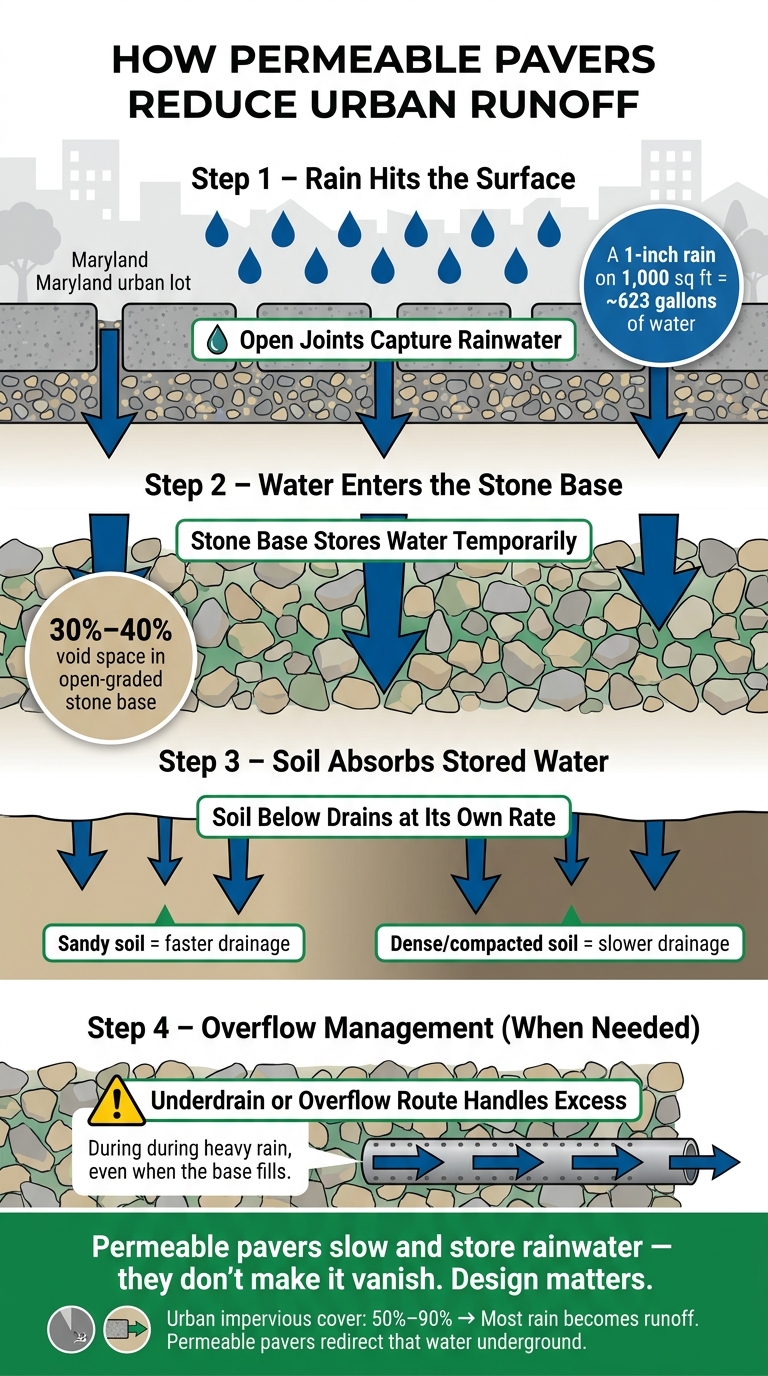
How Permeable Pavers Reduce Urban Runoff: Step-by-Step System Breakdown
Once water moves into the joints, the system slows runoff by keeping that water off the surface and sending it into storage below. It works in two simple steps: water drops through the joints, then sits in the stone base instead of racing toward a drain.
Surface Openings Send Water Into the Joints, Not Across the Surface
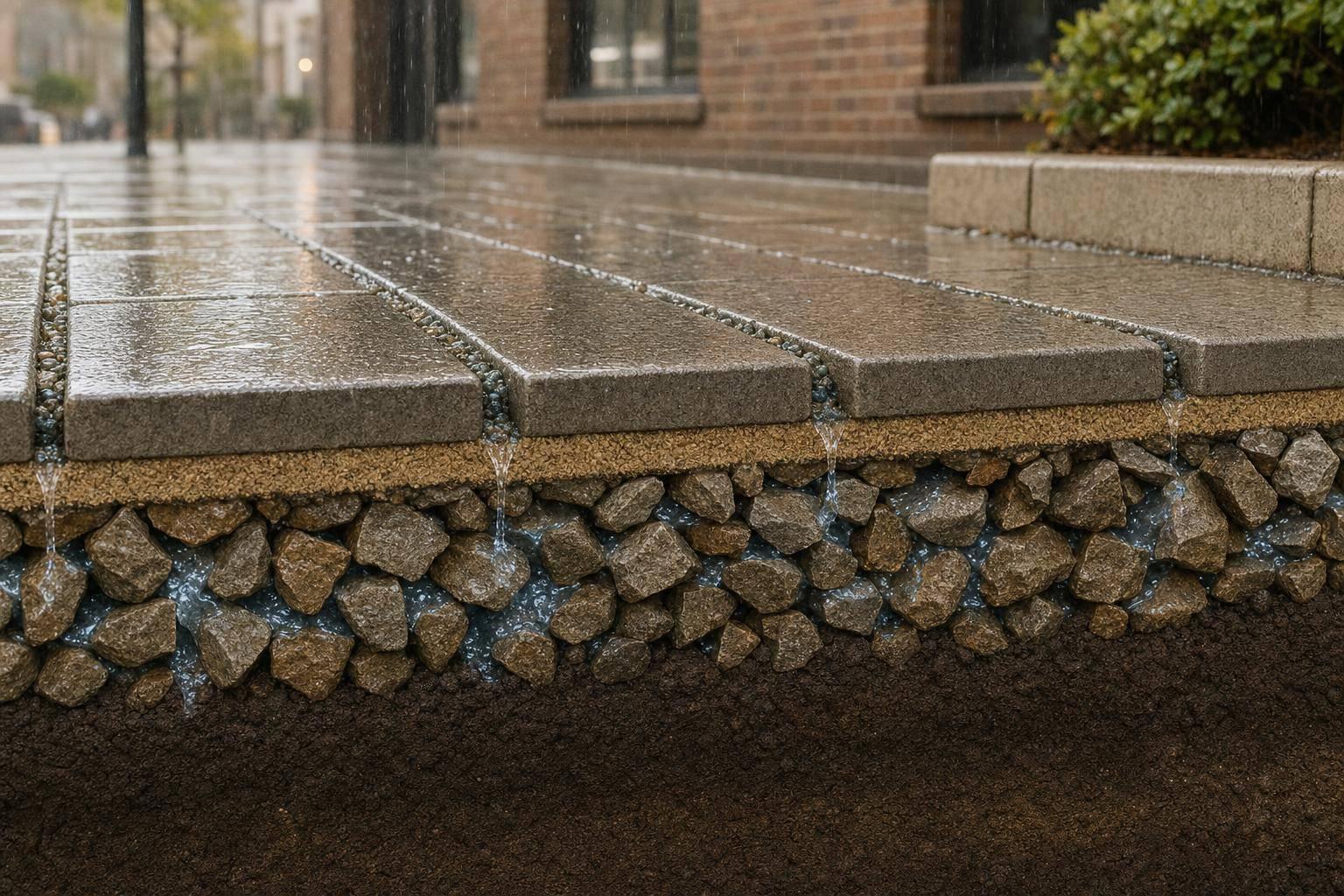
Permeable pavers use open joints filled with small aggregate. When rain lands on the surface, those joints give water a straight path down instead of letting it spread across the lot toward curbs, foundations, or nearby yards.
On compact lots, that matters a lot. Even a small patch of hard surface can send a lot of water in the wrong direction. By catching rain right away, permeable pavers help keep the surface drier and reduce buildup along the edges, where drainage trouble often begins.
That first step cuts surface flow and moves water into storage.
The Stone Base Stores Water Temporarily
Below the pavers is a deep layer of open-graded stone, usually crushed aggregate with enough empty space between the pieces to hold water. That layer works like a temporary reservoir. Water passes through the joints, collects in the stone base, and stays there until it either soaks into the soil below or leaves through a controlled outlet.
On a small Maryland lot, that storage space can hold a meaningful share of runoff from a moderate storm before any water reaches the storm drain.
How much runoff drops depends on two things: how much water the base can hold and how fast the soil below can take it in.
How Infiltration and Base Storage Work on Compact Lots
Base storage is only as good as the soil under it. On compact lots, infiltration comes down to two things: how fast water can move into the soil and how much water the stone base can hold.
Why Soil Conditions Under the Pavers Matter
Once water reaches the base, the next step is simple: it has to move into the soil below.
Sandy or well-draining soils let that happen faster. Dense or compacted soils slow the process, so the base holds water longer before it drains. Fill soil on older lots often drains poorly too, and that can slow infiltration even more.
In that kind of setup, the system can still store water in the base. It just may empty more slowly, which limits how fast the system can take on the next storm.
Why Permeable Driveways and Patios Can Still Make a Visible Difference
On a compact lot, the driveway or patio is often one of the biggest hard surfaces on the property. Swapping that area for permeable pavers stores water below the surface and lets it soak in at a slower pace.
Even if the soil drains slowly, the base still controls how fast water leaves the surface. That means less runoff moving off the paved area.
When storms are bigger than what the base can hold, the system needs a way to move extra water out.
What Happens During Heavy Rain and When Backup Drainage Is Needed
That storage limit shows up most during heavy rain. Permeable pavers cut runoff up to the point where the stone base fills up.
Infiltration Slows After the Base Fills
Once the base is full, the system can only drain as fast as the soil lets it. If rain falls faster than the soil can take it in, the extra water should move to a planned outlet. Permeable pavers help slow runoff, but hard storms can still lead to overflow.
That’s why site conditions decide whether backup drainage makes sense.
Sites That Often Need Underdrains or Overflow Planning
Some sites need an underdrain or overflow outlet along with the paver base. On compact Maryland lots, places with slow-draining soil or runoff pouring in from nearby surfaces often get the most from that extra outlet. Water from roofs or pavement can fill the system faster, so drainage planning becomes a bigger deal.
Runoff Control by System Type and Site Condition: Comparison Table
This quick table shows how the system setup affects runoff control.
| System Setup | Runoff reduction | Best fit | Heavy-storm limit | Backup drainage |
|---|---|---|---|---|
| Permeable pavers over well-draining soil | Water moves through the joints and into the ground | Sites with good infiltration | Storage can still fill during intense rain | Sometimes |
| Permeable pavers with stone storage base and underdrain | Water is stored below the surface and released through a drain | Sites that need more controlled drainage | The system still has a finite capacity | Yes |
How Pro Landscapes MD Designs Permeable Paver Systems for Maryland Properties

When storage and infiltration change from one site to the next, the design choices matter. Pro Landscapes MD looks at each property in central Maryland and Washington, DC, for grading, drainage, and site conditions before suggesting a permeable paver system. That’s where grading and drainage features come into play.
Pairing Permeable Pavers with Grading and Drainage Features
A permeable driveway, patio, or walkway doesn’t always work on its own. Some properties need a clear overflow path, especially when heavy rain pushes the stone base to its limit. In those cases, Pro Landscapes MD ties the paver system into French drains, dry riverbeds, or drain pipe placement.
On compact lots, that overflow planning helps protect the home and hardscape when the base reaches capacity. The idea is pretty simple: move extra water where it needs to go without wiping out the runoff control that permeable pavers provide.
Conclusion: Permeable Pavers Slow and Reduce Runoff, but Design Still Matters
Permeable pavers let water move through the surface and into a stone base, which cuts down runoff from the property. On compact Maryland lots, that can make a visible difference.
Still, the stone base can only hold so much water. During intense rain, the system may still need underdrains or an overflow route. In the end, design decides how much runoff the system can reduce.
FAQs
How do I know if my soil drains well enough for permeable pavers?
Do a percolation test by digging a hole 6 to 12 inches deep, filling it with water, and then watching how fast the water level drops once it stabilizes. A good rule of thumb: the water should soak in fully within 72 hours.
You can also use the USDA Web Soil Survey to get early soil data. If you want the most accurate read, go with professional infiltration testing or a geotechnical analysis.
How much rain can a permeable paver system hold before it overflows?
A permeable paver system doesn’t have one fixed water-holding limit. How much it can handle depends on the depth of the aggregate base under the pavers and the void space within that base. That layer works like a temporary reservoir, holding water for a period while it slowly soaks into the soil below.
In Maryland, these systems are often sized to manage the first inch of rainfall. But there’s a catch: if the base gets saturated or the soil drains too slowly, water can spill over. That’s why many professional designs include backup drainage as a safety measure.
When does a permeable paver project need an underdrain or overflow?
A permeable paver project may need an underdrain or overflow if the native soil doesn’t drain well. That’s often the case when infiltration rates fall below 0.6 inches per hour or when seasonal groundwater reaches the bottom of the aggregate reservoir.
An overflow may also be needed during major storms that push past the base layers’ short-term storage capacity. This helps prevent ponding and moisture problems that can affect the structure. Pro Landscapes MD can assess site conditions and determine whether these drainage features are needed.
Chat with Us