









- bhavya gada
- No Comments
If you let weeds seed out in a Maryland rain garden, they can fill bare soil fast and slow how water moves through the basin. I’d focus on three things first: spot the weed early, pull it before seed forms, and watch the wettest and thinnest-mulch areas most often.
Here’s the short version of what this article covers:
- A rain garden should drain within 24–48 hours
- New rain gardens get weeds fast because soil is disturbed and runoff brings in seeds
- The 13 weeds covered are:
- Dandelion
- White clover
- Ground ivy
- Common chickweed
- Broadleaf plantain
- Japanese stiltgrass
- Johnson grass
- Crabgrass
- Yellow nutsedge
- English ivy
- Japanese pachysandra
- Creeping Jenny
- Orange daylily
- The main trouble spots are:
- Upper edges and berms
- Shady side slopes
- Wet basin bottoms
- Inlets, outlets, and bare gaps
- The main fix is simple:
- Pull young weeds early
- Remove roots, runners, rhizomes, or tubers when needed
- Keep mulch at 2–3 inches
- Check the garden every 1–2 weeks in the first season, then about monthly in the growing season
RainWise: Weeding and Mulching Your Rain Garden
sbb-itb-843f8be
Quick Comparison
| Weed | Main ID clue | Usual spot in rain garden | What I’d do first |
|---|---|---|---|
| Dandelion | Yellow flower, low rosette, taproot | Dry edges | Dig out root after rain |
| White clover | 3 leaflets, white mark, creeping stems | Transition zones | Pull all stolons |
| Ground ivy | Scalloped leaves, square stems | Shady edges | Pull runners from nodes |
| Common chickweed | Tiny white star-like flowers, low mat | Wet or shady open soil | Pull before flowering |
| Broadleaf plantain | Flat oval leaves with strong veins | Compacted spots | Lift crown with trowel |
| Japanese stiltgrass | Pale grass with silvery midrib | Shady wet bottom | Pull before flowering |
| Johnson grass | Tall grass, white midrib, rhizomes | Sunny disturbed gaps | Dig out rhizomes |
| Crabgrass | Flat spreading grass, finger-like seedheads | Sunny bare spots | Pull young plants |
| Yellow nutsedge | Triangular stem, yellow-green leaves | Wettest basin areas | Dig deep for nutlets |
| English ivy | Lobed evergreen vine | Shaded borders | Pull and bag vines |
| Japanese pachysandra | Glossy evergreen mat | Shady upper edges | Lift rhizomes or smother |
| Creeping Jenny | Round leaves, yellow flowers, trailing stems | Wet lower zones | Remove all rooted nodes |
| Orange daylily | Strap-like leaves, orange flowers, thick roots | Edges and open gaps | Dig out full clump |
Bottom line: if a plant was not in your plan and it is forming a mat, rosette, runner, or thick clump where water should move, I’d treat it as a weed candidate and remove it before it spreads.
Why Weed Control Matters in Maryland Rain Gardens
A rain garden does its job only when the planted layer stays full and healthy. Native plants help make that happen. Their deep roots improve infiltration and help filter pollutants like nitrogen and phosphorus. When weeds crowd those plants out, the garden can’t work as well.
Weeds don’t just compete for space. They can also cause direct physical problems. Thick weed mats may block stormwater from getting into the basin. Their roots, along with trapped debris, can clog the drainage system below the surface. That can lead to standing water and weaker performance.
The best move is simple: pull weeds early, when roots are still small and before seeds form. Young weeds come out much more easily than established ones. Early removal also takes less time and costs less than trying to reclaim a basin that’s been taken over, which often requires professional cleaning and restoration. If no one stays on top of it, weeds can give way to shrubs and tree seedlings, and a stormwater bed can turn into a restoration project.[2]
Plan to weed at least once a month during the growing season. In spring and summer, pay closer attention before weeds go to seed. Over time, native groundcovers start to crowd weeds out on their own. But that doesn’t happen overnight. The first few years need steady care.[2]
| Native Rain Garden Plants | Common Weeds | |
|---|---|---|
| Root Systems | Deep roots that improve drainage and filtration | Often shallow or invasive; less helpful for infiltration |
| Stormwater Impact | Capture and slowly release runoff | Can block water flow and clog drainage pipes or outlets |
| Maintenance Over Time | Low maintenance once established | Require frequent removal to prevent takeover |
That quick comparison makes plant ID a lot easier in the sections below. Once you see what weeds can do, the next step is figuring out which plants belong and which ones need to go.
How to Tell a Weed From a Wanted Rain-Garden Plant
Start with a simple rule: if a plant pops up on its own and it’s not part of your planting plan, treat it as a weed candidate.
That matters most in bare soil or open spots in mulch. Your original planting plan is still the best guide here, and any plant showing up outside the areas you meant to plant deserves a closer look.
Growth habit can tell you a lot, fast. Plants that spread across open ground, form a low mat, or creep over the soil are often weeds. If you don’t recognize a plant, compare it with common Maryland rain garden plants like Joe Pye Weed, Swamp Milkweed, or Cardinal Flower before pulling it out.
Roots can help too. Many common weeds have shallow, fibrous roots and pull up with little effort. Established rain-garden plants usually have deeper, stronger root systems.
The leaves are another clue. If a volunteer plant doesn’t match the leaf shape, color, or texture of the plants around it, it’s worth a closer check.
If you’re not sure what it is, identify it first. But don’t let it stick around long enough to flower or set seed.
Use these clues to sort volunteer plants fast. Next, the list below covers the most common weeds found in Maryland rain gardens.
1. Dandelion
Scientific name: Taraxacum officinale
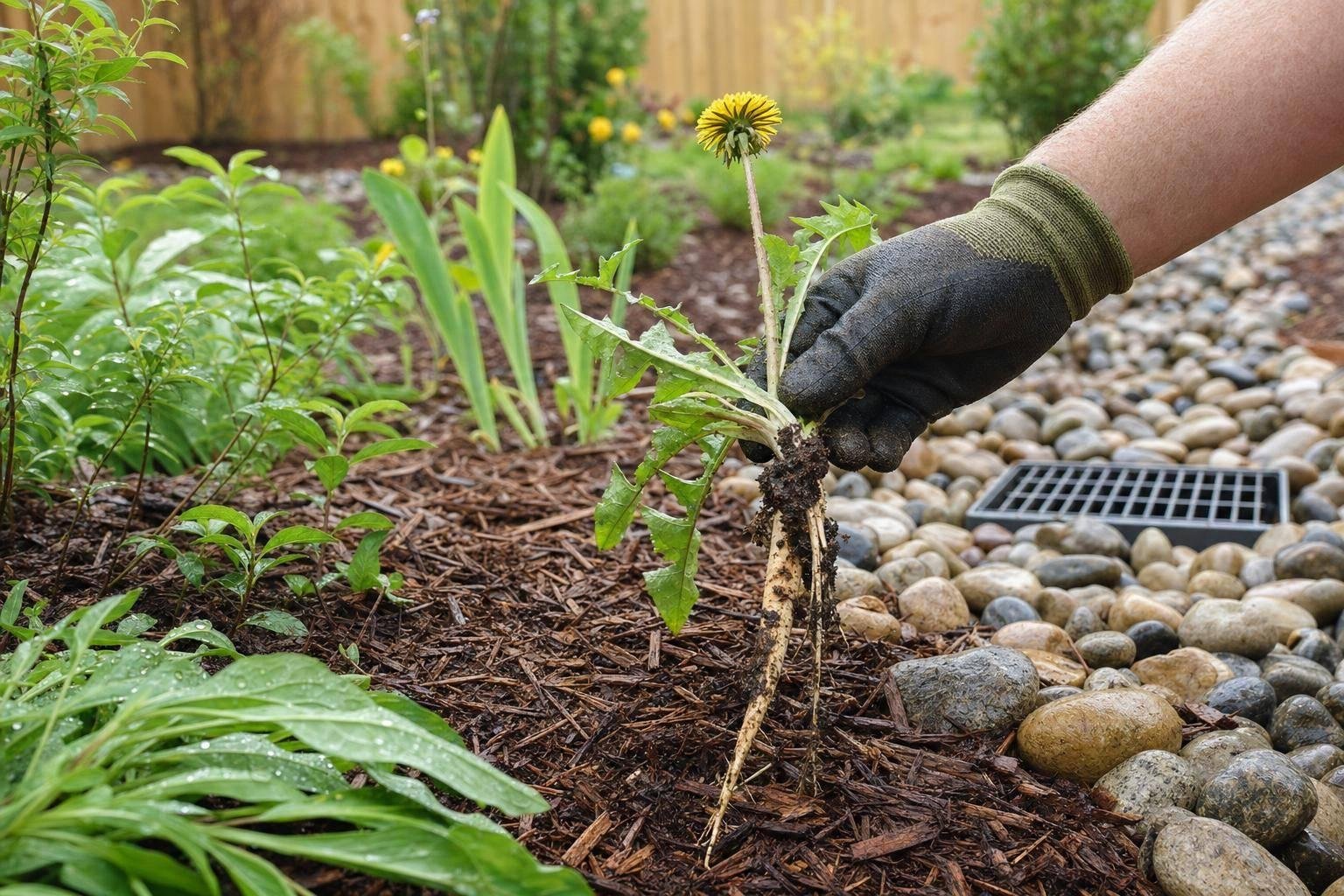
One of the easiest weeds to spot is dandelion. It’s a common lawn weed in Maryland, and it also shows up in rain gardens.[5][6]
How to identify it: Look for a low rosette of jagged leaves growing right at ground level. The leaves are deeply toothed and point back toward the center. If you break the stem, it releases milky sap. The flowers are bright yellow and grow on hollow stalks. Later, they turn into the familiar white puffball seed heads.
How it differs from wanted plants: Dandelion grows flat to the soil in a single rosette and has a thick, fleshy taproot. Most rain-garden plants grow in upright clumps with fibrous roots. So the giveaway is simple: no rosette, no hollow stalk, and no milky sap.
Where it spreads in the rain garden: Dandelions tend to show up on the upper slopes, berms, and outer edges of rain gardens. These are the drier edge areas where soil is exposed or mulch has thinned out. Each plant can produce up to 15,000 wind-blown seeds,[4] so even a small bare patch near a lawn or driveway can turn into an easy landing spot. That’s why the edges and thinly mulched spots are often the first places worth checking.
Best removal method: Dig after a rain event, when the soil is soft. Use a dandelion puller or a narrow trowel to loosen the taproot before lifting the plant out, and try to remove the root whole. Then backfill the hole and add 2–3 inches of organic mulch over open spots to help block new seedlings. Pulling plants early and adding mulch right away helps stop new seedlings from settling in.[3]
2. White Clover
Scientific name: Trifolium repens
White clover often shows up along thinly mulched edges and in open transition spots. Each leaf has three rounded leaflets, usually with a faint white V. The flowers are small, round, and white to pale pink. This plant stays low and spreads through creeping stems called stolons. As those stems move across the soil, they root at each node.
How it differs from wanted plants: White clover spreads into a low mat across bare or open ground, while native plugs tend to stay in clear clumps. The main tell is the creeping stolons.
Where it spreads in the rain garden: White clover usually moves into the transition zone between the moist basin and the drier outer edge, especially where the plants you want haven’t filled in yet.
Best removal method: Pull the full stolon chain, including each rooted node. If clover is growing among native plantings, loosen the soil around the base with a small hand tool first so you don’t pull out the plants you want to keep. In sunny spots, cover the area with a tarp or fabric barrier for 2–3 months to smother it. Keep mulch in place and remove new sprouts early.
3. Ground Ivy (Creeping Charlie)
Scientific name: Glechoma hederacea
Ground ivy is a common lawn-edge weed in Maryland rain gardens. It has round to kidney-shaped leaves with scalloped edges, square stems, a mint-like smell when crushed, and small bluish-purple flowers in spring. It spreads through above-ground runners that root at the nodes, which lets it form thick mats that crowd out rain-garden plants.
How it differs from wanted plants: Ground ivy often gets confused with native violets, which are usually welcome in Maryland rain gardens. The easiest way to tell them apart is the stem and leaf shape. Violets have heart-shaped leaves and round stems. Ground ivy has scalloped leaves and square stems.
Where it spreads in the rain garden: Ground ivy usually moves in from the lawn, then spreads along shady edges and upper slopes. It does best in damp, shaded spots and can form a mat that blocks native plants and slows infiltration.
Best removal method: Pull ground ivy when the soil is damp, ideally right after rain. That makes it easier to lift the whole runner without breaking it at the nodes. Go slowly and follow each stolon back to where it starts, because any rooted node left behind can sprout again. Bag the pulled plants and throw them in the trash. Don’t compost them, since cut pieces can root again. Keep 2–3 inches of hardwood mulch in place to stop new runners from taking hold. If you stop runners at the edge of the garden, you help protect infiltration in the basin. Regular trimming along the garden border also helps keep new runners from creeping in from the lawn.
4. Common Chickweed
Scientific name: Stellaria media
Like ground ivy, chickweed creeps low over bare soil. But this one hits its stride in the cool season.
Common chickweed is a low-growing, cool-season winter annual that forms mats across the soil surface. Its leaves are small, oval, and pointed at the tip, with opposite pairs along the stem. The stems are slender and light green, with a single row of fine hairs that flips sides at each node. In late winter and early spring, chickweed puts out tiny white flowers with five petals so deeply notched they look like ten, which gives the flower a star-like look.
How it differs from wanted plants: Chickweed stays flat and usually reaches just 2 to 4 inches tall. It forms a continuous mat instead of upright clumps. If you see a dense green carpet with tiny white star-shaped flowers in late winter or early spring, that’s a strong sign of chickweed. In Maryland rain gardens, that low winter carpet is often the giveaway.
Where it spreads in the rain garden: Chickweed tends to show up in lower basin areas that stay wet the longest after storms. It also moves into spots where mulch is thin, has washed away, or where the soil was recently disturbed. Open gaps are another favorite spot, especially near inlets and in shady areas. It germinates in late summer or fall, then spreads through winter before spring perennials wake up.
Best removal method: Hand-pulling works well because chickweed has a shallow, fibrous root system that usually lifts cleanly from moist soil. Pull it in late winter or very early spring, before it flowers, since each plant can produce over 800 seeds that can stay viable in the soil for up to 10 years.[7] Bag all pulled material. If stems are left on damp soil, they can re-root. After you clear a patch, add 2 to 3 inches of organic mulch to block the light chickweed seeds need to germinate. Then check the area every 2 to 3 weeks during the cool season.
5. Broadleaf Plantain
Broadleaf plantain is another low, rosette-forming weed that tends to show up when rain-garden soil gets packed down.
Scientific name: Plantago major
Broadleaf plantain grows as a flat rosette right against the soil. Its broad, oval leaves have 3 to 7 thick parallel veins. The easiest way to spot it is simple: those veins feel raised on the underside of the leaf.[15][11] The leaves are smooth, a bit leathery, and usually have smooth edges or a slight wave.[15][11][14] When the plant blooms, it sends up leafless spikes about 6 to 12 inches tall with tiny greenish flowers.[16][17][15]
How it differs from wanted plants: Most rain-garden plants grow upright or spill outward a bit. Broadleaf plantain does neither. It stays low and hugs the ground. Its oval leaves with parallel veins also look quite different from the net-veined or finely cut foliage you see on most flowering perennials. And those thin flower spikes? They blend into the background and don’t add pollinator value.
Where it spreads in the rain garden: Broadleaf plantain likes compacted, disturbed soil, especially around inlets, outlets, stepping-stone edges, transition zones, and bare spots.[13][9] In plain terms, it shows up where runoff and foot traffic have beaten up the soil. You’ll also find it in the strip between turf and the basin, plus any lightly mulched gap between plant groupings.[13][10] If plantain keeps coming back, that’s often a sign of compaction or drainage trouble.[8][9]
Best removal method: Use a narrow weeding knife or trowel to lift the crown from moist soil.[12] Try to pull plants before the flower spikes mature and drop seed. After you clear the area, add a 2- to 3-inch layer of coarse organic mulch to block light and slow new seedlings.[11] If packed soil is the root of the issue, aerate the area and improve soil structure.[9][12]
6. Japanese Stiltgrass
Scientific name: Microstegium vimineum
Next up is a grass-like invader that can take over shaded basin bottoms in a hurry. Japanese stiltgrass is a highly invasive weed that shows up often in Maryland rain gardens. The easiest way to spot it is the thin, silvery stripe along the upper leaf. That reflective midrib usually sits a bit off-center. The leaves are pale green, lance-shaped, and about 1 to 3 inches long, which gives the plant its grass-like look. It usually grows 1 to 3 feet tall and spreads by rooting at the nodes.
How it differs from wanted plants: The silver midrib is the big clue. White grass has a green, nonreflective midrib, and nimblewill has narrower leaves without the silver stripe. If you’re not sure, run your fingers along the upper midrib. Stiltgrass feels distinctly silvery. That small detail matters because this weed often hides in the wettest, shadiest part of the garden.
Where it spreads in the rain garden: Stiltgrass goes after the moist, shaded bottom of the basin and partly shaded edge zones. A single plant can produce hundreds to thousands of seeds, so even a small patch can spread fast and push out native sedges. If you leave it alone, it can shade young native plants and reduce infiltration.
Best removal method: Pull it by hand in late August through early September, before it flowers. Timing matters here. Late-summer removal stops seed before it spreads through the basin. Don’t mow or weed-whack once seed heads form, because that can spread seed. After pulling, cover bare soil with 2 to 3 inches of hardwood mulch until native plants fill in. Stiltgrass seeds can stay viable in the soil for several years, so keeping mulch in place helps cut down new growth.
7. Johnson Grass
Scientific name: Sorghum halepense
Another grass weed worth watching is Johnson grass. It grows fast and can hit 6 to 7 feet tall. The leaves are coarse and flat, up to 20 inches long, with a thick white midrib down the center. That white stripe is one of the easiest things to spot. In summer and fall, it also forms a tall, open, branching seed head that turns brown as it matures.[18][19][21]
This plant doesn’t just sit there. Its height and rhizomes help it overtop planted species and move into bare soil. In a rain garden, that means it can shade native plugs and fill open edges in a hurry.
How it differs from wanted plants: Johnson grass often gets mixed up with native grasses like switchgrass and big bluestem. But there are a couple of plain differences:
- Switchgrass has a ligule where the leaf meets the stem. Johnson grass does not.
- Big bluestem grows in a tight clump. Johnson grass spreads by rhizomes.[18][19]
Where it spreads in the rain garden: Johnson grass tends to show up in disturbed, open, or thinly mulched spots where soil is exposed and other plants aren’t putting up much of a fight. In rain gardens, it often appears in inflow zones, basin edges, and disturbed gaps where runoff drops seed.[23][25] It does well in sunny, moist areas and can move from a small patch into nearby planting zones through rhizomes.
Best removal method: Dig out small patches while the soil is moist, and make sure you remove the roots and rhizomes too. Bag all plant material instead of composting it. Then keep checking the area through the growing season, because even small rhizome pieces can sprout again. For patches outside the basin, repeated cutting every three weeks can weaken the roots and stop seed production.[22][24] Maryland lists Johnson grass as a prohibited noxious weed, so it shouldn’t be left to spread.[20][1]
8. Crabgrass
Scientific name: Digitaria sanguinalis
Crabgrass is a warm-season grass that moves into open, sunny gaps fast. It grows as a low, spreading mat from one central point. The blades are coarse and light green, and the seed heads look like fingers, so it tends to stand out in thin mulch and bare soil.
One thing to watch for: it roots at stem nodes, which means broken stems can keep spreading.
How it differs from wanted plants: Crabgrass grows flat and outward. Most wanted rain-garden plants grow upright or in clumps.
Where it spreads in the rain garden: It often shows up in sunny buffer and slope zones, especially where mulch is thin or the soil is bare.
Best removal method: Hand-pull it in spring before it sets seed. Then re-mulch bare spots to 2–3 inches and keep checking for late sprouts through summer.
9. Yellow Nutsedge
Scientific name: Cyperus esculentus
Yellow nutsedge may look grass-like at first glance, but it isn’t a grass. It’s a sedge. The easiest way to tell? Its stem is triangular. Roll it between your fingers and you’ll feel three edges. The leaves are bright yellow-green, shiny, waxy, and sharply pointed. In late spring and summer, it grows fast and can shoot past nearby plants, especially in wet soil.
How it differs from wanted plants: Native Carex sedges also have triangular stems, so don’t stop at the stem shape alone. Look at the leaf color and the way the plant spreads. Yellow nutsedge is brighter, shinier, and much more aggressive. It spreads through underground rhizomes and small tubers called nutlets. Many desired sedges and ornamental grasses, by contrast, are deeper green and tend to stay in tighter clumps.
Where it spreads in the rain garden: Yellow nutsedge does best in the bottom zone of the rain garden, which is the lowest and wettest part of the basin where water lingers the longest. If your rain garden has standing water for more than 48 hours after a storm, that creates prime nutsedge conditions. It tends to push hardest during Maryland’s hot, humid July and August.
Best removal method: Once you’ve confirmed nutsedge, move early before it builds underground tubers. Hand-pull new shoots in spring or early summer, before the plant reaches 5–6 leaves. After that, it has likely formed underground nutlets, and pulling the top growth can leave those behind and lead to regrowth. For plants that are already established, dig 8–10 inches deep and remove the rhizomes and nutlets. Then keep 2–3 inches of hardwood mulch in place to help slow regrowth.
10. English Ivy
Scientific name: Hedera helix
Unlike the low, mat-forming weeds listed above, English ivy is a woody vine that climbs, spreads, and smothers.
English ivy is a woody, evergreen vine with dark green, waxy leaves and pale or whitish veins. On young stems that creep along the ground, the leaves usually have 3–5 clear lobes and a somewhat triangular shape. As the plant climbs and gets older, those lobes fade away, and the leaves turn more oval or unlobed. The plant roots at each node, which lets it spread fast. In a rain garden, that can become a mess in fall and winter, when native plants die back and ivy keeps going. That’s why early removal matters.
How it differs from wanted plants: Many common Maryland landscape design plants grow in upright clumps that help water soak into the soil. English ivy does the opposite. It spreads across the ground, blocks light, and crowds out native plants. It also climbs up trees, fences, and walls with aerial roots, which is not how typical rain-garden plants grow. University of Maryland Extension advises against planting English ivy. [26][28]
Where it spreads in the rain garden: English ivy often begins along shaded edges, then moves inward from nearby beds, fences, or wooded areas. From there, it spreads across mulch and bare soil. It often settles around the bases of shrubs and trees, where it can switch from a flat ground cover to a climbing vine.
Best removal method: Pull small plants early, before the vines move through mulch and climb nearby structures. Hand-pull ivy when the soil is damp, and trace each vine back to its source so you can remove the rooting nodes. Work carefully around wanted plants instead of tilling the whole bed.
If ivy has climbed a nearby tree, cut each vine twice:
- once at waist height
- once at ground level
Then leave the upper part in place to die on its own. Don’t rip it off the bark.
Throw all removed material in the trash. Ivy stem pieces can re-root in a compost pile. Wear gloves and long sleeves while removing it, since the sap can irritate skin. For large patches, spot treatment or cut-stump treatment often works best, and you’ll need to watch for resprouts for several seasons.
11. Japanese Pachysandra
Scientific name: Pachysandra terminalis (also called Japanese spurge)
Japanese pachysandra is another shade-loving spreader that often shows up where people want an easy evergreen cover. It moves by rhizomes and forms thick mats fast. The leaves are leathery, oval, and grouped at the tips of short stems, with small teeth near the upper edge. The foliage is glossy, dark green, and stays green all year.
How it differs from wanted plants: Native Allegheny pachysandra (Pachysandra procumbens) has matte, mottled leaves and spreads more slowly. Japanese pachysandra looks shinier and spreads more aggressively. That thick growth can crowd out native plants. Maryland classifies it as invasive and recommends against planting it [2].
Where it spreads in the rain garden: It tends to move into shaded, better-drained edges and upper slopes instead of the wettest part of the basin. In plain terms, it often becomes a problem around rain-garden edges where mulch has thinned. Since it spreads underground through rhizomes, it can be stubborn to remove all the way.
Best removal method: Use a garden fork to loosen the soil and lift out the rhizomes as whole as you can. If the runners snap, pieces can stay behind, and even small fragments may regrow. After removal, add 2–3 inches of hardwood mulch to help block any leftover bits.
For a large patch, smothering usually works better:
- Lay down several overlapping layers of unwaxed cardboard
- Add 4 to 8 inches of mulch on top
- Cover that with 2 to 4 inches of compost
- Leave it in place for 2–3 months
Skip herbicides here. Runoff can carry chemicals out of the garden. Check the area each spring and fall, and pull any resprouts before they start to spread again.
12. Creeping Jenny (Moneywort)
Scientific name: Lysimachia nummularia
Creeping Jenny is a low, fast-spreading weed that can take over wet parts of a rain garden in a hurry. The leaves are small and round, about 1/2 to 1 inch across, and they grow in opposite pairs along smooth, trailing stems. In early to mid-summer, it produces small, bright yellow flowers with five petals from the leaf axils. The plant stays close to the ground and forms a dense, lime-green mat.
How it differs from wanted plants: Many native groundcovers grow in clumps. Creeping Jenny doesn’t. It spreads outward as a flat mat that can shade out seedlings. It can also be confused with ground ivy at first glance, but here’s the easy way to tell them apart: Creeping Jenny has smooth-edged, round leaves and yellow flowers, while ground ivy has scalloped leaves and purple-blue flowers.
Where it spreads in the rain garden: This plant does best in spots that stay wet, especially the bottom ponding zone and lower side slopes. It spreads by stolons that root at each node, so it can cover bare ground fast and crowd out native sedges and rushes. Those thick mats may also slow infiltration in the basin bottom.
Best removal method: Use a hand trowel or weeding fork to dig out each runner. Spring is the best time to do it, before the mat gets thick and tangled with nearby roots. Bag all plant debris and keep it out of the compost pile, since the nodes can stay alive and spread later when that compost is used. Check wet zones through the growing season and pull new runners before they root again. That last part matters a lot, because even a few missed nodes can restart the patch.
13. Orange Daylily
Scientific name: Hemerocallis fulva
Orange daylily is a common escaped ornamental in Maryland rain gardens. It grows in thick clumps of arching, strap-like leaves that are 1–3 feet long and rise in a fan shape from the base. In early to mid-summer, it sends up tall, leafless flower stalks with showy, trumpet-shaped orange blooms. Below the soil, it forms thick, fleshy roots and rhizomes that help it stay put and spread after it gets established. Once it escapes, it usually moves outward from the original clump into nearby openings.
Plants people usually want in rain gardens tend to grow in looser clumps and leave room for other species. Orange daylily does the opposite. It forms dense patches that crowd out nearby plants and reduce planting diversity. Native lilies like Turk’s cap lily look different: they have spotted flowers and leaves arranged along the stem, not just at the base. Maryland lists Hemerocallis fulva as a prohibited invasive plant.[27][32][33]
In rain gardens, orange daylily often spreads into spots where mulch has thinned, soil has been disturbed, or moisture stays fairly steady. You’ll often notice it first along edges, inflow points, paths, and open gaps in planting beds. Since rain gardens shift between wet and drier conditions, daylily can hang on well in better-drained areas and slowly keep pushing outward.
Getting rid of it takes more than pulling the leaves as part of your yard maintenance and landscape projects. The roots and rhizomes run deep, so hand-pulling often leaves pieces behind. A better method is to dig 8–12 inches deep with a spade or garden fork, loosen the soil around the full clump, and lift out the whole root mass. After that, check the soil for any leftover pieces. For larger patches, cut the foliage to the ground and smother the area with a tarp covered by 5–6 inches of mulch for one full growing season. Even small rhizome fragments can resprout fast, so remove any new shoots right away. Do not compost removed roots or tubers – bag them and throw them in the trash.[29][30][31]
Weed Comparison Tables at a Glance
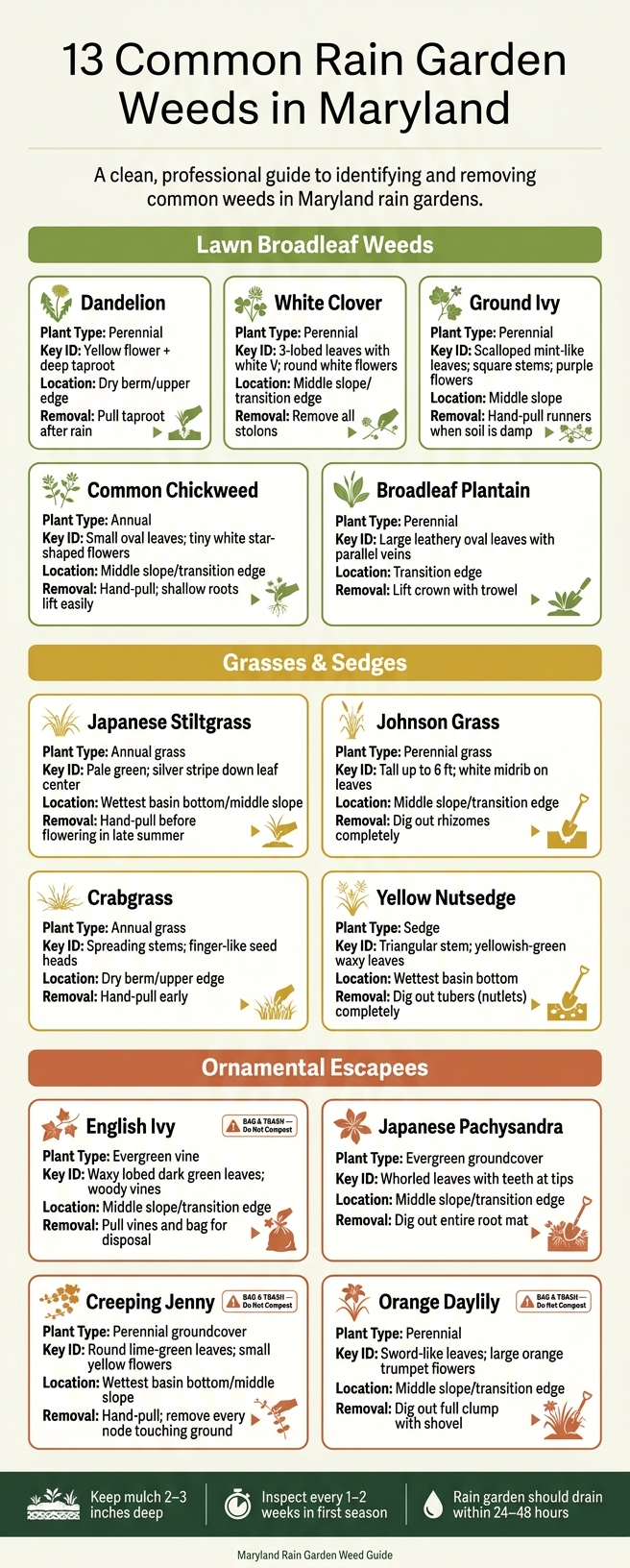
13 Common Rain Garden Weeds in Maryland: Quick ID & Removal Guide
Use these tables for a quick field check before you pull anything. Getting the ID right helps you take out weeds without harming nearby plantings or slowing drainage. Match the plant type, ID feature, and removal method below to move fast and avoid guesswork.
Table 1: Lawn Broadleaf Weeds
| Weed Name | Plant Type | Key ID Feature | Typical Rain-Garden Location | Spread Method | Best Manual Removal |
|---|---|---|---|---|---|
| Dandelion | Perennial | Bright yellow flower; deep taproot | Dry berm, upper edge | Wind-blown seeds | Pull the taproot after rain. |
| White Clover | Perennial | Three-lobed leaves with white "V"; round white flowers | Middle slope, transition edge | Creeping stolons and seeds | Remove all stolons. |
| Ground Ivy | Perennial | Scalloped, mint-like leaves; square stems; purple flowers | Middle slope | Creeping runners | Hand-pull runners when soil is damp. |
| Common Chickweed | Annual | Small oval leaves; tiny white star-shaped flowers | Middle slope, transition edge | Prolific seeding | Hand-pull; shallow roots lift easily. |
| Broadleaf Plantain | Perennial | Large, leathery oval leaves with prominent parallel veins | Transition edge | Seeds from central stalks | Lift the crown with a trowel. |
Table 2: Grasses and Sedges
| Weed Name | Plant Type | Key ID Feature | Typical Rain-Garden Location | Spread Method | Best Manual Removal |
|---|---|---|---|---|---|
| Japanese Stiltgrass | Annual grass | Pale green; bamboo-like; silver stripe down leaf center | Wettest basin bottom, middle slope | Seeds | Hand-pull before flowering in late summer. |
| Johnson Grass | Perennial grass | Tall (up to 6 ft.); prominent white midrib on leaves | Middle slope, transition edge | Rhizomes and seeds | Dig out rhizomes completely. |
| Crabgrass | Annual grass | Spreading stems; finger-like seed heads | Dry berm, upper edge | Seeds | Hand-pull early. |
| Yellow Nutsedge | Sedge | Triangular stem; yellowish-green waxy leaves | Wettest basin bottom | Underground tubers (nutlets) | Dig out tubers completely. |
Table 3: Ornamental Escapees
These are escaped ornamentals. Bag them and put them in the trash instead of composting.
| Weed Name | Plant Type | Key ID Feature | Typical Rain-Garden Location | Spread Method | Best Manual Removal |
|---|---|---|---|---|---|
| English Ivy | Evergreen vine | Waxy, lobed dark green leaves; woody vines | Middle slope, transition edge | Creeping vines and bird-dispersed seeds | Pull vines and bag for disposal. |
| Japanese Pachysandra | Evergreen groundcover | Whorled leaves with teeth at the tips | Middle slope, transition edge | Underground rhizomes | Dig out the entire root mat. |
| Creeping Jenny | Perennial groundcover | Round, lime-green leaves; small yellow flowers | Wettest basin bottom, middle slope | Creeping stems | Hand-pull; remove every node touching the ground. |
| Orange Daylily | Perennial | Sword-like leaves; large orange trumpet flowers | Middle slope, transition edge | Tuberous roots and rhizomes | Dig out the full clump with a shovel. |
For long-term control, follow the maintenance steps next.
Rain Garden Maintenance Tips to Keep Weeds From Coming Back
After you’ve identified the usual weeds, the next job is keeping them from sneaking back in.
During the first growing season, inspect the garden every 1 to 2 weeks. That early routine makes a big difference. Small weeds are much easier to deal with than big, established ones.
Once you’ve cleared out the weeds mentioned above, stay on top of regrowth with a few simple habits:
- Pull weeds while they’re young, before they flower or go to seed.
- If the roots are tangled with native plants, cut the weed at the base instead of yanking it out.
- Keep mulch 2 to 3 inches deep.
- After heavy rain, check inflow points for buildup.
- Fill bare spots fast with dense native plants.
Mulch does a lot of the heavy lifting here. Most weed seeds need sunlight to germinate, so a steady mulch layer blocks that light before seeds can sprout. If mulch gets thin or washes away, add more where needed. Just keep it a few inches back from plant stems so you don’t end up with crown rot.
Heavy rain can also bring trouble with it. Runoff often carries in weed seeds, sediment, and debris, which can clog the basin and hurt drainage. A quick check after storms helps keep water flowing the way it should and keeps the basin doing its job.
Bare soil is basically an open invitation for weeds. Filling those spots quickly with dense native plants helps shade the soil and crowd out new weed growth. It also works like living mulch, helping water move through the basin while cutting down on reinvasion.
When to Call a Professional
If weeds keep coming back after hand-pulling and mulching, the issue may be more than basic upkeep.
One of the clearest warning signs is an aggressive grass takeover. When grass-type weeds move past a small area and start spreading through the basin, it’s time to get help.
Another red flag is standing water after 48 hours. If water is still pooling after weeding and mulching, the basin likely has a drainage problem that needs to be fixed.
Large dead patches are another reason to call a professional. Bare areas leave soil exposed, and weeds move in fast. A professional can figure out what caused the dieback and replant the space.
For site-wide drainage or replanting problems, getting expert help is often faster than repeating spot treatments. Pro Landscapes MD can assess drainage, restore planting gaps, and rebuild rain-garden function.
Conclusion
Most weeds in a Maryland rain garden fit into three main groups: lawn broadleaf weeds like dandelion and chickweed, aggressive grasses and sedges like Japanese stiltgrass and yellow nutsedge, and ornamental escapees like English ivy and creeping Jenny. Each group grows in its own way, so removal isn’t one-size-fits-all. The next step is simple: identify the plant, check where it’s growing, and remove it the right way.
Identify the plant first, then match the removal method to its growth habit and location.
In Maryland rain gardens, fast identification and the right removal method help keep the basin healthy and working.
FAQs
How can I tell a weed from a young native plant?
Plant native species in clear groups of three to five. That way, the plants you meant to grow create an easy-to-read pattern, and random volunteers stand out much faster. A simpler planting palette helps too. You’ll learn your wanted plants sooner, which makes weeding a lot less of a guessing game.
If you’re not sure about a sprout, ask local gardening groups, the University of Maryland Extension, or a Master Gardener. Check your rain garden often so you can pull invasive plants before they get settled in or go to seed.
Why do weeds spread so fast in new rain gardens?
Weeds can move in fast in new rain gardens. Early heavy storms leave the soil warm and wet, which gives unwanted plants a good place to sprout. On top of that, newly disturbed ground creates bare spots where weed seeds can settle and germinate.
That’s why early weeding matters. When weeds are still small and their roots are shallow, they’re much easier to pull. Wait too long, and they can set seed and spread across the garden. Wet areas can be especially prone to this during the early stage, since they tend to favor weeds that do well in moist soil.
When should I call a professional for rain garden weeds?
Routine weeding is part of normal garden care. But when weeds keep coming back, the issue may be more than basic upkeep.
Contact Pro Landscapes MD if you’re dealing with persistent weed infestations, need soil testing, have drainage issues like standing water or poor stormwater management, or are dealing with deep-rooted invasive weeds that could spread if they’re removed the wrong way. Spring and fall are also good times to bring in expert help.
Chat with Us