









- bhavya gada
- No Comments
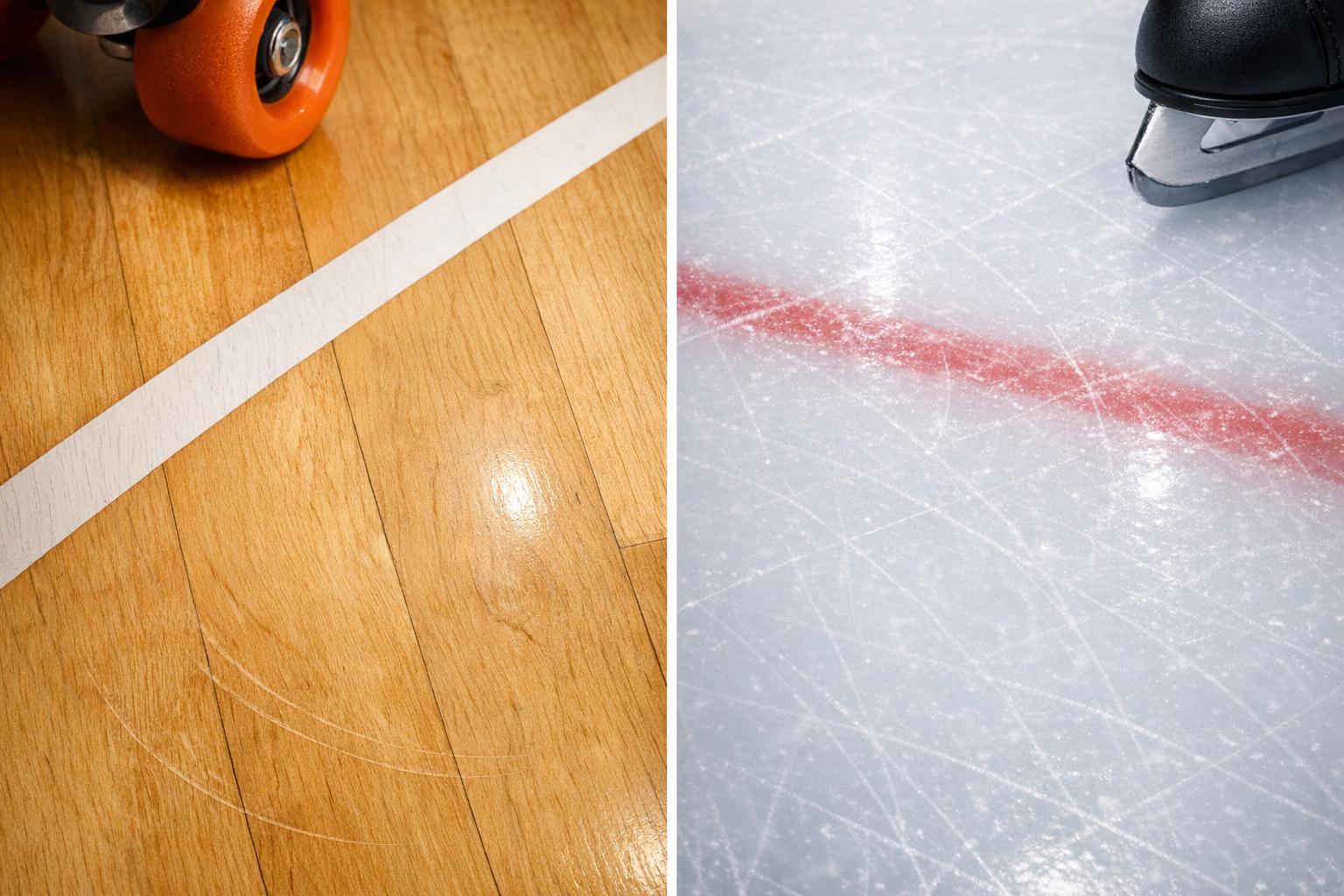
Roller and ice skating rink floors are built for entirely different experiences. Roller rinks use solid, dry surfaces like hardwood, concrete, or modular tiles for smooth, controlled wheel movement. Ice rinks, however, rely on frozen water over a refrigerated concrete slab, creating a low-friction surface ideal for blade gliding. Here’s what sets them apart:
- Materials: Roller rinks use hardwood, concrete, or tiles; ice rinks require reinforced concrete with embedded refrigeration pipes and a frozen water layer.
- Performance: Roller floors offer higher friction for controlled traction, while ice provides a slick, gliding experience.
- Maintenance: Roller rinks need cleaning and occasional refinishing; ice rinks demand constant resurfacing, refrigeration, and dehumidification.
- Costs: Roller rinks are cheaper to build and operate, while ice rinks involve high construction and energy expenses.
- Use Cases: Roller rinks are great for casual skating and multi-use spaces. Ice rinks cater to hockey, figure skating, and winter events.
Quick Comparison
| Factor | Roller Rink Floor | Ice Rink Floor |
|---|---|---|
| Surface Material | Hardwood, concrete, or tiles | Frozen water over concrete |
| Friction | High (0.2–0.4+) | Low (0.005–0.05) |
| Maintenance | Cleaning, refinishing | Resurfacing, refrigeration upkeep |
| Cost | Lower upfront and operating | High construction and energy costs |
| Best For | Public skating, training | Hockey, figure skating, events |
Roller rinks are budget-friendly and versatile, while ice rinks excel in specialized sports and winter attractions. Choose based on your goals, budget, and audience.
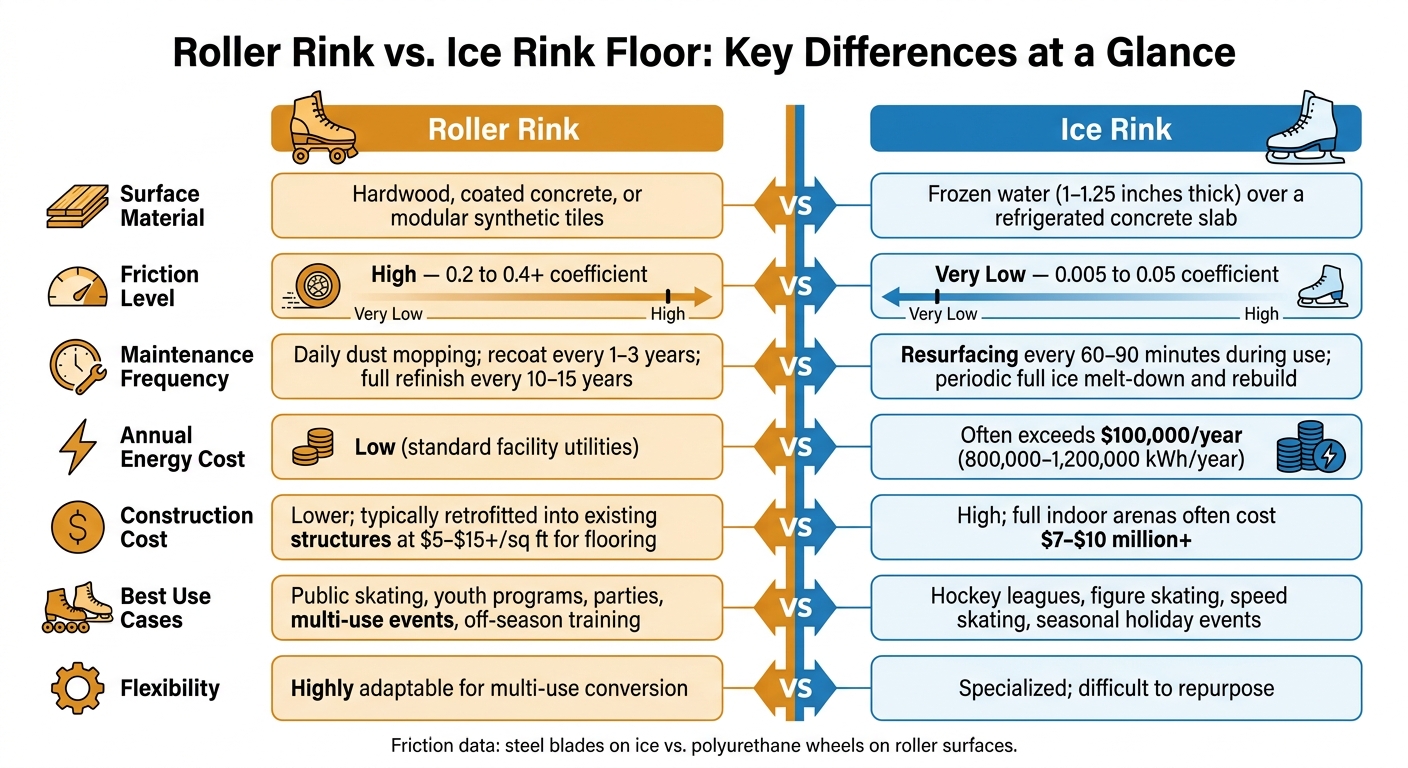
Roller Rink vs. Ice Rink Floor: Key Differences at a Glance
Roller Rink Floor Materials
Common Materials Used in Roller Rinks
In the U.S., roller rinks generally rely on maple hardwood, coated concrete, or modular synthetic tiles for their floors.
Maple hardwood is the top choice for dedicated roller rinks. Made from northern hard maple, these floors are installed over a subfloor, sanded, and finished with layers of polyurethane. The result is a smooth, fast surface with enough cushioning to minimize skater fatigue. Coated concrete, on the other hand, involves a polished concrete slab sealed with epoxy or urethane sports coatings. While it’s more budget-friendly, it lacks the cushioning that hardwood provides. Lastly, modular synthetic tiles, crafted from high-density polypropylene, are interlocking panels placed over a level base. These are favored in multi-purpose facilities since damaged sections can be replaced individually without disturbing the rest of the floor.
| Material | Best For | Trade-off |
|---|---|---|
| Maple hardwood | Dedicated rinks, artistic/speed skating | Higher upfront cost, sensitive to humidity |
| Coated concrete | Budget builds | Hard underfoot, no cushioning |
| Modular synthetic tiles | Multi-use facilities | Slightly slower glide, more wheel noise |
Each material impacts the surface’s performance, as explained below.
How Roller Rink Floors Perform
The performance of roller rink floors depends heavily on the material, surface coatings, and how the flooring is installed. Surface coatings, in particular, play a key role in how the floor feels and functions.
For hardwood floors, a glossy polyurethane finish reduces friction, allowing for faster gliding. Some formulations, however, are designed to add grip, making them more beginner-friendly. Concrete floors coated with epoxy help smooth out imperfections and can include additives to adjust slip resistance. This flexibility is especially useful for facilities catering to both casual skaters and competitive athletes.
Maple hardwood floors can be refinished multiple times, which helps distribute maintenance costs over many years. Modular synthetic tiles, while durable, need precise installation and must include expansion gaps to handle temperature changes without warping. Concrete, though stable under environmental changes, offers no cushioning – a downside for long skating sessions or falls. Across all materials, maintaining consistent traction throughout the floor is critical. Sudden changes in grip levels can lead to accidents, making uniformity a top priority for safety.
sbb-itb-843f8be
Ice Rink Floor Construction
Core Parts of an Ice Rink Floor
Building an ice rink floor involves creating a carefully designed, multi-layered system to ensure a flat and safe skating surface.
At the foundation, a compacted gravel subbase provides stability and allows for proper drainage. On top of this lies a rigid foam insulation layer, typically made of extruded polystyrene (XPS). This insulation prevents heat from rising from the ground, which would counteract the refrigeration system. In colder regions, a heated subfloor (sometimes called an anti-frost slab) is added beneath the main concrete layer. This prevents the ground from freezing and expanding, which could damage the structure above.
The main component is a 4–5 inch reinforced concrete slab, which contains a grid of pipes embedded about 2 inches below the surface. These pipes, typically made of high-density polyethylene (HDPE), are spaced 3–4 inches apart and circulate a chilled glycol or brine solution. This fluid, cooled to 16–20°F by a refrigeration plant, absorbs heat from the slab, lowering the surface temperature enough to freeze water. For context, an NHL-standard rink contains approximately 200 miles of piping within the slab.
Once the slab is cooled, crews spray fine mists of water to create a bond coat, followed by layers of white paint. They then add additional water layers, paint rink markings, and seal everything under a final clear ice flood. This process creates a skating surface that’s about 1–1.25 inches thick.
| Layer | Material | Purpose |
|---|---|---|
| Subbase | Compacted gravel | Provides stability and drainage |
| Insulation | Rigid XPS foam board | Blocks ground heat, reduces energy demand |
| Anti-frost slab | Heated glycol loop | Prevents frost heave in cold climates |
| Rink slab | Reinforced concrete | Structural base, houses refrigeration pipes |
| Refrigeration piping | HDPE or steel | Circulates chilled glycol to freeze surface |
| Ice surface | Layered water floods | Creates 1–1.25 inch skating surface |
Each layer plays a crucial role in ensuring the ice performs as intended, which we’ll explore further below.
How Ice Rink Floors Perform
Unlike roller rinks, the performance of an ice rink depends heavily on precise temperature control and the quality of the surface. In the U.S., hockey rinks aim for an ice surface temperature of 20–22°F to create hard, fast ice that keeps pucks gliding smoothly and minimizes snow buildup. For figure skating, the surface is slightly warmer, around 22–25°F, allowing skaters to achieve better edge control during spins and jumps.
Even small temperature changes – just 1–2°F – can significantly impact performance. If the ice is too cold, it becomes brittle and slippery, making it difficult for skaters to control their movements. On the other hand, if it’s too warm, the surface softens and develops ruts, especially under heavy use. To maintain consistency, modern rinks use sensors and automated systems to keep temperatures within narrow tolerances during skating sessions.
Since the ice degrades with use, regular resurfacing is essential. Typically, this happens every 60–90 minutes. Machines like Zambonis shave off the top layer of ice, clean away debris, and apply 60–80 gallons of hot water in each pass. This water freezes into a fresh, smooth layer, ensuring the ice remains consistent and predictable. Whether for a casual skater or a professional hockey player, a well-maintained rink with uniform refrigeration and resurfacing keeps the experience enjoyable and reliable.
Performance Differences: Roller vs. Ice Rink Floors
Skating Feel: Roller vs. Ice Surfaces
The main difference between roller and ice surfaces comes down to friction. Ice has an incredibly low coefficient of friction – steel blades gliding on ice experience friction levels between 0.005 and 0.05, depending on factors like speed and temperature. To put that into perspective, it’s similar to the friction of oiled metal. Roller rink floors, on the other hand, have much higher friction. Polyurethane wheels on these surfaces typically measure friction coefficients between 0.2 and 0.4, or even higher, depending on wheel hardness and the floor’s finish. In short, ice is far slicker than roller surfaces.
This difference in friction changes how each surface feels. On roller floors, skaters experience immediate grip when pushing off. Stops are easier to control, turns feel stable, and maintaining balance at slow speeds is more forgiving. Ice, however, offers a completely different experience. A single push can send you gliding across the rink, and even small weight shifts – or dull blades – can lead to unexpected slides. For beginners, roller skating tends to be easier to pick up, while ice skating requires mastering blade edges right from the start.
Stopping methods also highlight these contrasts. Roller skaters use techniques like toe stops, heel brakes, T-stops, and plow stops, all relying on wheel friction against the floor. Ice skaters, however, use snowplow and hockey stops, where the blade digs into or shaves the ice. These moves require more practice and confidence to execute smoothly.
| Factor | Roller Rink Floor | Ice Rink Surface |
|---|---|---|
| Friction level | High (0.2–0.4+) | Very low (0.005–0.05) |
| Top speed at equal effort | Lower | Higher |
| Stopping technique | Wheel resistance (toe stops, brakes) | Blade edge shaving ice (hockey stop) |
| Balance for beginners | Easier to manage | Steeper learning curve |
| Glide length | Short | Long |
These differences in friction and handling create unique challenges and opportunities for skaters on each surface.
How Each Floor Supports Skill Development
The traits of each surface play a big role in shaping how skaters develop their skills. Roller floors, with their high friction, emphasize strong pushes, ankle stability, and precise footwork. The instant feedback from the grippy surface helps skaters refine their movements quickly. For example, roller derby athletes rely on explosive starts, sharp lateral movements, and controlled blocking – techniques that depend on the floor’s ability to grip their wheels during quick direction changes.
Ice surfaces, in contrast, focus on edge control, glide efficiency, and balance during extended low-friction phases. Hockey players hone rapid acceleration, deep-edged turns, and sliding stops, while figure skaters practice jump takeoffs and spin entries that require the smooth, consistent glide that only ice can provide. These skills are unique to ice and can’t be fully replicated on roller floors.
That said, there is some overlap in skill development between the two surfaces. Many figure skating and ice hockey programs incorporate roller or inline skating during the off-season to maintain lower-body strength and stride mechanics when ice time is limited or costly. Posture, weight shifts, and rhythm in strides translate reasonably well between the two. However, techniques that rely on ice’s low friction – like deep hockey stops or figure skating’s rocker turns – can only be mastered on ice itself.
Maintenance and Upkeep
After exploring material performance, it’s clear that proper maintenance is essential to keep both roller and ice rinks safe and functional.
Maintaining Roller Rink Floors
Roller rink floors need daily attention to stay in top shape. Dust mopping every day is crucial to remove grit, which can quickly wear down floor finishes. For busier rinks, an auto-scrubber is typically used at least once a week, paired with a pH-neutral, manufacturer-approved cleaner to avoid damaging the finish.
For more intensive upkeep, hardwood floors – commonly found in traditional roller rinks – require screening and recoating every one to three years, depending on the level of traffic. A full sand-and-refinish, which is much more involved, is generally needed every 10 to 15 years for well-maintained facilities. This process costs about $3.00–$5.00 per square foot and requires the rink to close for several days to allow the coatings to cure. On the other hand, modular sport tiles are much simpler to maintain: regular sweeping, damp mopping, and replacing damaged tiles as needed – no full closures necessary.
Humidity poses the biggest challenge for roller rink floors, especially hardwood. Too much moisture can cause the wood to cup, warp, or develop gaps. Keeping HVAC systems and dehumidifiers in good condition is just as important as regular cleaning to protect the floor.
Maintaining Ice Rink Floors
Ice rinks require a completely different level of care, with highly specialized maintenance to ensure they perform well.
Resurfacing is a cornerstone of ice rink upkeep. Machines like Zambonis shave off 0.02–0.04 inches of ice with each pass and apply hot water to create a smooth surface. Beyond that, staff must constantly monitor the temperatures of the brine or glycol in the refrigeration system and check for uneven ice buildup along the boards. Many arenas rely on desiccant dehumidifiers and ceiling insulation to control humidity and temperature. Occasionally, the entire ice sheet must be melted down and rebuilt to correct thickness, repaint lines, and inspect the underlying slab.
Maintenance Costs and Effort Comparison
Maintaining roller rinks is relatively straightforward, relying on standard cleaning tools and occasional refinishing. Ice rinks, however, require specialized machinery, trained operators, and continuous energy consumption to keep refrigeration and dehumidification systems running 24/7, which significantly drives up operational costs.
For context, a full-size indoor ice sheet in North America typically consumes 800,000 to 1,200,000 kWh of energy per year, often resulting in annual energy bills exceeding $100,000, depending on local electricity rates. When you add the cost of maintaining resurfacing equipment, refrigeration system service contracts, and skilled labor, the total annual operating expenses for an ice rink can easily climb into the hundreds of thousands of dollars.
| Factor | Roller Rink Floor | Ice Rink Floor |
|---|---|---|
| Daily tasks | Dust mopping, spot cleaning | Resurfacing every 60–90 min, ice inspection |
| Major resurfacing | Every 1–3 years (recoat); 10–15 years (full refinish) | Periodic full ice melt-down and rebuild |
| Sensitivity to ambient conditions | Moderate (humidity affects wood) | High (temperature, humidity, airflow all critical) |
| Specialized equipment needed | Auto-scrubber, floor finishes | Zamboni, edger, refrigeration plant |
| Estimated annual energy cost | Low | Often exceeds $100,000 |
| Recoating cost (hardwood) | ~$0.75–$1.50/sq ft (screen & recoat) | N/A |
| Downtime for major work | Several days (refinishing) | Short breaks between sessions |
These maintenance practices not only influence daily performance but also have a big impact on long-term facility costs. For those planning new construction or renovations, proper site drainage and grading around the building are critical. This is particularly important for ice rinks, as water intrusion beneath the slab can lead to frost heave or uneven surfaces – problems that are both costly and difficult to fix.
Installation and Facility Requirements
Installing rinks comes with specific demands, and these requirements directly impact how well the rink performs and the effort needed to maintain it over time.
What Roller Rinks Need to Be Built
Building a roller rink is relatively simple compared to other types of rinks. They can be set up in a variety of spaces – think warehouses, former big-box stores, or community centers – with minimal structural changes. The main cost considerations include flooring (ranging from $5 to $15 or more per square foot), lighting, sound systems, and safety barriers. Ceiling height and open floor plans are also important – fewer interior columns mean a safer, more open skating environment. These elements should be factored into the planning process early on.
On the other hand, ice rinks come with a whole different level of complexity.
Construction Challenges for Ice Rinks
Ice rinks require a sophisticated mechanical setup. A typical indoor ice rink includes a reinforced concrete slab with embedded refrigeration pipes, insulation layers made of extruded polystyrene, vapor barriers, and a dedicated mechanical room. This room houses essential equipment like chillers, brine pumps, and condensers. For a full-sized rink, the ice plant usually needs 100 to 150 tons of refrigeration, depending on the building design and local climate.
The building itself must be designed to minimize heat and moisture entering the rink. Dehumidification systems – often using desiccant technology – are critical to prevent issues like fog, condensation on the ceiling, and soft ice. Additional features like Zamboni access ramps, snow melt pits, and proper service circulation are also necessary. With an NHL-sized rink measuring 200 feet by 85 feet (17,000 square feet), fitting all the required infrastructure into the space requires careful planning from the outset.
These construction differences have a big impact on upfront costs and the facility’s long-term performance.
Cost and Long-Term Durability
The complexity of installation plays a major role in long-term investment. Modern indoor ice arenas often cost upwards of $7–$10 million to build. Roller rinks, on the other hand, are typically retrofitted into existing structures, making them a more affordable option. With proper maintenance, roller rinks can last over 40 years, while their modular sport tiles usually hold up for 10–15 years under normal use.
For ice rinks, durability depends on several factors: insulation quality, the condition of the concrete slab, and corrosion-resistant piping. Mechanical failures can lead to damage not only on the ice surface but also in the structure beneath it. In comparison, roller rinks require a much smaller capital investment and are easier to construct, making them a more accessible option for many communities.
Best Use Cases for Each Rink Floor Type
When deciding between a roller rink and an ice rink, it’s all about matching the surface to its intended purpose. Each type offers distinct advantages tailored to specific activities and user needs. Here’s how they stack up:
Roller Rinks for Recreation and Training
Roller rinks shine in settings that prioritize flexibility and ease of use. They’re perfect for public skating sessions, after-school programs, birthday parties, and family events – situations where a durable surface that doesn’t require constant maintenance is key. Plus, they’re designed for multi-use, making it easy to switch gears for sports or other events, which can help maximize revenue for facility operators.
Roller surfaces are also great for skill development. Their slightly higher friction compared to ice provides beginners with better control, making it easier to learn balance, stopping, and turning without the fear of high-speed falls. Many youth programs in the U.S. start kids on roller surfaces before transitioning to ice. For athletes like hockey players and speed skaters, roller rinks also serve as an effective training ground during the off-season. Inline skating on these surfaces mimics the mechanics of ice skating and offers similar cardiovascular benefits.
While roller rinks are versatile and accessible, ice rinks cater to more specialized needs, particularly in competitive sports and winter-themed events.
Ice Rinks for Sports and Seasonal Events
Ice rinks are the go-to choice for ice sports like hockey, figure skating, and speed skating. These activities require the unique qualities of real ice – its hardness, smoothness, and responsiveness to blades are essential for competitive performance. In regions with strong hockey and figure skating traditions, especially in northern states, the demand for ice rinks is steady, driven by leagues, lessons, and tournaments. While operating costs are higher, the consistent usage often makes up for it.
Ice rinks also play a starring role in seasonal attractions. Holiday rinks and winter festivals, especially popular from November to January, draw large crowds and enhance community appeal. The association of real ice with winter traditions in the U.S. makes these rinks a magnet for tourism and local branding. Some facilities even opt for temporary ice installations, using insulated flooring to create a seasonal rink that can be removed after peak demand, allowing the space to be repurposed.
| Use Case | Roller Rink | Ice Rink |
|---|---|---|
| Public recreational skating | Optimal | Good |
| Youth programs and parties | Optimal | Limited |
| Hockey leagues and tournaments | Not suitable | Optimal |
| Figure skating instruction | Limited | Optimal |
| Off-season athlete training | Good | Not applicable |
| Seasonal holiday events | Limited | Optimal |
| Multi-use facility conversion | Optimal | Difficult |
Conclusion: Key Differences at a Glance
Roller and ice rink floors serve entirely different purposes, and their construction reflects these distinctions. Roller floors – made from hardwood, coated concrete, or modular sport tiles – are designed for traction and versatility. Ice rink floors, on the other hand, feature a refrigerated concrete slab with embedded piping that freezes a thin layer of water (around 1–1.5 inches) into ice.[3][4]
The way these surfaces perform highlights their unique qualities. Roller surfaces provide higher friction and controlled traction, making them beginner-friendly and suitable for a variety of activities. Ice surfaces, with their low-friction glide, are perfect for hockey and figure skating but require more precise skills and careful maintenance. These performance differences also influence costs and upkeep.
Speaking of costs, roller rinks are generally more affordable to build and maintain. They don’t require chillers, daily resurfacing, or dehumidification systems. Ice rinks, however, represent a much larger investment, with full-size indoor facilities often costing millions to construct and hundreds of thousands annually to operate.[3][2]
| Aspect | Roller Rink | Ice Rink |
|---|---|---|
| Surface Material | Hardwood, concrete, or sport tiles | Frozen water over a refrigerated slab |
| Friction/Feel | Higher friction for controlled traction | Low-friction glide via a thin water film |
| Installation Complexity | Moderate | High (requires piping, insulation, chillers, and boards) |
| Operating Costs | Lower | Higher (refrigeration, specialized staffing, energy) |
| Flexibility | Highly adaptable for various uses | Specialized for ice sports |
The choice ultimately depends on your facility’s goals. If you’re aiming for year-round, versatile programming with lower overhead, a roller floor is the way to go. However, if your focus is on hockey leagues, figure skating, or winter-themed events – and you have the budget to cover the higher costs – an ice floor is the better fit. For facilities in central Maryland and Washington, DC, proper site grading, drainage, and hardscaping are essential to protecting the structural integrity of either rink type. These services, offered by Pro Landscapes MD, can ensure long-term durability.[1]
FAQs
Can one building support both roller and ice skating?
Yes, it’s entirely possible for a single building to accommodate both roller skating and ice skating. The key lies in designing the space with the right infrastructure. Roller skating needs a smooth, durable floor, while ice skating depends on refrigeration systems to keep the ice frozen. Combining these uses calls for advanced engineering to handle surface materials, support layers, and climate control effectively. For outdoor needs like landscaping or drainage, Pro Landscapes MD provides expert hardscaping and stormwater management services across Maryland and Washington, DC.
What type of floor is safest for beginners?
The text doesn’t clarify whether roller skating or ice skating is safer for beginners. If you can provide details about the flooring materials or specific surfaces discussed, I can tailor the response to that context.
What contributes most to ice rink operating costs?
The provided information does not mention anything about the costs associated with operating an ice rink. Pro Landscapes MD focuses on delivering expert services in landscaping, hardscaping, and drainage solutions for properties located in Maryland and Washington, DC. However, their expertise does not extend to ice rink management or maintenance.
Chat with Us