









- bhavya gada
- No Comments
A soil binder can help stop bare soil from washing away – but only when water stays shallow and spread out. If runoff starts to form a channel, a binder alone usually won’t hold.
Here’s the short version:
- I’d use a soil binder on bare, disturbed soil that will sit exposed for more than about 2 weeks
- It works best on gentle to moderate slopes with sheet flow
- It needs about 24 hours to dry before rain
- It is a poor fit for swales, drain outlets, ditches, and washout paths
- On slopes steeper than 3:1, or where runoff keeps building speed, I’d pair it with grading, diversions, drains, mulch, or planting
- After storms with 0.5 inches or more of rain, I’d check for rills, peeling crust, and sediment at the bottom of the slope
A few numbers matter here. Sheet flow often starts turning into concentrated flow within about 400 feet. Some slope guidance also treats lengths over 50 feet as a sign that added flow control may be needed. And near a house, finish grade should drop 6 inches over the first 10 feet to move water away from the foundation.
Soil Erosion & Sediment Control Solution – GRT Enviro Binder
sbb-itb-843f8be
Quick Comparison
| Binder type | Best use | Slope fit | Planting fit | Main issue |
|---|---|---|---|---|
| Plant-based / organic | Short-term cover on seedbeds | Flat to moderate | High | Breaks down faster |
| Polymeric | Temporary hold on disturbed soil | Moderate | Medium | Fit depends on soil and application |
| Cementitious | Hard-surface stabilization | Steeper or higher-flow areas | Low | Not a fit where vegetation is planned |
My takeaway: soil binders are a short-term surface fix, not a drainage fix. If the same area keeps washing out, I’d look at the water path first – then use binders as part of the setup, not the whole answer.
How Soil Binders Limit Sediment Movement During Storms
Soil binders are sprayed onto bare soil to help keep loose particles from washing away during rain. Once they dry, they form a thin crust on the surface. That crust helps soil particles stick together and cuts down erosion from raindrop impact and sheet flow.
There’s a catch, though: this works best when runoff stays shallow and spread across the surface. If water starts to gather and speed up, the binder has a much harder time doing its job.
These products make sense for newly graded areas and other exposed soil surfaces. Most need about 24 hours to cure, so timing matters. Put them down before rain is in the forecast.[3][4]
How Binders Hold Surface Particles in Place
A binder-treated surface softens the hit from raindrops and helps stop fine particles from breaking loose. That matters most with silts and clays. Those small particles travel far, and they’re often what turns runoff into sediment-heavy flow that ends up in storm drains, streets, and low spots.
Binders can also help keep seed, mulch, and hydromulch from shifting on newly seeded slopes. That’s a big plus right after installation, when the surface is still easy to disturb. The effect is strongest where water moves as sheet flow, not where it cuts into a channel.
Common Binder Types and Where Each Fits
Here’s the basic fit for the main binder categories:
| Binder Type | Best Practical Fit |
|---|---|
| Organic / plant-based (cellulose, plant gums, starches) | Light-duty temporary stabilization for newly seeded lawns and moderate slopes |
| Polymeric (PAM-based products) | Stronger temporary stabilization for steeper slopes and construction areas |
| Cementitious / mineral-based (cement, lime, or similar materials) | More rigid surface stabilization for non-vegetated access paths and utility corridors |
PAM-based binders can reduce erosion, but bare-soil use is generally limited to slopes 3:1 or flatter.[6] In plain terms, the best product depends on how water moves across the site. A binder that works well on one slope can fall short on another if runoff behaves differently.
Why Soil Binders Cannot Work Alone
A soil binder only deals with the surface layer. It does not change how much water reaches the area, where that water goes, or how slope shape affects flow. That’s why binders tend to work best on shallow, even slopes with fine surface particles that can form a crust or stay locked in place.
They perform best under uniform sheet flow. Once runoff starts to concentrate, other site controls start to matter more. At that point, grading, drains, and planting often decide whether the binder stays in place or gives way.
Matching Soil Binders to Site Conditions
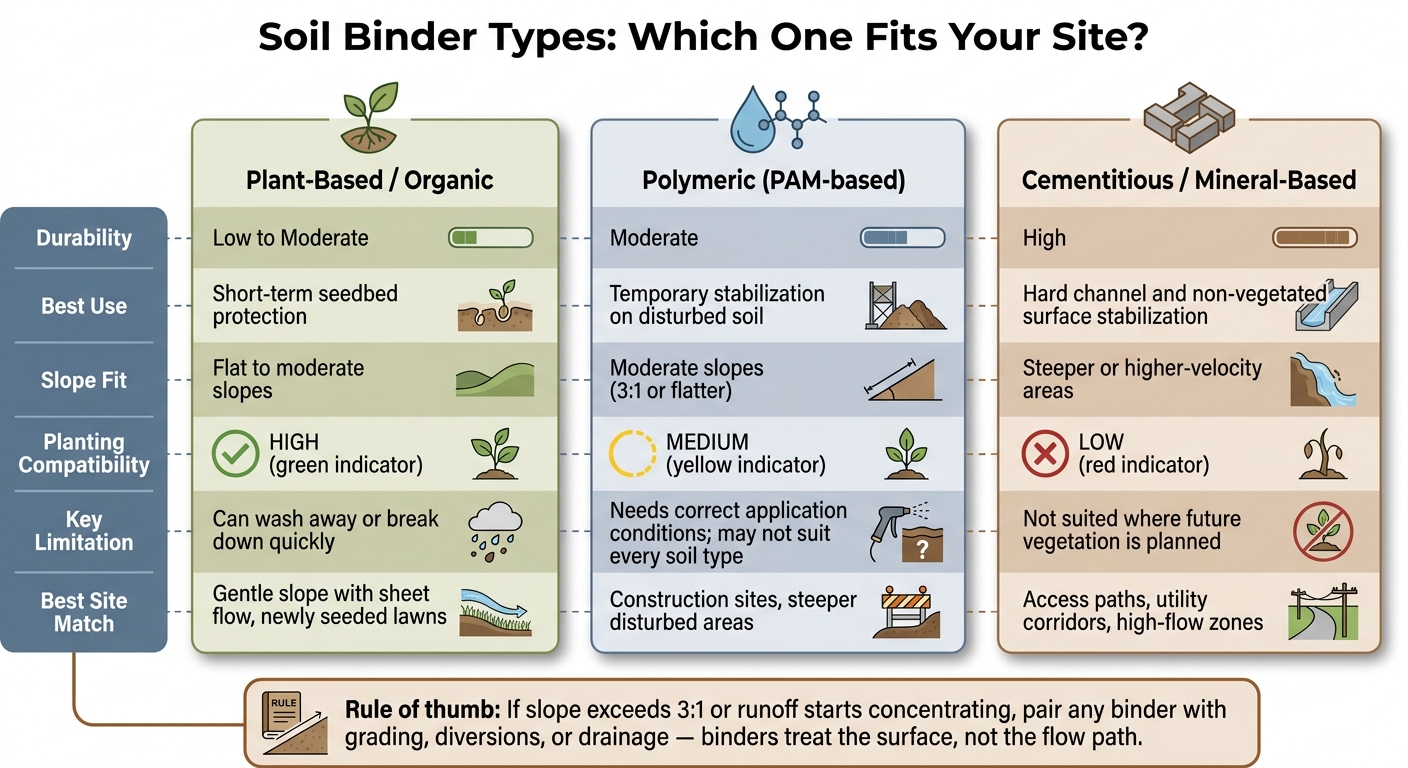
Soil Binder Types: Which One Fits Your Site?
Binder performance comes down to three things: runoff path, slope, and soil type. Once you’ve covered the surface, the next step is figuring out where a binder makes sense on the site.
Sheet Flow vs. Concentrated Flow
The rule is pretty simple: binders work best when water moves as sheet flow. Once runoff collects into a channel, you need drainage or armoring instead.
Sheet flow is shallow, even movement across a broad disturbed area. Think of a freshly graded lawn after a light to moderate rain. The water spreads out and moves across the surface.
Concentrated flow is another story. That’s water pushed into a defined path, like a swale, drain outlet, ditch, or erosion channel. In those spots, flow shear is more than a binder can hold back. Use rock armoring, lined channels, or drain structures instead. A binder can still help on the nearby disturbed soil, just not inside the flow path itself.[10][11]
How Slope Angle and Length Affect Binder Performance
On a mild grade with diffuse runoff, a binder paired with mulch or seeding is often enough to hold the surface while plants get established. But as slope angle increases, runoff moves faster and hits the surface harder. That cuts into binder performance.
Slope length matters just as much as slope angle. USDA guidance says sheet flow often starts to concentrate within about 400 feet of slope length.[1][7] Kentucky erosion-control guidance flags slopes longer than 50 feet as needing added flow control, and slopes steeper than 3:1 as needing more than binder alone, especially on erodible soils.[9][12]
That’s the key shift: when runoff starts building speed, the answer is no longer just surface treatment. You need flow control first. Add grade breaks, berms, or diversions before water reaches the treated area.
How Soil Type and Site Condition Change the Approach
Soil texture has a direct effect on how well a binder sticks and how fast the surface wears away.
Clay soils tend to seal over and shed water instead of soaking it in. That makes rill formation more likely as runoff starts to collect. Sandy soils do the opposite. They take in water fast, but the particles are loose and weakly bound, so they detach easily. In many cases, sandy soils need a binder plus mulch or a blanket for steady surface protection.[8][9]
Disturbed subsoil and compacted fill bring a different problem. They often have low infiltration, little organic matter, and weak structure. In plain terms, they’re hard, poor-quality surfaces that don’t give a binder much to grab onto. Roughen compacted or fill material first so the binder can bond to the surface, then add mulch or a blanket if needed.[4][13]
Use the table below to match binder use to the site condition.
| Site condition | Binder use | What to add or use instead |
|---|---|---|
| Gentle slope, sheet flow | Good fit | Mulch or seeding |
| Long slope, runoff building speed | Limited alone | Grade breaks, diversions, then binder on disturbed soil |
| Swale, channel, or drain outlet | Poor fit | Rock lining, blankets, or armoring |
| Silty or highly erodible soil | Less reliable alone | Stronger surface protection plus vegetation |
| Sandy or loose fill soil | Possible, prone to detachment | Roughening, mulch, and runoff control |
Combining Soil Binders with Grading, Drains, and Planting
When runoff starts beating a binder, the answer usually isn’t more surface treatment. It’s better site design. Pair binders with grading, drains, and planting, and each one handles a different part of how water moves across the property.
Grading to Direct Water Away from Problem Areas
Grading is where most drainage work begins. It helps deal with foundation pooling, basement seepage, and water hitting treated soil too fast. Finished grades should drop at least 6 inches over the first 10 feet away from the foundation so water doesn’t collect near footings or work its way into basements.[5][19] Of course, that only helps if the rest of the yard sends that water to a safe outlet.
Right after grading, soil is exposed and easy to wash out. Freshly shaped slopes, berms, and the edges where hardscape features meet lawn are all common trouble spots. That makes them good places for binders, especially before plants have time to take root. Around foundation fill, applying a binder right after seeding and mulching can help stop small rills from forming and turning into channels that steer water back toward the house.[9][16]
French Drains, Dry Riverbeds, Swales, and Pipe Outlets
When water keeps choosing the same route, drainage features need to take over. French drains move subsurface water away from wet areas and foundation walls. Vegetated swales and dry riverbeds carry surface runoff through the yard more safely while also slowing it down.[5][20]
Some spots need hard protection, not binders. Pipe outlets, downspout discharges, and tight channel bends should use riprap, stone, or reinforced matting.[17][18] Those areas take too much force for a surface treatment alone.
Binders still have a job nearby. They work well on the side slopes of swales and dry riverbeds and around French drain trenches. In those places, they help hold seed and mulch in place while plants get started. They also help keep fine soil out of drainage stone, which helps preserve drainage capacity.[2][5]
Planting as the Long-Term Soil Hold
Vegetation is what takes over for binders in the long run. Grasses and groundcovers send out fine roots that lock soil particles together and make the surface harder to erode. Shrubs and trees root deeper, which helps hold slopes and improve infiltration. Their canopy and leaf litter also soften raindrop impact and slow water moving across the ground.[14][15]
Before plants fill in, binders protect the setup those plants need. They help keep topsoil from crusting and washing into rills, tack seed to the surface, and keep mulch from sliding downhill during storms. Once plants form a dense root mat, binders usually aren’t needed anymore. Planting is what turns short-term surface cover into long-term slope hold.
Planning, Maintenance, and Key Takeaways
When a Soil Binder Application Makes Sense
After you’ve matched the binder to the slope and runoff path, timing is the next call. Use a soil binder when bare soil is going to sit exposed long enough to erode before planting begins. It also helps on bare soil above retaining walls and other drainage features, where fine soil can wash into drainage stone and clog flow paths.
A simple rule of thumb: if grading will be idle for more than about 2 weeks and planting hasn’t started, apply a binder [22][21]. It gives the soil short-term cover until vegetation can take over.
What to Check After Heavy Rain
After the first heavy rain, inspect the treated area right away. Walk the site within 24 hours after any storm that drops about 0.5 inches or more [3][23]. Check for:
- Fresh rills or small channels
- Areas where the binder film has cracked or peeled
- Muddy sediment collecting at the base of slopes or near drain inlets
- Exposed roots or edges where the soil has pulled back
If the surface stays in place and sediment loss is low, the binder is doing its job. If the same spot keeps washing out, that usually points to a drainage or grading issue that a surface treatment won’t solve on its own.
Reapplying the binder may help for the moment. But the better fix is to change the flow path, improve drainage, or get plants established sooner.
Binder Comparison Table and Final Summary
This is a quick way to match binder type to site conditions.
| Binder Type | Durability | Typical Use | Planting Compatibility | Slope Suitability | Key Limitation |
|---|---|---|---|---|---|
| Plant-based / organic | Low to moderate | Short-term seedbed protection | High | Flat to moderate slopes | Can wash away or break down quickly |
| Polymeric | Moderate | Temporary stabilization on disturbed soil | Moderate | Moderate slopes | Needs the right application conditions and may not fit every soil type |
| Cementitious | High | Hard channel surfaces | Low | Steeper or higher-velocity areas | Not suited where future vegetation is the goal |
Soil binders can cut surface soil loss, but results still depend on slope, runoff path, and soil type. They work best when used with grading, drainage, and planting.
If washouts, sediment near drains, or slope failures keep coming back, the flow path still needs to be fixed. In those cases, Pro Landscapes MD can combine binders with grading, drainage, and planting across central Maryland and Washington, DC.
FAQs
How do I know if my runoff is sheet flow or concentrated flow?
Watch how water moves across your property during a storm. That gives you a clear picture of where runoff goes and how it behaves.
Sheet flow moves in a thin, even layer across the ground without forming a channel. Concentrated flow builds up and moves through a defined path, such as a swale, low spot, or drainage channel.
Map those drainage paths and note where water tends to collect. That simple step can help you spot the pattern and choose the right erosion control measures.
Can I use a soil binder on a steep slope?
A soil binder on its own may not do the job on a steep slope. On grades steeper than 3:1, it’s usually smarter to lead with structural support and vegetation if you want stronger, longer-term stability.
Options like turf reinforcement mats, deep-rooted native vegetation, and physical barriers such as reinforced silt fences or terracing can slow runoff and help shield the soil from washout. Just make sure your plan lines up with local drainage and stormwater rules.
When should I use a binder instead of fixing drainage first?
You shouldn’t use binders instead of fixing drainage first. Proper drainage is a basic requirement before or alongside soil stabilization.
Binders work best when drainage is already in place. If the soil stays saturated, they can lose strength and won’t do the job as well. A professional can help make sure the grading and drainage set you up for a result that lasts.
Chat with Us