









- bhavya gada
- No Comments
If you build, grade, or add hard surfaces in Howard County, stormwater rules can change your plan fast. I’d boil it down like this: county review is not just about pipes. It also covers grading, easements, runoff paths, storage, swales, inlets, channels, and how water leaves the site.
Here’s the short version:
- Howard County uses both local rules and Maryland rules for stormwater design.
- ESD is required statewide, but in some Howard County watersheds, ESD alone is not enough.
- In the Tiber-Hudson and Plumtree watersheds, projects may need to handle:
- 10-year storms
- 100-year storms
- Short-duration, high-intensity storms
- A key local benchmark comes from the July 2016 Ellicott City flood:
- 6.6 inches of rain in 3.55 hours
- In parts of Ellicott City, county targets aim to keep modeled 100-year flood depth at 1 foot or less and cut flow speed to under 20% of 2016 and 2018 flood levels.
- Do not build in or fill a drainage easement.
- Adding a patio, driveway, wall, or grading change can trigger drainage review if runoff shifts onto nearby lots or into public systems.
- Permeable pavers, swales, and micro-bioretention can help reduce runoff, but in higher-risk watersheds they do not replace required storage.
In other words: closed systems like pipes move water away, while open systems like swales slow it down and spread it out. Howard County often wants both working together, especially where flash flooding is a known issue.
Quick comparison
| Area | What it means for you |
|---|---|
| County code + design manual | Local drainage details must match county standards |
| Maryland stormwater manual | ESD is the starting point for site design |
| CR-123 watersheds | Tighter flood and flow rules apply |
| Easements and lot grading | Water must keep a clear path across the site |
| Hardscape work | New impervious area can mean added drainage controls |
| Outfalls and channels | Discharge points need erosion control |
If I were planning site work in Howard County, I’d check the property’s watershed, easements, and runoff route before finalizing any layout. That one step can affect the full drainage plan.
sbb-itb-843f8be
Regulatory Framework: County and Maryland Stormwater Requirements
Howard County works within Maryland’s statewide stormwater rules, but in some watersheds, the county goes further.
How Howard County Code Applies to Conveyance Systems
Public and private drainage systems have to meet county standards before they can be approved. That review covers conveyance capacity, drainage routing, and discharge control. The Howard County Department of Planning and Zoning’s Development Engineering Division reviews submitted plans, and the Construction Inspection Division checks drainage infrastructure before the county accepts it.
The bar gets higher in flood-prone areas. Council Resolution 123 (CR-123), adopted in 2019 after the Ellicott City floods, set tighter standards for the Tiber-Hudson and Plumtree watersheds [2]. Under CR-123, new development and redevelopment in those areas must handle short-duration, high-intensity storms, along with 10-year and 100-year storm events [2].
That shift came from hard experience. The July 2016 Ellicott City flood dropped 6.6 inches of rain in 3.55 hours, which pushed the county past the limits of old 24-hour storm modeling [2]. In plain terms, the old playbook wasn’t enough. Howard County’s local rules now sit on top of Maryland’s statewide ESD requirement, and those approvals shape how conveyance systems are sized, routed, and tied together.
How the Maryland Stormwater Design Manual Shapes Local Design
Maryland’s Stormwater Design Manual sets the statewide starting point for design. It requires Environmental Site Design (ESD), which uses small-scale filtering and infiltration to manage the 1-year, 24-hour storm and improve water quality.
In Howard County, ESD is required, but in higher-risk watersheds, it can’t do the whole job by itself. Those areas also need larger control measures, such as ponds and underground storage pipes, to manage peak flows and cut downstream impacts [2]. So even if a site plan meets Maryland’s statewide ESD rules, it may still miss Howard County’s local standards, especially in the Tiber-Hudson and Plumtree watersheds.
Before locking in a drainage design, it makes sense to confirm which watershed the property falls within. That one check can change the design path for pipes, channels, inlets, and outfalls discussed next.
Technical Design Standards for Pipes, Channels, and Surface Conveyance
Design Storms, Peak Flow Control, and Hydraulic Methods
These standards set the storm events each system has to handle. In Howard County, local rules add stricter controls in the Tiber-Hudson and Plumtree watersheds, including 10-year, 100-year, and short-duration design storms [2].
The short-duration model is based on 6.6 inches of rainfall in just 3.55 hours [2]. That benchmark came from the July 2016 storm because it tracks flash-flood peak flow better than a 24-hour storm curve [2]. The point is simple: cut peak stormwater flow from new development and make downstream areas safer and better able to handle future storms [2].
In Lower Main Street, the target is specific. Modeled 100-year flood depth should stay at or below 1 foot, and flow velocity should drop to less than one-fifth of the 2016 and 2018 flood levels [2].
Closed Systems: Storm Drains, Inlets, Manholes, and Outfalls
Closed systems – pipes, inlets, manholes, and outfalls – mainly move water from one place to another. But there’s a tradeoff. When flow gets concentrated, it hits harder at the outlet.
That’s why outfalls need energy dissipation to limit erosion and protect downstream channels, especially in steep parts of Ellicott City where shallow granite layers make channel damage more likely [2].
The Bureau of Highways maintains county storm drains and related stormwater facilities [1].
So pipe capacity, inlet placement, and outfall protection aren’t separate choices. They’re part of the same drainage setup and need to be designed together.
Open Systems and ESD Features: Swales, Channels, and Micro-Practices
Open conveyance systems do more than carry runoff. Features like vegetated swales, filter strips, and micro-bioretention can slow water down, filter it, and cut velocity while still moving flow across a site. That lines up with Maryland’s ESD approach and matters even more in Howard County, where ESD practices are paired with large storage and conveyance systems to manage peak flows [2].
Still, open systems can only do so much. They need enough surface area, and flow speeds have to stay low enough to avoid eroding the channel lining. During high-intensity storms, they can’t handle peak flow on their own, which is why the county uses them alongside larger infrastructure [2].
A simple way to think about it:
- Closed systems move runoff fast through pipes.
- Open systems slow runoff, filter it, and cut velocity before discharge.
On residential sites, the same idea shows up in swales, yard grading, and runoff capture before water enters a pipe. That balance between surface conveyance and storage shapes grading, hardscape drainage, and runoff control.
What the Standards Mean for Residential Site Work, Hardscaping, and Drainage Planning
Lot Grading, Easements, and Private Drainage Constraints
At the lot level, Howard County’s stormwater rules affect how grading, paving, and drainage features move water off a property. The county requires private runoff to be routed in a way that does not increase downstream flow depth or velocity [2].
That has direct site-work impacts. Do not fill or build over a drainage easement. These areas need to stay open so they can carry peak storm flows. If an overland relief route gets blocked, water can back up and cause nuisance flooding on nearby lots. Before adding a retaining wall, fence, or graded feature near a property line, check the location of all drainage easements with Howard County’s Department of Planning and Zoning.
Patios, Driveways, Environmental Pavers, and Runoff Reduction
The same rules also shape how impervious surfaces can be added. New patios, driveways, and walkways increase impervious area, which means more runoff. In the Tiber Branch (Ellicott City) and Plumtree watersheds, CR-123 applies stricter local controls and requires stormwater management for short-duration, high-intensity storms [2].
For homeowners, that usually means planning hardscape and drainage features together, not as separate jobs. Permeable pavers and micro-bioretention can help reduce runoff on residential sites. But in high-risk watersheds, they do not replace required storage [2].
Working With a Local Drainage and Landscape Contractor
Design and permit coordination should happen before construction begins. These rules are county-specific, and small site decisions can affect grading, drainage flow, and permit approval. A local contractor should line up the grading plan, hardscape layout, and drainage details with Howard County requirements before work starts.
Research Trends, Comparisons, and Key Takeaways
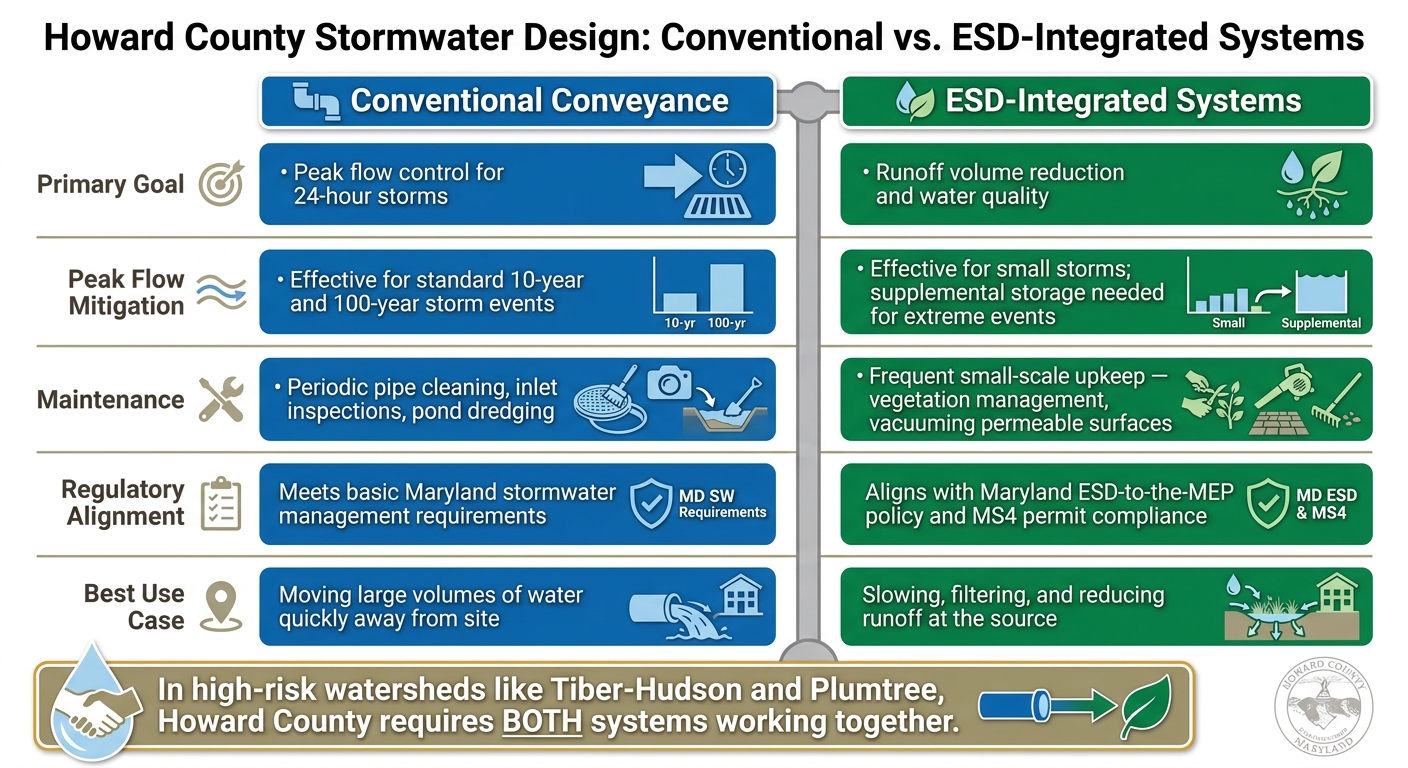
Howard County Stormwater Design: Conventional vs. ESD-Integrated Systems
Current Research and Policy Direction in Maryland Stormwater Design
Howard County’s standards show Maryland’s move away from end-of-pipe drainage and toward source control. That change matters on the ground. It means conveyance design now has to do two jobs at once: manage day-to-day runoff and help sites hold up during flash-flood conditions.
Howard County’s post-2016 storm rules make that shift pretty clear. The county now sizes conveyance systems for short-duration, high-intensity storms. County officials said the 2016 and 2018 storms overwhelmed ponds and storm drains. CR-123 ties ESD to storage and conveyance upgrades.
Conventional Conveyance Versus ESD-Integrated Systems
For site design, the big difference comes down to how each method deals with small storms versus extreme events.
| Feature | Conventional Conveyance | ESD-Integrated Systems |
|---|---|---|
| Primary goal | Peak flow control for 24-hour storms | Runoff volume reduction and water quality |
| Peak flow mitigation | Effective for standard 10-year and 100-year events | Effective for small storms; supplemental storage is needed for extreme events |
| Maintenance | Periodic pipe cleaning, inlet inspections, and pond dredging | Frequent small-scale upkeep such as vegetation management and vacuuming permeable surfaces |
| Regulatory alignment | Meets basic Maryland stormwater management requirements | Aligns with Maryland’s ESD-to-the-MEP policy and MS4 permit compliance [1] |
On its own, neither system is enough in high-risk watersheds. A pipe-only setup can move water fast but may fall short during intense bursts. An ESD-only setup helps with runoff volume and water quality, but it still needs backup when big storms hit. That’s why Howard County’s current standards combine source control through ESD with structural storage and conveyance work to cut flood risk during flash-flood conditions.
Conclusion: Main Points for Howard County Property Owners
For homeowners and property managers, the main issue isn’t just the pipe. It’s the full grading and hardscape plan around it. Howard County’s stormwater rules pull from the Howard County Code, CR-123, and the Maryland Stormwater Design Manual. In higher-risk watersheds, county targets now focus on reducing peak depth and velocity during extreme storms.
Well-planned site work, including permeable pavers, proper grading, and coordinated drainage details, can help with code compliance and long-term site performance. Put simply: drainage needs to be part of the site plan from day one.
FAQs
How do I find my watershed in Howard County?
Check Howard County’s official mapping tools or reach out to the Department of Planning and Zoning. The county’s site development requirements include drainage area maps, which can help you find watershed boundaries.
If you need details for one property, start with your plat. You can also contact the Howard County Department of Public Works.
Will a new patio or driveway require stormwater review?
It depends on your project’s size and where the property is located. In Howard County, a new patio or driveway that adds impervious surface may need stormwater review. The goal is simple: make sure the project doesn’t create drainage problems or push runoff past storm-event limits set by the Howard County Design Manual.
Some locations face tighter rules. That includes areas within the Tiber and Plumtree Branch Watersheds. In those cases, the review may be more involved.
A professional can look at your plans and tell you whether the job needs a formal stormwater management plan or a design manual waiver.
When is ESD not enough for a project?
ESD alone may not be enough in every case.
That can happen when a project can’t meet ESD to the maximum extent practicable, or when site hydrologic or topographic conditions call for extra measures.
An approving agency may also require an engineered stormwater management plan if there are existing downstream flooding problems, stream channel erosion, water quality issues, or other state or local requirements that apply.
Chat with Us