









- bhavya gada
- No Comments
If runoff is coming off your roof, driveway, or yard, the right BMP depends on how the water moves and where your lot can handle it. For most Frederick County homes, bioretention is the go-to pick, filter strips work for sheet flow, sand filters fit tight or poor-draining sites, and inlet protection is only for construction.
I’d boil it down like this:
- Use filter strips when runoff spreads out in a thin, even flow
- Use bioretention for most home runoff from roofs and driveways
- Use sand filters when space is tight or soils don’t drain well
- Use inlet protection to keep sediment out of storm drains during grading or construction
A few numbers matter right away:
- Many rain gardens serve 2,000 sq. ft. or less
- Micro-bioretention can serve up to 20,000 sq. ft.
- Many infiltration-based BMPs need at least 0.5 in./hr soil infiltration
- They often need 2 to 4 feet above the seasonal high water table
- These practices are built mostly for about 1 inch of rain, which covers about 90% of yearly storm events
The short version: I’d match the BMP to the drainage pattern first, then check slope, soil, setbacks, and overflow. If water comes from more than one direction, one BMP usually won’t fix the whole yard.
| BMP | Best fit | Main job | Main limit |
|---|---|---|---|
| Filter strip | Gentle slope with sheet flow | Slow runoff and trap sediment | Fails if flow gets channelized |
| Bioretention | Roof/driveway runoff on home lots | Filter runoff and reduce some volume | Needs space, setbacks, and drainable soil or underdrain |
| Sand filter | Tight lots or poor soils | Filter solids, metals, and some nutrients | More build work and more upkeep |
| Inlet protection | Construction areas near storm drains | Keep sediment out of inlets | Temporary only |
If I were planning this on a Frederick County lot, I’d start by walking the yard during rain, marking where water goes, and checking whether the problem is water quality, wet-yard volume, or inlet sediment.
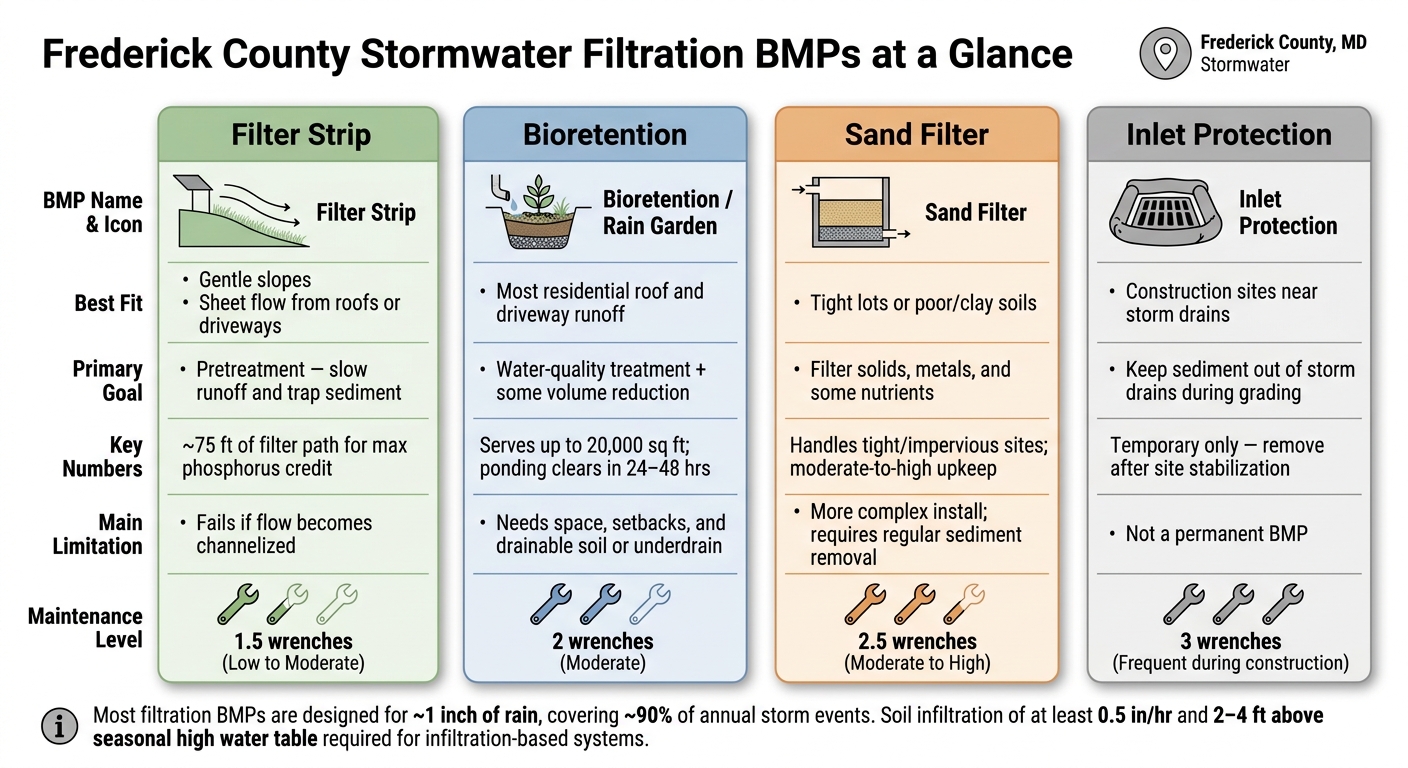
Frederick County Stormwater Filtration BMPs: Side-by-Side Comparison
How to Choose the Right Filtration BMP for Your Site
Start with a simple drainage map. Mark downspouts, driveways, patios, and low spots. That quick sketch helps narrow your BMP options fast. From there, match each flow path to the BMP that site can actually handle.
Site Conditions That Control What Will Work
Drainage area, slope, soil, and open yard space usually decide what fits. Residential rain gardens often serve 2,000 square feet or less, while micro-bioretention can serve up to 20,000 square feet.[2][7][8][9]
Some BMPs also need the right flow pattern. Filter strips need sheet flow across gentle grades. Bioretention tends to work best on slopes of around 5% or less.[11] If the site is steep or boxed in, structural BMPs or underdrains are often the better fit.
Infiltration-based BMPs also need enough soak-in rate below ground. In most cases, that means at least 0.5 in/hr infiltration and 2 to 4 feet of separation above the seasonal high water table.[2][10] If you’re dealing with heavy clay or a shallow water table, sand filters or underdrained bioretention usually make more sense. It also helps to check utilities, septic systems, and wells early, since setback rules can rule out some spots before work even starts.
Runoff Goals: Water Quality, Volume Reduction, or Inlet Protection
Once the site makes sense for a BMP, focus on the job it needs to do. The goal might be sediment building up at storm drain inlets, nutrients and fine pollutants washing off roofs and driveways, or too much runoff leaving the yard wet for days.
These BMPs are built to treat small, frequent storms – about 1 inch of rain, which is roughly 90% of annual events.[6][12] Bigger storms still need a safe overflow path. That’s where swales, reinforced outfalls, or drain pipe come in. They move extra water away without letting it tear up the yard.
When a Drainage and Landscape Plan Makes Sense
If runoff enters the yard from more than one direction, one BMP usually won’t do the whole job. A single BMP at one downspout won’t fix a yard where water also moves in from side grades, where the slope runs toward the house, and where the driveway sends runoff straight to the street.
In those cases, an integrated plan usually works better. That can mean mixing regrading, drain pipe installation, dry riverbeds, and filtration BMPs so each part handles a piece of the problem.
Pro Landscapes MD can coordinate grading, drainage installation, French drains, dry riverbeds, and stormwater management for integrated site plans.
sbb-itb-843f8be
The 4 Core Stormwater Filtration BMPs Used in Frederick County
Each BMP solves a different runoff problem. Once you know the site’s limits, the goal is simple: match the BMP to how water moves, not just to the spot you happen to have open.
Filter Strips: Best for Sheet Flow and Pretreatment
A filter strip is a gently sloped, vegetated area that takes runoff as shallow sheet flow from roofs, driveways, or small paved areas. As water moves slowly across grass or planted ground cover, sediment settles out and the flow slows before it reaches the next drainage feature.
This practice only works well when runoff stays as sheet flow. If water gets channelized, it can cut into the strip and slip past treatment. Slope matters too. When the grade is too steep, water moves too fast to filter well. Maryland guidance says phosphorus reduction credit is highest at about 75 feet of filter path.[5] At the inlet edge, a level spreader or gravel diaphragm is often used to spread flow evenly across the full width.
Filter strips usually make the most sense as pretreatment before a larger BMP, such as bioretention. By themselves, they help water quality by slowing runoff and trapping sediment, but they do not do much to reduce runoff volume. If the runoff needs more than a strip can handle, bioretention is often the next move.
Bioretention: Rain Gardens and Engineered Planted Basins
Bioretention is a common option for homeowners. It’s a shallow planted basin – often called a rain garden – filled with mulch, engineered planting media, and sometimes an underdrain. Runoff from a roof or driveway flows in, ponds for a short time, and filters through the media before either soaking into the ground or draining through the underdrain.
Bioretention treats nutrients, sediment, and other pollutants through filtration, plant uptake, and soil contact. Maryland design guidance says pretreatment for bioretention may include a 20-foot grass filter strip, a gravel diaphragm, and mulch in some setups.[15] It can also cut runoff from smaller storms when native soils drain well.
The limits come down to site conditions. It needs enough yard space, the right setbacks, and soils that drain well enough – or an underdrain when they don’t. Ponding should not last more than 24 to 48 hours after a storm. Maintenance usually includes:
- refreshing mulch
- removing sediment at inlets
- replacing plants during the establishment period
If space, soil, or setbacks make that hard, a structural filter may be a better fit.
Sand Filters and Inlet Protection: Where Structural Filtration Fits
Sand filters work well on sites with limited space, high impervious coverage, or poor infiltration. They move runoff through layers of sand and filter media to remove solids, metals, and some nutrients. EPA-cited research shows strong removal of solids, metals, and some phosphorus.[14] The tradeoff is that they are more involved. Sand filters usually need careful installation, regular sediment removal, and inspection so the media does not clog.
Inlet protection serves a very different role. It is a temporary sediment control used during construction or grading. It uses silt socks, filter fabric, or sediment barriers around storm drain inlets while the site is exposed. The point is to keep sediment and debris out of storm drains during disturbance. It should go in before soil disturbance starts and come out once the site is stabilized.[13] It is not a permanent water-quality BMP for a finished yard.
The table below compares the four practices:
| BMP | Best Use | Runoff Goal | Site Limits | Maintenance Level |
|---|---|---|---|---|
| Filter strips | Gentle slopes receiving sheet flow from roofs or driveways | Pretreatment and modest water-quality treatment | Poor fit for channelized flow or steep grades | Low to moderate |
| Bioretention | Planted basins for roof and driveway runoff | Water-quality treatment with some volume reduction | Needs space, setbacks, and compatible soils or underdrain | Moderate |
| Sand filters | Tight or impervious sites needing compact engineered filtration | Water-quality filtration, especially solids and metals | More structural; requires careful design and installation | Moderate to high |
| Inlet protection | Temporary protection around storm drains during construction | Sediment control before runoff enters the storm drain | Not a permanent BMP; remove after site stabilization | Frequent inspection during construction |
Even when you pick the right BMP, siting, maintenance, and budget still shape what will work on the ground.
Design Limits, Maintenance, and Homeowner Planning Points
Common Siting Limits and Installation Red Flags
After you pick a BMP type, the next step is simple: figure out whether the site can actually make it work. Start with the drainage pattern, not the patch of open grass that looks easiest to use. The key question is whether that spot receives the runoff the BMP is supposed to treat.
A yard can look usable and still be a bad fit. Poor-draining soils, steep slopes, tight setbacks, utility easements, septic fields, wells, and low spots near basements can all rule out a location.[3][4] And if water is moving in a concentrated path, that channelized flow can wash out filter strips and bioretention areas no matter how well they were sized or planted.
One of the easiest ways to check a site is to walk the yard during or right after a rain. Watch where the water actually goes, then mark those paths. If runoff skips past the area you’re considering and stays in one narrow track, the BMP needs to be placed where the water flows – not where the yard just happens to have space.
What Maintenance Looks Like Through the Year
Once a BMP is in the ground, it still needs regular care to keep doing its job. It helps to think of filtration BMPs as engineered systems, not just planted areas. After major storms, check inlets, pretreatment zones, and flow spreaders, then remove sediment, reseed bare areas, and clear out debris as needed.[1][4]
Through the year, the routine usually includes:
- Post-storm inspections
- Debris removal
- Fast repair of small erosion channels
- Reseeding or patching bare spots
Those small erosion channels and thin bare patches matter more than they may seem. They often mean water is starting to concentrate instead of spreading out. Fixing those early can save a much bigger repair bill later.
Budget and Project Coordination on Residential Properties
Even a well-planned BMP can run into trouble if cost planning or project timing gets pushed too far down the list. Pricing depends on site conditions like soil, slope, drainage area, and access. It also depends on whether the system needs excavation, underdrains, or engineered media. Your budget should include follow-up items too, such as mulch or media refresh, plant replacement during establishment, and periodic sediment removal.
A common mistake on residential jobs is treating drainage work like its own separate project. In practice, it rarely works that way. If you’re already planning a patio, walkway, or downspout rerouting, those changes will shift how water moves across the yard. They need to happen before the BMP is sized and placed, not after.[3][4]
Pro Landscapes MD coordinates drainage, grading, planting, and hardscaping for Frederick County stormwater projects.
Conclusion: Matching the BMP to the Runoff Problem
Each BMP in this guide has a clear job. Filter strips work best as pretreatment for sheet flow. Bioretention is usually the most practical choice for homes because it treats runoff and can also cut runoff volume. Sand filters make sense on tighter lots where space is limited and a compact, engineered system is the better fit. Inlet protection is temporary and belongs around storm drain inlets only during construction.
Put simply: use filter strips for sheet flow, bioretention for most residential runoff, sand filters for constrained sites, and inlet protection only during construction.
The final call still comes down to site fit. Things like drainage area, slope, soil infiltration rate, setbacks from foundations and wells, overflow routing, and the level of seasonal maintenance you can honestly keep up with will shape the right pick.
If runoff shows up in more than one part of the yard, one BMP by itself often won’t do the whole job. A coordinated drainage and landscape plan usually works better. Pro Landscapes MD can tie together drainage, grading, planting, and hardscaping so the BMP fits the full site plan.
FAQs
How do I know which BMP fits my yard?
Start with a site assessment. Measure impervious surfaces like roofs, driveways, and patios. Then check soil type, drainage patterns, water table depth, slope, and any utility conflicts.
There’s no one-size-fits-all BMP for every yard. That’s why it helps to bring in a professional. They can match your site conditions and project needs with the right option, whether that’s bioretention, permeable pavers, or dry riverbeds.
What if my soil drains poorly or space is tight?
Put filtration first, not simple infiltration. Underground filters and vault systems are a good fit for tight urban and suburban sites because they treat runoff from impervious surfaces without taking up visible space.
If the soil drains poorly, the filtered water can flow to storm drains or nearby surface water instead of depending on the ground to absorb it. In smaller areas, narrow bioretention cells, terraced rain gardens, and permeable pavers can also help control runoff.
Can one BMP manage runoff from my whole property?
Usually not. A single BMP rarely handles all runoff from an entire property. Different parts of a site often have different soils, slopes, and land uses, so one practice usually isn’t enough.
Stormwater management tends to work best with a treatment train approach. That means using multiple site-specific practices to capture, filter, and infiltrate runoff across different drainage areas.
Chat with Us