









- bhavya gada
- No Comments
Outdoor kitchens face intense sunlight, rain, humidity, and freezing temperatures, making UV-resistant coatings essential for long-lasting protection. These coatings shield surfaces from fading, discoloration, and structural damage caused by UV rays and weather exposure. Here’s what you need to know:
- Why It Matters: Maryland’s climate – with hot summers, freeze-thaw winters, and high humidity – accelerates surface wear. UV-resistant coatings protect materials like stone, concrete, wood, and metal from damage.
- Surface Materials: Each material has unique needs. For example, natural stone benefits from penetrating sealers, while wood requires UV-protective oils.
- Choosing the Right Coating: Match coatings to materials. Look for labels like "UV-stable" and "non-yellowing." Acrylics, polyurethanes, and silane/siloxane sealers are common options.
- Maintenance: Regular inspections, cleaning, and reapplication (every 2–5 years) ensure long-term performance.
- Local Expertise: Maryland’s unique climate demands coatings designed for freeze-thaw cycles and intense UV exposure.
Key Takeaway: Protect your outdoor kitchen by selecting coatings tailored to your materials and climate. Proper application and maintenance will extend the life of your investment.
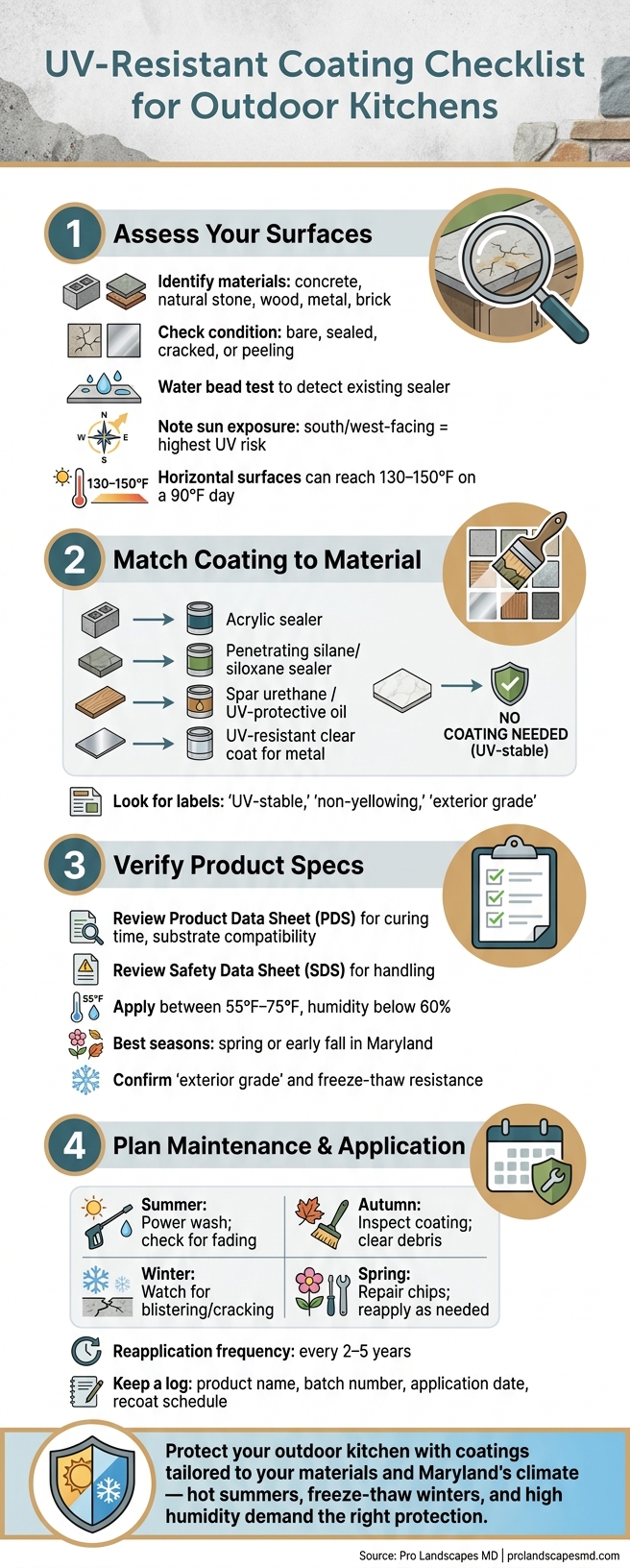
UV-Resistant Coating Checklist for Outdoor Kitchens
How To Resin Coating an Outdoor Bar Top – Tips & Tricks
sbb-itb-843f8be
Step 1: Assess Your Outdoor Kitchen Surfaces
Before diving into coating options, it’s important to understand exactly what you’re dealing with. Taking the time to evaluate your outdoor kitchen surfaces now can save you from costly mistakes later.
Identify Surface Materials and Current Condition
Start by examining every part of your outdoor kitchen – countertops, floors, backsplashes, bar fronts – and note the materials used. You’ll likely encounter surfaces like poured concrete, concrete pavers, natural stone (granite, bluestone, flagstone, or travertine), manufactured stone veneer, brick, exterior wood, or metal cabinet frames. Each material reacts differently to UV exposure and requires a tailored coating approach.
Next, determine if the surfaces are bare, sealed, painted, or stained. A simple water test can help: splash some water on the surface. If the water beads up, there’s an intact sealer in place. If it soaks in quickly, the surface is either bare or the existing sealer is failing. For a coating to work properly, the surface must be clean and sound.
Inspect for any visible damage, such as hairline cracks, powdery residue, wood rot, rust, or peeling finishes. These issues must be addressed before applying any coating. A coating won’t fix structural problems; it’ll just temporarily mask them and fail sooner.
Evaluate Sun and Weather Exposure
Take note of how much sun and shade each surface gets throughout the day – morning, noon, and mid-afternoon observations are helpful. In Maryland, south- and west-facing surfaces endure the most intense UV exposure, especially during summer afternoons. Horizontal surfaces like countertops and bar overhangs are particularly vulnerable since they take the brunt of direct sunlight without the benefit of a vertical angle to deflect it.
The local climate in Maryland adds another layer of complexity. Freeze–thaw cycles during winter can force moisture into tiny cracks, leading to scaling or flaking in concrete and stone. According to NOAA, Maryland’s humid subtropical to humid continental climate – with its hot, humid summers and frequent heavy rainfall – can speed up the deterioration of unprotected outdoor surfaces. Moisture intrusion, mildew, and thermal expansion only make matters worse. The U.S. Energy Information Administration (EIA) also notes that horizontal surfaces exposed to summer sun can heat up to 40–60°F above air temperature. So, on a 90°F day, dark surfaces can reach a scorching 130–150°F, which can strain coatings not designed for such extreme heat.
Don’t forget about heat sources like grills, smokers, or fire pits. Surfaces within 18–24 inches of these areas face additional challenges from radiant heat, grease splatter, and smoke buildup. Coatings in these zones need to withstand more than just UV rays – they also need to resist heat and stains effectively.
Understand Usage and Wear Patterns
Pay attention to high-use areas, like those around the grill, prep counters, sink, and refrigerator. These spots see more foot traffic and activity, so they’ll need coatings with higher abrasion resistance. The more wear and tear these areas endure, the more frequently you’ll need to reapply the coating. If you notice widespread cracks, pooling water, or significant surface movement, it’s a good idea to consult a professional. Teams like Pro Landscapes MD specialize in evaluating outdoor kitchen surfaces in central Maryland and can help you prepare for the region’s unique challenges, such as freeze–thaw cycles and intense UV exposure [1].
Step 2: Explore Coating Options and UV Performance
After evaluating your surfaces, the next step is to pair them with the right coating. UV performance can vary significantly depending on the material you’re working with.
Match Coating Types to Surface Materials
It’s essential to choose coatings that complement the material. For example, acrylic sealers are a great fit for concrete surfaces because they bond effectively, allow moisture vapor to escape, and provide solid UV protection. On the other hand, natural stone, such as granite or flagstone, often benefits more from a penetrating sealer. This type of sealer protects from within without altering the stone’s natural appearance. However, be aware that granite treated with color-enhancing resins may not hold up well under UV exposure.
"Granite is naturally UV resistant, but if it has been treated with color-enhancing resins these resins will fade with prolonged exposure to the sun." – WilgusIQ [2]
Quartzite is another excellent option for outdoor settings. It’s naturally UV stable, less porous than granite, and doesn’t require sealing as frequently. Stone veneers, including popular options like El Dorado Stone used in Maryland outdoor kitchens, should be protected with a UV-resistant clear coat labeled as non-yellowing to maintain their original color and texture. For metal frames or cabinet components, select a UV-resistant clear coating specifically designed for metal and ceramic surfaces. Once you’ve identified the right coating type, confirm its UV stability by reviewing the product data sheet.
Verify UV Stability and Outdoor Ratings
When selecting a coating, always check for labels indicating "Exterior" or "Interior/Exterior" use. These designations are critical for materials exposed to Maryland’s intense sunlight and unpredictable weather. Additionally, product data sheets can provide details on UV resistance, non-yellowing properties, and moisture resistance – qualities that ensure the coating can withstand direct sunlight, high humidity, and rain without breaking down.
Timing is another important factor when applying coatings. For optimal results, apply them when temperatures are between 55°F and 75°F, with humidity levels below 60%. Maryland’s spring and early fall seasons often provide ideal conditions for this work. Once you’ve gathered all the necessary information, compare your options side by side to find the best fit.
Compare Coating Types Side by Side
Here’s a quick comparison of surface materials and their recommended coatings, highlighting UV stability and maintenance needs:
| Material / Coating Type | UV Stability | Reapplication Frequency |
|---|---|---|
| Granite (Natural) | High | Regular sealing needed for stain resistance |
| Resin-Treated Granite | Low | Resins fade under UV; careful maintenance required |
| Quartzite | High | Requires less frequent sealing than granite |
| Porcelain | High | Non-porous; no sealing or UV coating needed |
| Sintered Stone (e.g., Dekton) | High | Impervious to UV, rain, and ice; no sealing needed |
| UV-Resistant Clear Coat | High | Periodic reapplication on wood, metal, or ceramic |
| Acrylic Crystal Clear | High | Excellent adhesion; reapply based on wear |
If minimizing maintenance is your goal, materials like porcelain and sintered stone stand out. Their color and finish are integrated into the material itself, so they don’t require additional coatings for UV protection. For existing surfaces, applying a high-quality acrylic or UV-resistant clear coat can significantly extend their lifespan, protecting them from Maryland’s hot summers and harsh freeze–thaw cycles.
Step 3: Review Product Specs and Maintenance Needs
Once you’ve assessed the surfaces and chosen the right coatings, it’s time to dig into the product details and plan for long-term upkeep. This step ensures the coating will perform as expected and stay in top shape over time. Start by reviewing the technical documentation and then establish a maintenance routine.
Check Product Data Sheets and Application Requirements
Every coating product comes with a Product Data Sheet (PDS) and a Safety Data Sheet (SDS). These documents are your go-to resources for understanding the product:
- PDS: Covers key details like application temperatures, curing times, substrate compatibility, and whether it’s meant as a base coat or topcoat.
- SDS: Focuses on chemical safety, handling, and storage instructions.
Make sure the coating is specifically designed for the material you’re working with. For example, a UV Curing Topcoat for Plastics won’t work the same way on natural stone or masonry. Also, check the product’s technology – whether it’s solventborne, waterborne, or UV-curing – as this affects how it’s applied and cleaned up.
If you’re working in areas like Baltimore or Washington, D.C., where materials like Pennsylvania flagstone, natural wall stone, or stone veneers (e.g., El Dorado Stone) are common, confirm the coating is compatible with these surfaces. Manufacturers may also highlight specific compatibility requirements, so don’t skip this step. And if you’re dealing with colder climates, note whether the product requires cold-weather additives.
"We ensure that the materials we use are durable and suited to withstand the local weather conditions." – Pro Landscapes MD [1]
Once you’ve confirmed the specs, shift your attention to planning for regular maintenance.
Plan for Cleaning and Ongoing Maintenance
Keeping up with maintenance is crucial for preserving UV protection and extending the life of your coating. Schedule bi-annual inspections – one in the fall before freezing temperatures set in, and another in the spring to address any winter-related wear and tear. During the summer, power washing helps remove pollutants that can break down the coating.
Stay vigilant for early signs of trouble like cracking, peeling, blistering, or fading. These issues indicate the coating is starting to fail, and fixing them early is far cheaper than repairing deeper damage to the surface underneath.
"With proper care and maintenance, hardscaping materials such as stone and concrete can last decades." – Pro Landscapes MD [1]
Here’s a seasonal maintenance guide to help you stay on track:
| Season | Key Maintenance Actions |
|---|---|
| Summer | Power wash surfaces; check for sun-induced fading |
| Autumn | Inspect coating condition; clear debris before freezing |
| Winter | Watch for blistering, cracking, or moisture-related damage |
| Spring | Repair chips or fading; reapply coating as needed |
Step 4: Coordinate Coatings With Your Outdoor Kitchen Design
Once you’ve assessed surfaces, chosen coatings, and planned for maintenance, it’s time to tie everything together with your design vision. The goal is to ensure your coating choices complement your outdoor kitchen’s overall aesthetic. A protected kitchen that clashes with nearby patios or walkways misses the chance to create a unified, inviting space where every element – from countertops to stone veneers – works together seamlessly.
Match Coatings to Your Hardscape Aesthetics
Take a step back and consider the dominant colors and textures in your outdoor area. For example, a satin-finish polyurethane on a concrete countertop can subtly echo the deep tones of nearby charcoal pavers, creating a cohesive look without feeling overly polished.
- Opt for low-sheen finishes on horizontal surfaces to minimize glare, hide smudges, and improve slip resistance.
- Save glossy finishes for vertical elements, like stone veneer facings or seat walls, where a bit of shine can highlight the material’s texture and color.
If you’re working with natural stone, like Pennsylvania flagstone, a penetrating silane/siloxane sealer is often the best option since it preserves the stone’s natural appearance. On the other hand, solvent-based acrylics or polyurethanes can darken concrete or pavers by one to two shades. Always test coatings on a small, inconspicuous area first, and give it time to fully cure – usually 24–72 hours – before deciding. Check the results under different lighting conditions, like direct sunlight and shade, to ensure you’re happy with the final look.
Work With Professional Installers
Professional installers bring the skills and tools needed to avoid common problems like peeling, clouding, or uneven finishes – issues that are especially prevalent in Maryland’s freeze–thaw climate. They handle everything from moisture testing to surface preparation, including cleaning and etching, to ensure the coatings adhere properly and look flawless.
Choosing experienced professionals, such as Pro Landscapes MD, ensures that your coating applications are part of the overall construction process rather than an afterthought. Their expertise allows for smooth transitions between the patio and kitchen base, avoiding the "patched-on" look. Before committing to a full application, ask your installer to create small sample sections on less visible areas. This lets you compare how different coatings impact color and sheen in natural light, giving you confidence in your final choice.
Use Local Expertise for Maryland Conditions
Maryland’s climate presents unique challenges for outdoor surfaces. Summers bring intense heat and humidity with strong UV exposure, while winters feature freeze–thaw cycles and occasional deicing salts. A coating that thrives in a dry, arid climate may fail quickly here, leading to blistering, chalking, or discoloration.
Products designed for exterior horizontal surfaces in Maryland’s freeze–thaw and high-humidity environment are essential. Local experts, familiar with the region’s conditions, know to avoid non-breathable, film-forming coatings on exterior concrete slabs that are exposed to winter moisture. They also schedule applications during ideal weather – spring or early fall – when temperatures range between 50–80°F and humidity is more manageable. Applying coatings outside these windows can lead to problems like hazing, blushing, or poor adhesion due to slow curing.
Years of working in areas like Howard, Frederick, and Prince George’s counties have given local professionals a deep understanding of these challenges. Their experience ensures that your outdoor kitchen is not only beautiful but also built to withstand Maryland’s unpredictable weather. This kind of hands-on knowledge is something you simply can’t get from reading a product label.
Conclusion: Your UV-Resistant Coating Checklist at a Glance
Picking the right UV-resistant coating doesn’t have to be overwhelming if you follow a clear process. Start by listing every surface – whether it’s concrete slabs, pavers, natural stone veneer, wood bar tops, or metal cabinet panels – and take note of their current condition. Next, evaluate how much sun each area gets. Surfaces facing south or west that receive 6+ hours of direct sunlight daily need the toughest protection, such as an aliphatic polyurethane or polyaspartic topcoat.
Pair each material with the most suitable coating. For example, use penetrating silane/siloxane for porous stone, exterior-grade acrylic or polyurethane for concrete and pavers, spar urethane for wood, and factory-applied powder coatings for metal. Always check product data sheets for terms like "UV-stable", "non-yellowing," and "exterior grade." These details ensure the coating can handle outdoor conditions.
Here’s a quick summary of the key steps:
| Checklist Step | What to Confirm |
|---|---|
| Surface inventory | Identify all materials; note cracks, stains, and existing sealers |
| Sun and weather exposure | Map full sun vs. shaded areas; consider freeze-thaw cycles and humidity |
| Coating-to-material match | Ensure product is rated for your specific surface |
| UV and outdoor durability | Verify "UV-stable", "non-yellowing", and "exterior grade" on the TDS |
| Slip, heat, and stain resistance | Confirm suitability for cooking zones and wet areas |
| Maintenance schedule | Document recoat intervals (usually 2–5 years), cleaning method, and costs |
| Professional installation | Choose an installer familiar with Maryland’s climate and your materials |
Keeping a log with the product name, batch number, application date, and recoat schedule is a smart way to stay organized. For homeowners in central Maryland, partnering with experts like Pro Landscapes MD ensures that coating choices are integrated into the design and construction of your outdoor kitchen from the start.
"With proper care and maintenance, hardscaping materials such as stone and concrete can last decades." – Pro Landscapes MD [1]
FAQs
Do I need a penetrating sealer or a clear coat?
When deciding, consider the surface type and the protection you need. Penetrating sealers soak into the material, providing protection from UV rays and moisture while maintaining a natural appearance. On the other hand, clear coats create a surface layer that enhances UV resistance and adds either a glossy or matte finish. For outdoor surfaces, penetrating sealers are a great choice to preserve their natural look. If you want a noticeable finish, clear coats are the better option.
How can I tell if an old sealer is failing?
To spot a failing sealer, start by closely examining the surface for any visible damage. Common signs include peeling, cracking, blistering, or delamination. A quick test involves using a sharpened putty knife to scrape the surface – if the coating comes off with little effort, it’s likely no longer effective. Additionally, check for moisture or rust beneath the coating, which often points to poor sealing and signals that it’s time for a reapplication.
What UV coating works best near grills and fire pits?
A UV-resistant clear coating, like Krylon® UV-Resistant Clear Coating, works perfectly for spots near grills and fire pits. It shields surfaces from damaging UV rays and is specifically made for outdoor areas, including those exposed to heat.
Chat with Us