









- bhavya gada
- No Comments
If your project changes runoff, your permit can stall. In Wicomico County, a patio, driveway, retaining wall, or grading job may need stormwater review before a grading or building permit can be issued.
Here’s the short version: new impervious area, drainage changes, and land disturbance of 5,000 sq. ft. or more are the main triggers. Some single-lot jobs get a simpler review path, but only if they stay under 15% lot impervious cover and 30,000 sq. ft. of disturbance. And even with a waiver or lighter review, you still have to keep runoff on your lot, protect neighbors, and give water a stable outlet.
If I were planning work on my lot, I’d check these first:
- Will I add hard surface area?
- Will I change grading or flow paths?
- Will disturbance hit 5,000 sq. ft. or more?
- Does the lot stay at 15% impervious cover or less?
- Does runoff stay off the neighbor’s property?
- Is there DPW review before work starts?
A few numbers matter most:
- 5,000 sq. ft.: common threshold for a formal stormwater plan
- 15%: max impervious cover for some single-lot simplified reviews
- 30,000 sq. ft.: max disturbance for that same single-lot path
- 50%: open-space minimum noted for townhouse lots
This guide breaks down the rules into plain steps so you can spot permit issues early, place hardscape the right way, and avoid drainage problems after construction.
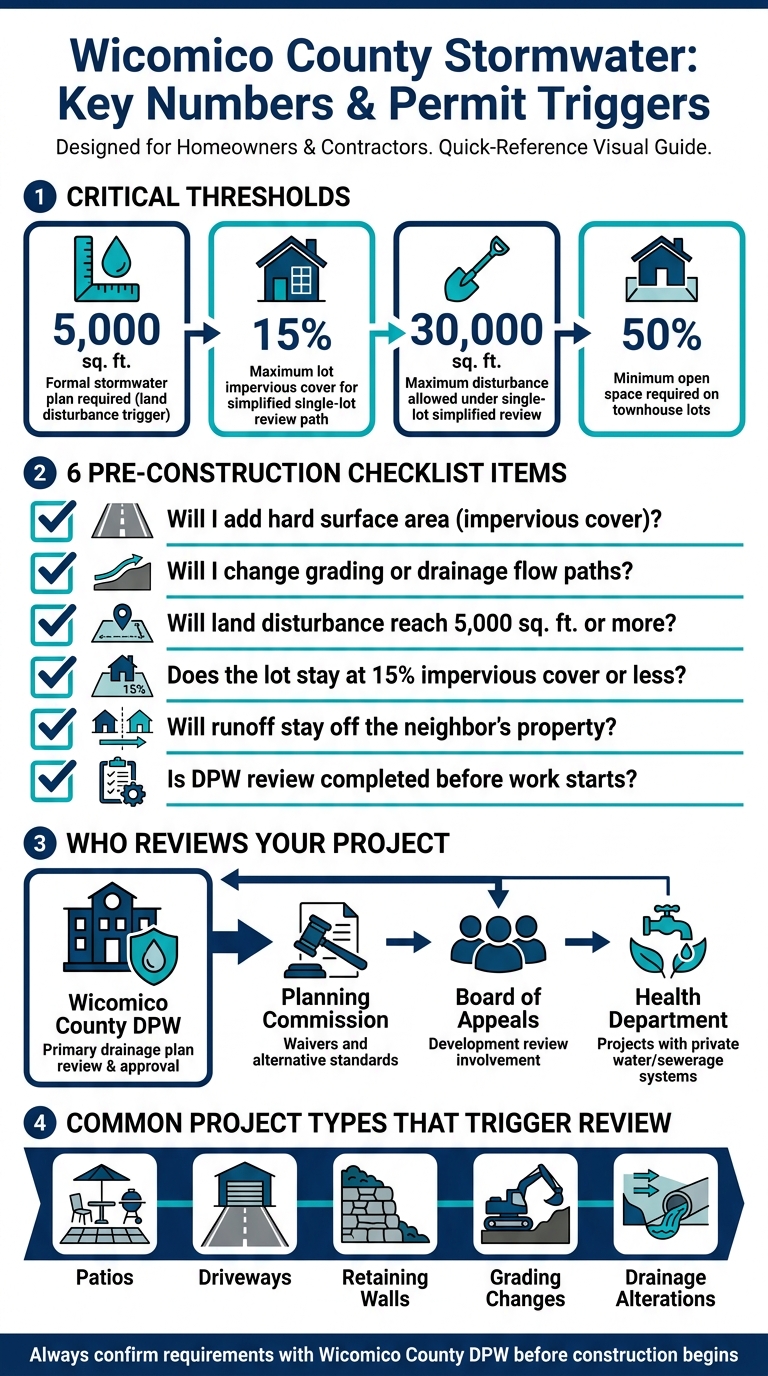
Wicomico County Stormwater Permit Triggers & Key Thresholds
Wicomico County Stormwater Rules and the Review Process
The Wicomico County Department of Public Works (DPW) is the main agency that reviews and approves drainage plans.[1] On some projects, the Planning Commission and Board of Appeals may also step in as part of the County development review process. If the project includes a private water or sewerage system, you’ll also need to work with the Wicomico County Health Department separately.
Core Technical Requirements for Residential Compliance
For residential work, DPW pays close attention to grading, runoff control, and erosion protection. In plain English, the site needs to drain well, the grading needs to move water away the right way, and bare soil needs to be stabilized so it doesn’t wash out.[1]
This isn’t just for big subdivision work. It also applies to standard residential projects like:
- Patios
- Driveways
- Grading changes
- Drainage alterations
Plan Submission, Review, and Approval Steps
For most residential projects, the drainage plan should go to DPW for review and approval before any site improvements begin.[1] Reaching out early can save a lot of hassle. A quick check-in with DPW may help spot issues before the plans are locked in.
Once DPW determines the review path, the next move is making sure the lot’s drainage plan lines up with County standards.
Exemptions, Waivers, and Common Review Triggers
The Planning Commission can waive a standard or allow an alternative when a site-specific condition makes one of the rules unreasonable or unnecessary.[1] That said, a waiver doesn’t mean drainage can be ignored. The lot still needs safe runoff routing and stable grading.
That point matters for common residential features like patios, driveways, and retaining walls. Even when the County allows a modified approach, the project still has to handle water properly. Projects that add a large amount of impervious surface or change drainage patterns are the ones most likely to face a closer review.
sbb-itb-843f8be
Drainage Design Basics for Residential Lots
Once the review path is clear, the next step is grading the lot so it can handle runoff on site. Start by mapping the way water already moves across the property before any grading or construction begins. That existing pattern matters. If you ignore it, water tends to find its own route later, and that usually means trouble.
Patios, driveways, and retaining walls need to work with those flow paths, not cut across them or block them. A lot can look fine on paper and still fail in the field if hardscape gets in the way of drainage.
ESD to MEP, Natural Flow Paths, and On-Site Runoff Control
For residential lots, ESD to MEP means keeping natural swales in place where possible, limiting regrading, and holding runoff on site. On townhouse sites, at least 50% of the lot must remain in open space, and all exposed soil must be stabilized right after grading. [1]
The idea is pretty simple: disturb less, keep the land’s drainage pattern working, and avoid creating runoff problems that were not there before.
That design approach then has to end in a stable outlet.
Positive Outlets, Overflow Routing, and Lot-to-Lot Drainage
Residential lots should be graded so runoff has a permanent positive outlet. [1] That outlet keeps water from sitting on the lot and forming ponded areas.
Overflow also needs a clear route to a stable outlet before runoff reaches property lines. Just as important, overflow must stay on the lot and must not add runoff to adjacent property. Wicomico County standards require protection of neighboring properties from runoff. [1]
These basics set the boundaries for the stormwater practices and grading details that come next.
Stormwater Measures, Grading Limits, and Maintenance Duties
Approved Residential Stormwater Practices
After the plan is approved, the focus shifts to how the site is built and cared for. Residential stormwater measures must match the approved drainage plan and keep disturbed ground stable. Once review is finished, construction has to follow that approved drainage plan. Floodplain status should be confirmed before design starts [1].
For patios, driveways, and parking pads, use stabilized, approved surfaces. During construction, keep erosion controls in place and stabilize any exposed soil [1].
Grading Stability, Soil Compaction, and Slope Protection
Once the site is stable, private drainage features still need regular care. Grading and site work must include enough protection for nearby properties [1]. During construction, all exposed ground surfaces must be covered with erosion-control materials [1].
Who Is Responsible for Maintaining Private Stormwater Facilities
Private stormwater facilities are maintained by the owner or operator [1]. That means the job doesn’t end when construction wraps up. Owners should inspect private drainage features on a regular basis and fix grading or ponding problems early [1]. Regular inspections help spot drainage issues before they turn into a bigger mess [1].
Planning Patios, Driveways, and Retaining Walls Without Creating Drainage Problems
Hardscape Layout Choices That Support Drainage Compliance
Once the drainage plan is in place, the next big risk is the hardscape layout. Placement matters just as much as the materials you choose. A patio, driveway, or retaining wall can interrupt a natural drainage path or send runoff straight toward your foundation or a neighbor’s lot.
The goal is simple: keep water moving the way the site was meant to handle it, and keep runoff on your property. Patios, driveways, and walls should be placed so they don’t block swales or push water back toward the house. If you’re planning to expand a driveway or add other paved areas, check any impervious-surface limits before work starts. Retaining walls also need careful placement because they can’t redirect runoff onto neighboring property.
What to Confirm Before Construction Starts
Before any digging begins, make sure the project’s review path, lot limits, and approved footprint are clear. Confirm whether the work needs DPW drainage-plan review before construction. Check the plat for recorded easements that may restrict hardscape placement, verify setback rules from property lines, and make sure the final hardscape footprint matches the approved plan exactly [2].
Conclusion: Key Standards Homeowners Should Keep in Mind
Good hardscape design starts with drainage-aware placement and then sticks to the approved plan. If the project triggers review, get drainage-plan approval before construction begins. Grading should protect drainage function for neighboring properties, not just the home being improved. Drainage-aware layout, approved plans, and post-construction maintenance are the core homeowner responsibilities.
FAQs
Do small patio or driveway projects still need DPW review?
Yes, sometimes. Even a small patio or driveway job can still need DPW review if it triggers local stormwater or sediment control rules.
In Maryland, that often happens when a project disturbs more than 5,000 sq. ft., moves more than 100 cubic yards of fill, or affects sensitive areas like watercourses, floodplains, wetlands, or buffer/critical zones.
What counts as a drainage change on a residential lot?
A drainage change usually means grading or drainage work that changes the way stormwater moves across a lot or how runoff is handled.
That can include:
- Regrading the lot
- Adding or changing drainage features like French drains or dry riverbeds
- Changing where runoff leaves impervious surfaces
In Wicomico County, you must submit a drainage plan for review and approval by the Department of Public Works when drainage planning is required.
What happens if runoff from my project reaches a neighbor’s property?
If runoff from your project reaches a neighbor’s property, drainage usually wasn’t handled the right way and likely doesn’t meet Maryland stormwater standards.
Under state rules, you’re expected to keep pre-development runoff patterns in place and send water to approved drainage areas or natural waterways, not onto nearby lots. That means grading and drainage need to be planned from the start, not patched in later.
A simple example is grading the land with a 2% to 3% slope away from structures so water moves away instead of pooling or spilling next door. Other fixes can include:
- swales
- French drains
- retention systems
These measures help keep runoff under control and reduce the chance of water ending up on adjacent property.
Chat with Us