









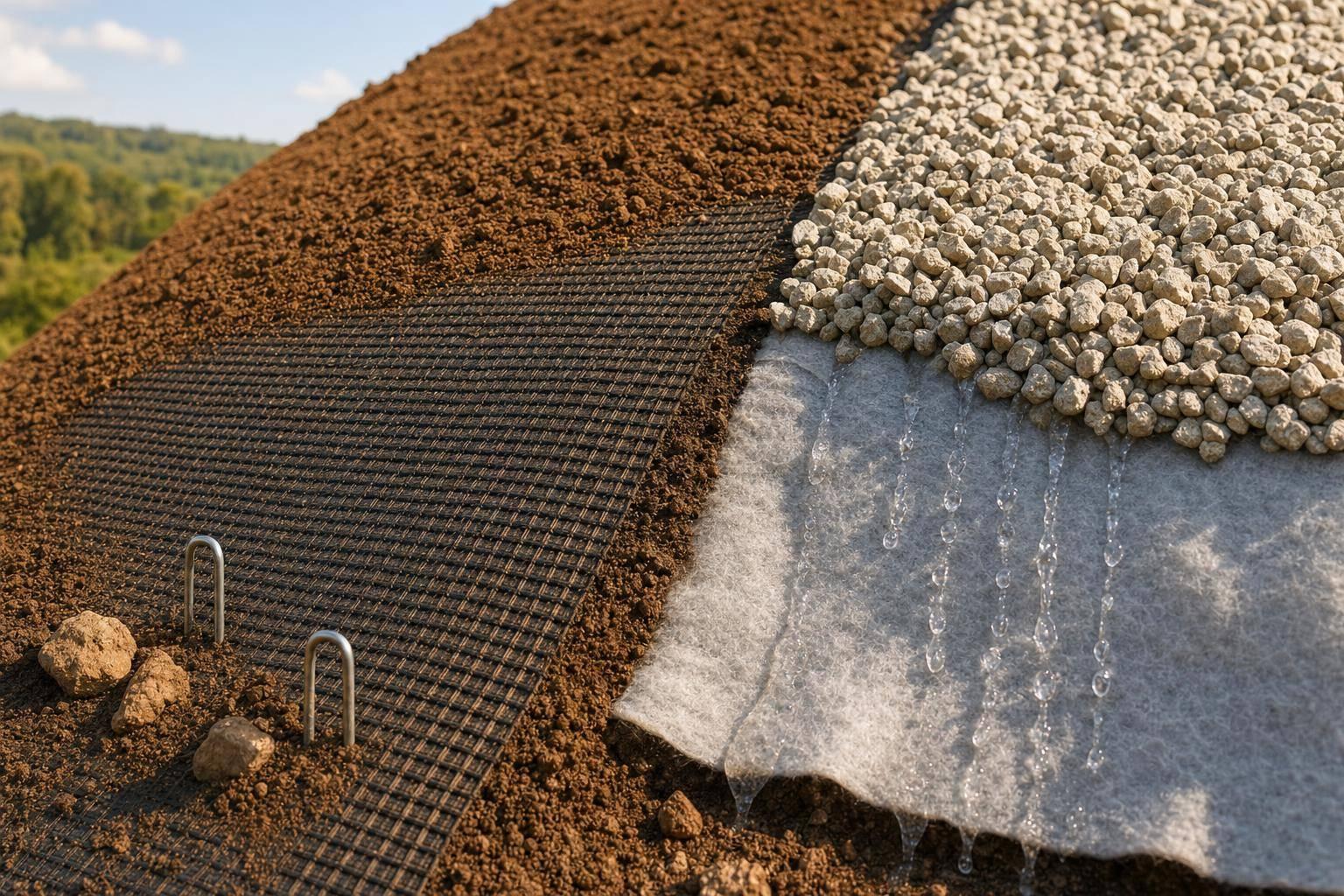
- bhavya gada
- No Comments
If I had to boil it down to one line: woven geotextiles are for strength, nonwoven geotextiles are for water flow, and steep slopes often need both.
On steep Maryland slopes, the main risks are usually soil movement and water buildup. Heavy rain can saturate soil, and just 1 inch of rain can move a lot of runoff down a steep grade. So when I compare these two fabrics, I look at four things first:
- Reinforcement: woven fabric is better when soil needs support
- Drainage: nonwoven fabric is better when water needs to pass through
- Filtration: nonwoven fabric does a better job keeping fines out of stone and drains
- Soil type: clays and silts often lean nonwoven; gravel and coarse fill often lean woven
If the slope supports a driveway, patio base, or compacted fill, I’d lean toward woven. If the slope stays wet or has clay soil, I’d lean toward nonwoven. If both load and drainage matter, I’d use a combined system.
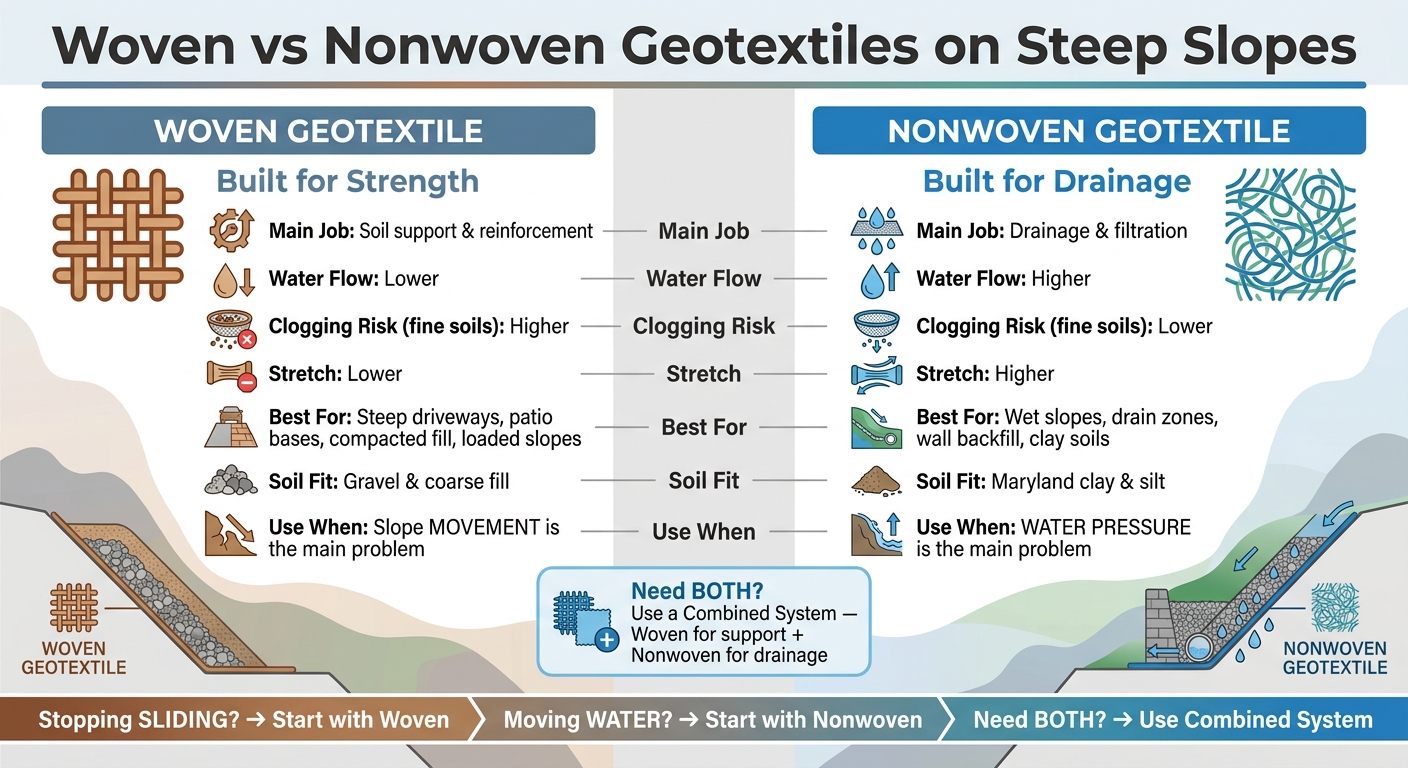
Woven vs Nonwoven Geotextiles on Steep Slopes: Quick Comparison Guide
Woven vs Nonwoven Geotextile Fabric | Choosing the Correct Geotextile for Your Project
sbb-itb-843f8be
Quick Comparison
| Criteria | Woven Geotextile | Nonwoven Geotextile |
|---|---|---|
| Main job | Soil support | Drainage and filtration |
| Best for | Steep loaded areas, fill support, separation under base | Wet slopes, drain zones, wall backfill, clay soils |
| Water flow | Lower | Higher |
| Clogging risk in fine soils | Higher | Lower |
| Stretch | Lower | Higher |
| Good fit for Maryland clay/silt | Less often | More often |
| Good fit for gravel/coarse fill | Yes | Sometimes |
| Best choice when | Slope movement is the main problem | Water pressure is the main problem |
Simple rule: if you’re trying to stop sliding, start with woven. If you’re trying to move water, start with nonwoven. If you ignore install details like overlap, anchoring, and drain connections, either one can fail early.
That’s the short answer I’d want before getting into the rest.
Woven vs nonwoven: how each fabric performs on steep slopes
On steep slopes, the choice usually comes down to soil support versus water flow.
Strength and slope reinforcement
Use woven fabric where the slope needs to resist sliding, settlement, or heavy fill. It has more strength, which makes it the better pick when movement is the main threat.
That’s the core tradeoff: when movement is the issue, strength matters more. When water pressure is the issue, drainage matters more.
Drainage, filtration, and clogging risk
Use nonwoven fabric where water control comes first. Its open structure helps move water away from the slope and lowers pressure around drains. That makes it a strong fit around perforated drain pipe, drainage stone, and wet slope areas where hydrostatic pressure can build up.
Low-permeability woven fabrics can clog fast in fine-grained soils. And once a woven fabric clogs behind a retaining wall or along a slope, water gets trapped and pressure starts to build. That’s where problems can snowball.
Nonwoven fabrics usually resist clogging better. But they still need to match the soil grain size on site if they’re going to keep working over time.
Soil fit for Maryland clays, silts, sands, and mixed fill
Soil texture decides which need comes first. Fine soils tend to hold water. Coarse soils usually put less stress on reinforcement.
Maryland clays and silts tend to work better with nonwoven fabric because it drains better and is less likely to clog. If drainage isn’t handled well, water can sit behind the fabric and push up the risk of slope failure.
Coarser fill, like gravel, rocky material, or sandy sub-base, works well with woven geotextiles for separation and reinforcement. Why? Larger particles are less likely to clog the fabric openings. Mixed fill usually leans toward nonwoven fabric.
Pros and cons at a glance
| Factor | Woven Geotextile Advantage | Nonwoven Geotextile Advantage | Best Takeaway |
|---|---|---|---|
| Reinforcement | Superior load distribution and reinforcement | Limited; prone to stretching | Woven is better for preventing slope creep or sliding |
| Drainage | Can be used to divert water away from a zone | Prevents hydrostatic pressure buildup | Nonwoven is essential for wet slopes to reduce failure risk |
| Filtration | Better for large-particle separation | Excellent at keeping fines out of drainage stone | Nonwoven helps prevent piping and soil loss |
Where each geotextile works better on Maryland residential properties
Once you compare strength, drainage, and clog risk, the next step is simple: where does each fabric make the most sense on a Maryland property?
That answer usually comes down to the job the fabric needs to do. Some slopes need support under weight. Others need water to move out without washing soil into the drainage layer.
Best uses for woven geotextiles
Woven fabric is the better choice when reinforcement and load distribution matter most. On Maryland residential properties, that often means steep driveway and patio projects, where the fabric helps support compacted fill below the finished surface.
Use woven fabric when the slope needs to hold compacted fill, pavement base, or other structural loads.
Best uses for nonwoven geotextiles
Use nonwoven fabric when drainage and filtration matter more than raw strength, especially in clay soil. It works best on slope areas where water needs to move through the system while keeping soil fines out of the drainage layer.
When a combined system makes more sense
Sometimes one fabric alone won’t do the whole job. If the slope needs both load support and water control, use both: woven for reinforcement, nonwoven for filtration and drainage.
Pro Landscapes MD can integrate grading, drainage, and retaining walls to match the fabric system to the slope.
Use-case comparison table
Use this quick guide to match fabric choice to slope condition.
| Slope Condition | Better Fabric | Why | Install With |
|---|---|---|---|
| Steep driveway or patio project | Woven | Structural reinforcement and load distribution | Where the slope carries compacted fill and surface loads |
| Heavy clay soil drainage area | Nonwoven | Lets water pass while keeping fines out of drainage layer | Fine-grained soils where water movement is the priority |
| Project needing both support and drainage | Both | Reinforcement and filtration are both required | Woven for support, nonwoven for drainage layers |
Installation details that affect long-term slope performance
Even the right geotextile can fail early if the install is sloppy. On a steep slope, the system only works when water stays where it’s supposed to go and can’t sneak under the fabric or around the edges.
Overlap, anchoring, and slope placement
On any slope, fabric sections should overlap in the direction of water flow. The upslope piece goes over the downslope piece, like roof shingles, so runoff can’t get under the fabric and wash out the soil.
The fabric also needs to be anchored in a shallow trench at the top edge so it stays in place on the slope. Skip either step, and runoff can undermine the system and erode the subgrade. That same shingle-style layout should continue anywhere the fabric meets drains, stone, or wall backfill.
How geotextiles connect with walls, drains, stone, and pavers
Installation needs to follow the drainage path, not just the face of the slope. Run the fabric continuously into drain stone, wall drainage zones, and paver base so runoff stays in the drainage path instead of slipping past the system.
These connection points are where water bypass and clogging often begin. Woven fabric needs firm anchoring at each junction to maintain reinforcement. Nonwoven fabric needs open drainage paths at those same edges so it can stay unclogged and keep working.
Common installation mistakes and their effects
Skipping proper overlap or anchoring lets water bypass the fabric altogether. On steep slopes, either mistake can shorten the life of the installation and increase the risk of soil loss behind walls, around drains, and under paved surfaces.
Conclusion: choosing the right fabric for steep slopes
Final takeaways
For steep slopes, the choice is pretty simple once you know the job the fabric needs to do.
Use woven geotextiles when the main goal is reinforcement. Use nonwoven geotextiles when the slope needs drainage and filtration. And when a steep slope has to handle both, a combined system usually makes the most sense.
Here’s the short version:
- Woven geotextiles add strength
- Nonwoven geotextiles help with drainage
- Combined systems handle both needs at once
The right pick comes down to what the slope needs most: more strength, more drainage, or a mix of both.
For steep-slope drainage, grading, retaining walls, and land leveling in central Maryland and Washington, DC, Pro Landscapes MD can help.
FAQs
How do I choose the right geotextile for my soil?
Choose based on your project’s main need: strength or drainage.
Use nonwoven geotextile for French drains, retaining wall backfill, or slope erosion control when water needs to pass through while the soil stays in place.
Use woven geotextile for load-bearing areas like driveways or paver patios, where strength and separation help stop aggregate from sinking into the subgrade.
Can woven and nonwoven geotextiles be used together?
Yes. Woven and nonwoven geotextiles can be used in the same project, but they do different jobs. The right setup depends on what your Maryland property needs.
In most cases, woven geotextiles are used for strength and support. Nonwoven geotextiles are used for drainage and filtration. For example, one layer might help reinforce a base, while the other helps water move through a French drain without carrying soil along with it.
What installation mistakes cause geotextile failure on slopes?
Common problems usually come down to material choice and installation mistakes.
Pick the wrong fabric, and things can go sideways fast. For example, using woven geotextiles in areas that need drainage can hold water instead of letting it pass through. That trapped water can build hydrostatic pressure and lead to slope instability. On top of that, fabric that’s too light may tear during installation or wear out much sooner than expected.
Installation errors can be just as damaging. A few common ones include:
- Skipping a top-of-slope trench to anchor the fabric
- Using too little overlap between rolls
- Failing to secure the edges tightly with stakes
Chat with Us