









- bhavya gada
- No Comments
If you add hard surface area in Montgomery County, stormwater review may apply before work starts. I’d keep four things in mind right away: check if your project adds impervious area, confirm setbacks, test soil before choosing an infiltration setup, and plan for upkeep after installation.
Here’s the short version:
- County review may be required for patios, driveways, walkways, roofs, and other hard surfaces.
- Runoff adds up fast: 1 inch of rain on a 1,500-square-foot roof can produce more than 900 gallons of water.
- Water cannot be pushed onto a neighbor’s lot or left to pond where it can cause damage.
- Ponding or infiltration features should stay at least 10 feet from foundations and 5 feet from slabs.
- Slow-draining soil matters: if a perc test shows drainage slower than 36 hours, a standard rain garden may not fit the site.
- Common residential options include rain gardens, conservation landscapes, permeable pavers, infiltration trenches, dry wells, and dry riverbeds.
- Projects disturbing 5,000 square feet or more need a county-approved concept plan before grading or building permits move ahead.
- Skipping approval can get expensive, with fines up to $10,000 per day.
- RainScapes rebates and county permits are not the same thing.
- Maintenance is part of the job: many systems should drain within 24 to 48 hours, and new planting usually needs weekly watering during dry periods in year one.
If I had to sum up the guide in one line, it would be this: pick a stormwater setup that fits your soil, slope, space, and drainage path – and make sure it meets county rules before construction begins.
Stormwater in Montgomery County, Maryland
sbb-itb-843f8be
Montgomery County Stormwater Rules Homeowners Need to Know
Understanding when and why the county gets involved in your project can save time and money before you start construction.
What Triggers a Stormwater Management Review
Before you add impervious area, check if DPS review is required. Any project that adds impervious surface – roofs, driveways, patios, or other hard surfaces – may need county stormwater review. In many cases, these projects trigger county review. The Montgomery County Department of Permitting Services (DPS) reviews required permits [1][2]. It’s smart to confirm DPS review before construction starts.
Core Design Standards Behind County Review
County review is built around a simple idea: stormwater should stay on-site, move more slowly, and soak into soil or vegetation before it reaches storm drains or nearby properties.
Two rules matter most here. First, your design can’t redirect water onto a neighbor’s property or cause ponding on adjacent lots [3]. Second, stormwater features that include ponding or infiltration systems – like rain gardens or permeable pavement – must be set back at least 10 feet from house foundations, including basements or crawl spaces, and 5 feet from slabs such as garages, patios, or driveways [1][3].
Soil conditions can also shape what you’re allowed to build. If a percolation test shows drainage slower than 36 hours, a standard rain garden won’t work. In that case, use a 3-inch Ponding Conservation Landscape or an underdrain system [1][3].
Once you know these standards, you can start narrowing down the design that fits your lot and meets county rules.
County Agencies and Design References
DPS handles required permits, while DEP manages voluntary RainScapes projects [1][2]. That distinction matters. RainScapes projects are voluntary and can’t be used to satisfy a county-required stormwater permit [3].
Residential stormwater projects in Montgomery County usually follow these references:
- Maryland Stormwater Design Manual
- Guidelines for Environmental Management of Development in Montgomery County
- RainScapes Stormwater Garden Project Manual [4][1]
If your property is in a Special Protection Area (SPA), such as the Ten Mile Creek watershed, stricter rules apply. That can mean tighter limits on impervious surface coverage and expanded buffer requirements [4]. And if you live in Rockville, Gaithersburg, or Takoma Park, local rules apply instead, and those properties do not qualify for county RainScapes rebates [2][3].
These references shape the design options available for residential lots.
Approved Stormwater Design Options for Residential Lots
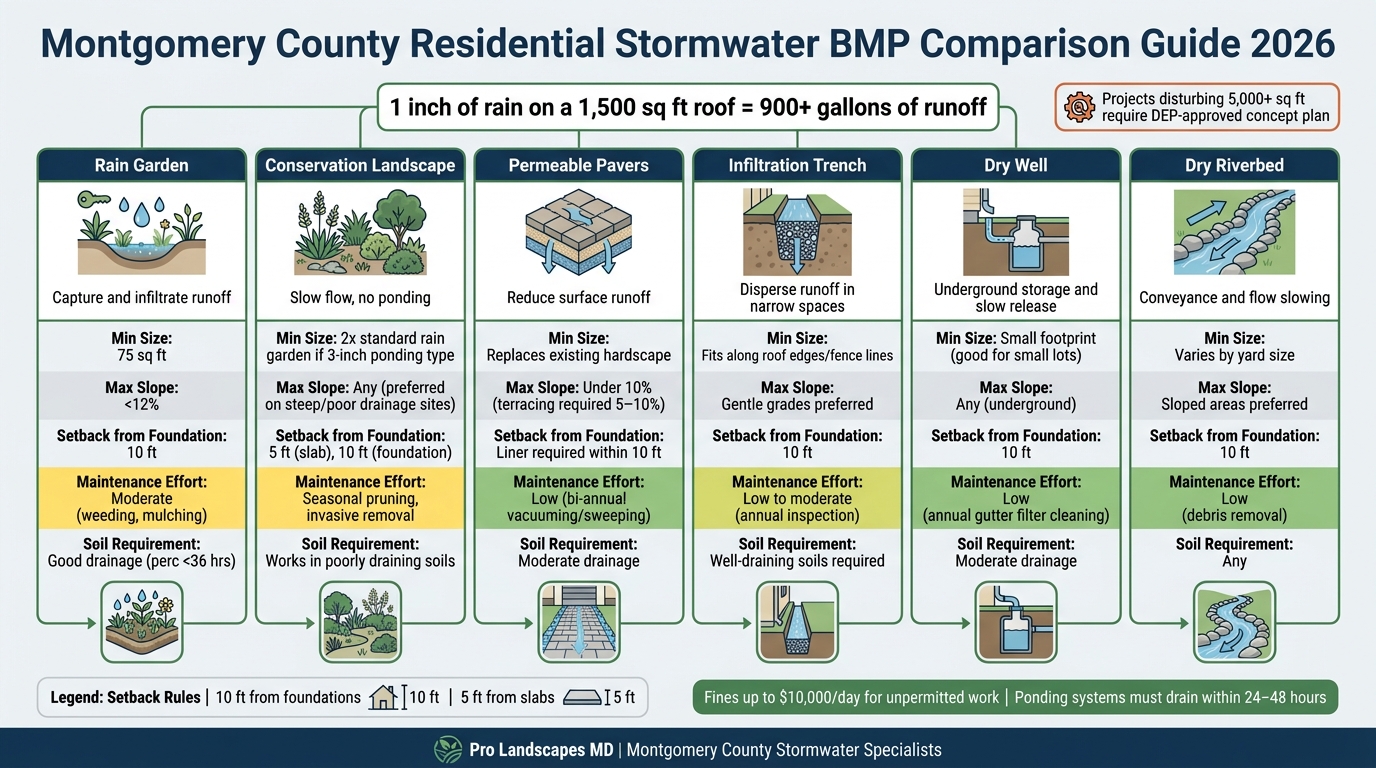
Montgomery County Residential Stormwater BMP Comparison Guide 2026
Montgomery County allows several small-scale stormwater practices for residential lots. The right pick comes down to a few site basics: soil, slope, open space, and distance from the foundation.
Rain Gardens and Small Bioretention Areas
Once the county rules are clear, the job is to match the practice to the lot.
Rain gardens are shallow planted depressions that collect runoff from roofs, driveways, or patios and let that water soak into the soil. A standard residential rain garden should be at least 75 square feet [1].
If the soil drains too slowly, a 3-inch Ponding Conservation Landscape is the backup option. It holds only 3 inches of water and must be twice the size of a standard rain garden. On steep slopes, in poorly draining soils, or where there isn’t much room near the foundation, a Conservation Landscape with native plants and no ponding is often the better choice [1].
RainScapes projects must use at least 75% native plants from the Maryland Piedmont region, measured by plant count and planted area [1]. New gardens need weekly watering during dry spells in the first year. Every rain garden also needs a planned overflow route. A weir notch – a low point in the berm protected with stone – lets extra water exit safely during heavy storms [1].
If the soil doesn’t drain fast enough, move to a ponding or underdrained setup.
Permeable Pavers, Infiltration Trenches, and Dry Wells
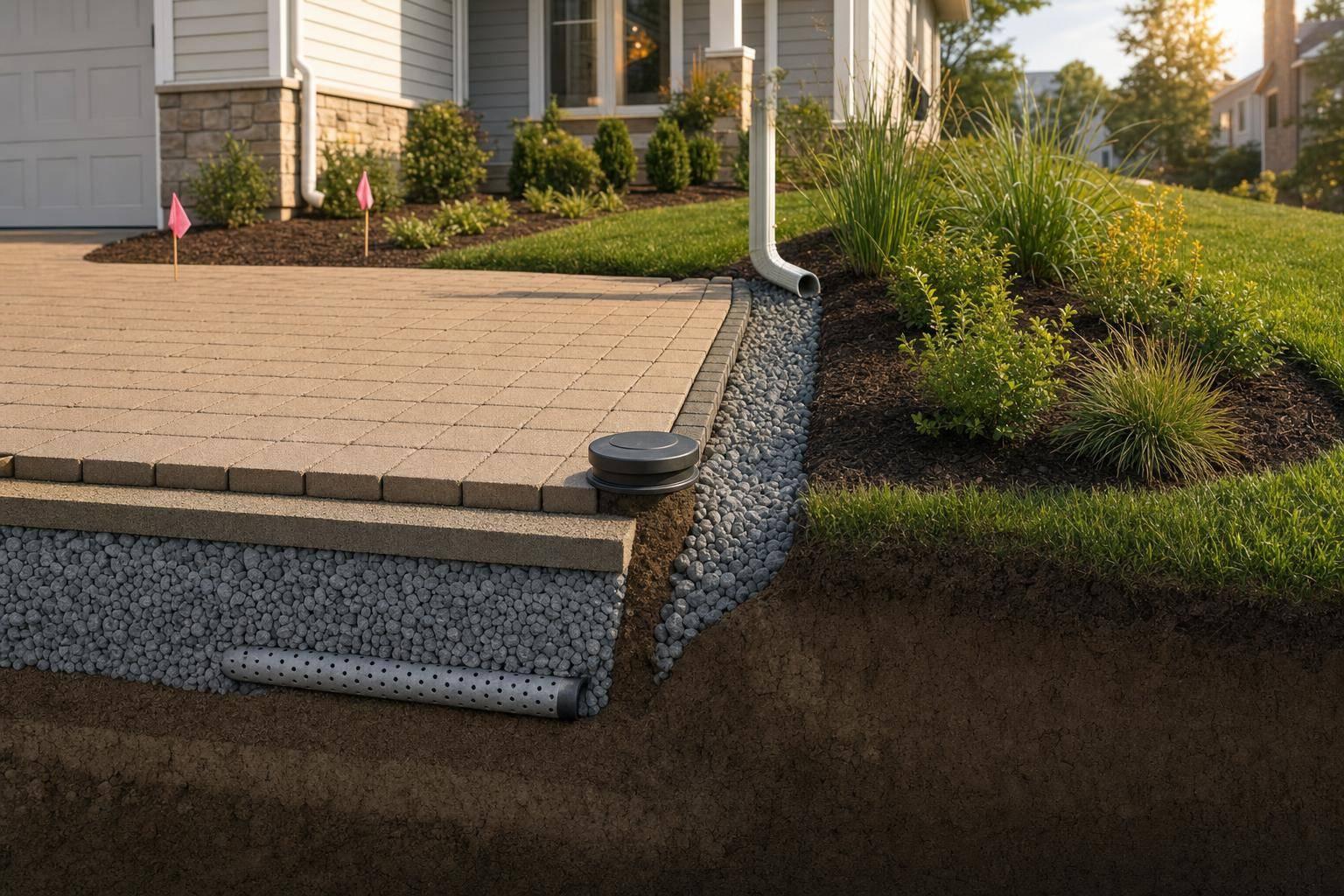
Permeable pavers swap solid pavement for interlocking blocks over a stone base, so water can pass through the joints and into the ground. They must be installed on slopes under 10%. For slopes between 5% and 10%, the sub-grade has to be terraced and include flow barriers. If the system is within 10 feet of a foundation, it needs a waterproof liner underneath, and overflow pipes should discharge at least 10 feet from property lines or rights-of-way [3].
Infiltration trenches fit narrow spaces well, like along roof edges or fence lines where there’s not much surface area to work with. They carry water through a gravel-filled channel. Dry wells do much the same thing below ground by collecting downspout runoff and releasing it slowly into nearby soil. Both need periodic inspection, especially after heavy leaf drop or construction work nearby [1].
These systems tend to work best when the drainage route matches the site’s grade.
Dry Riverbeds, Grading, and Integrated Drainage Layouts
Dry riverbeds and swales help move runoff toward a treatment area while slowing it down. A rock-lined dry riverbed can carry water across a yard and give it more time to soak in. Small earthen berms can steer runoff into planted areas and stretch out the flow path, which helps infiltration too [1].
Grading and conveyance features should direct runoff into planted treatment areas. That’s the idea behind a treatment train approach: several practices working together to handle more runoff than one feature could manage alone. Grading changes can also push sheet flow away from foundations and toward planted areas. Buried PVC pipes with stone outlets or shallow trench drains can give water a controlled path to follow [1].
The table below compares the main residential options side by side:
| Practice | Primary Function | Maintenance Effort | Lot Suitability |
|---|---|---|---|
| Rain Garden | Capture and infiltrate | Moderate (weeding, mulching) | Flat areas (<12% slope) with good drainage |
| Small Bioretention Area | Filter and infiltrate | Moderate to high | Sites with specific soil/percolation requirements |
| Permeable Pavers | Reduce runoff | Low (occasional sweeping/vacuuming) | Slopes under 10%; replaces existing hardscape |
| Infiltration Trench | Disperse runoff | Low to moderate | Requires well-draining soils |
| Dry Well | Underground storage | Low | Small lots with limited surface space |
| Dry Riverbed | Conveyance and slowing flow | Low (debris removal) | Sloped areas or treatment train links |
After choosing a practice, review permits, site limits, and maintenance needs before locking in the design. Next comes permits, soil limits, and long-term maintenance.
Permits, Site Constraints, and Long-Term Maintenance
Typical Permit and Plan Submission Steps
Once you pick a BMP, the next move is to confirm whether county review is required. If your project disturbs 5,000 square feet or more, you need a DEP-approved stormwater management concept plan before grading or building permits are issued. Starting work without that approval can lead to fines of up to $10,000 per day [5].
Voluntary RainScapes projects follow a different application and inspection path, even when they fall below the mandatory review threshold.
| Step | Action | Purpose |
|---|---|---|
| Site Assessment | Drainage map, utility check | Identify runoff sources and site limits |
| Feasibility Testing | Soil percolation (perc) test | Confirm whether infiltration-based BMPs will work |
| Concept Design | BMP selection, sizing calculations | Check that the design meets ESD rules |
| Plan Preparation | Planting plan (75% native [1]), grading/drainage plan | Confirm plant choice and water flow |
| Application | DEP concept plan or RainScapes Rewards Application | Enter county review or rebate process |
| Construction | Photos of sub-grade, stone, and liner; receipts [3] | Document the built system |
| Final Inspection | Property Owner Agreement, itemized receipts | Confirm compliance and close the permit or rebate |
A few small details can trip people up. If you plan to store equipment or materials in the county right-of-way, you also need a separate ROW permit [3]. And before any digging starts, call 811 [1]. If you live in Rockville, Gaithersburg, or Takoma Park, check city rules before sending in a county application, since local requirements may also apply [5].
Soils, Slopes, Groundwater, and Natural Resource Limits
After the permit check, the next question is simple: Will the site actually support the BMP you want?
Soil is one of the first things to look at. Infiltration-based BMPs rely on how fast water moves through the ground. If the site drains slowly, you may need an underdrained or non-ponding design [1][3]. Soggy ground is usually a red flag. It often points to poor drainage or high groundwater, and that can rule out rain gardens [1].
Slope and groundwater can narrow your choices even more. Sites near wetlands, stream buffers, floodplains, or Special Protection Areas like Ten Mile Creek may need lined or underdrained systems [4]. Tree protection also matters. Projects near large canopy trees are reviewed case by case so root systems are not damaged [1][3].
For permeable pavement, there is one spacing rule you don’t want to miss: overflow pipes must discharge at least 10 feet from any property line or right-of-way [3].
Maintenance Requirements After Installation
Once the system is in the ground, upkeep becomes the big factor. Most long-term issues don’t start with the design. They start when maintenance gets skipped.
Ponding areas should drain within 24 to 48 hours. New plantings also need weekly watering during the first year when rainfall is under 1 inch per week [1]. If water sits longer than that, the BMP is not working the way it should.
| BMP Type | Inspection Frequency | Common Upkeep Tasks | Signs of Failure |
|---|---|---|---|
| Rain Garden | Seasonal / after major storms | Weeding, mulching with a 3-inch layer, sediment removal from the inlet [1] | Standing water >48 hours [1], erosion at inflow, mosquito larvae [1] |
| Permeable Pavers | Bi-annually [3] | Vacuuming joints, replenishing aggregate, checking for settling [3] | Surface ponding, clogged joints, shifting pavers [3] |
| Conservation Landscape | Seasonal [1] | Pruning, invasive species removal, watering in Year 1 [1] | Plant die-off, bare soil, sediment buildup [1] |
| Dry Wells / Infiltration Trenches | Annually [3] | Cleaning gutter filters, checking overflow pipes [3] | Water backing up into downspouts, slow drainage [3] |
When maintenance slips, clogging and overflow can follow. That can push water toward your foundation or into a neighbor’s yard [1][3]. In more serious cases, fixes may include regrading, inlet repair, or restoring drainage.
Conclusion: Planning a Compliant and Durable Stormwater Solution
Once you know the rules and approved methods, the last step is simple: fit the system to your lot.
Montgomery County stormwater design comes down to one core idea: slow, filter, and infiltrate runoff with practices that follow natural drainage patterns [1][2]. That means matching the BMP to your soil, slope, and drainage conditions. It also means respecting setback rules. Keep ponding systems 10 feet from foundations and 5 feet from slabs [1][3].
Key Takeaways for Homeowners in 2026
Before you build, a few choices have the biggest impact.
- Soil testing comes first. A percolation test must show drainage within 36 hours before you use ponding BMPs [1][3].
- Native planting matters. RainScapes plans need at least 75% Maryland Piedmont native plants [1].
- Rebates and permits are separate. Rebates can help offset approved work, but they do not replace county permits [3].
- Maintenance is part of the design. Plan for first-year watering, mulching, weeding, and regular post-storm inspections [1].
Pro Landscapes MD installs drainage, grading, French drains, dry riverbeds, and permeable pavers in Montgomery County.
FAQs
Do I need a stormwater permit for my patio or driveway?
It depends on your project. A new patio or driveway may need a permit if it changes the way water drains on the property or goes over local square-foot limits for additions.
And there’s one more piece to watch: if runoff will be sent into a public right-of-way through a pipe, you’ll also need a separate right-of-way permit.
For project-specific questions, check with your local permitting office before construction.
What if my soil drains too slowly for a rain garden?
If your soil drains too slowly for a rain garden, you still have options. Deep-rooted native plants can help the soil open up over time, and compost may help it drain and function better.
If the soil is especially hard to work with or close to impermeable, it’s smart to talk with a professional designer or engineer for site-specific fixes. Pro Landscapes MD also offers drainage services like grading and yard leveling.
Who handles permits, rebates, and local reviews?
In Montgomery County, you submit building permits and drainage plans for property improvements to the Land Development Division for review and approval.
If runoff will discharge into a public right-of-way, you’ll also need a separate permit before the building permit can be issued.
For voluntary RainScapes Rewards projects, homeowners work directly with a RainScapes planner. That planner handles project approval, required paperwork, final inspections, and rebate qualification.
Chat with Us