









- bhavya gada
- No Comments
Most Maryland partial-shade problems come down to 4 things: light hours, sun timing, soil moisture, and drainage. If I want a bed to work, I need to check how much direct sun it gets – usually 3 to 6 hours – whether that sun comes in the morning or afternoon, where water sits for 24–48 hours after rain, and how trees, walls, and slopes change the space through the year.
Here’s the short version:
- Partial shade is not full shade. In Maryland, many beds shift between sun and shade as tree canopies fill in.
- Morning sun is easier on plants than hot late-day sun.
- Spring light can fool me. A bright bed in April may be much darker by July.
- Wet spots need attention first. If water stands for more than 1 to 2 days, planting first is a mistake.
- Plant choice should match both light and moisture. Dry shade under trees is different from moist shade near low ground.
- Layering works better than flat rows. Groundcovers in front, perennials in the middle, shrubs in back.
- Hard surfaces change the bed. Patios, walls, and walkways can make shade beds hotter and drier.
- Care matters by season. Mulch at 2–3 inches, water at the root zone in summer, and prune shrubs based on bloom time.
A few numbers help make this simple:
| Item | Quick guide |
|---|---|
| Partial shade | 3–6 hours of direct sun |
| Full shade | Less than 3 hours of direct sun |
| Check light at | 9 a.m., noon, 3 p.m., 6 p.m. |
| Water warning sign | Pooling for 24–48 hours |
| Bed width, both sides reachable | 3–4 ft. |
| Bed width, along wall or fence | 2–3 ft. |
| Path width | 36 in. minimum; 48–60 in. for two people |
| Mulch depth | 2–3 inches |
If I had to sum up the whole article in one line: read the site first, fix water issues, then plant by light level, moisture, and season.
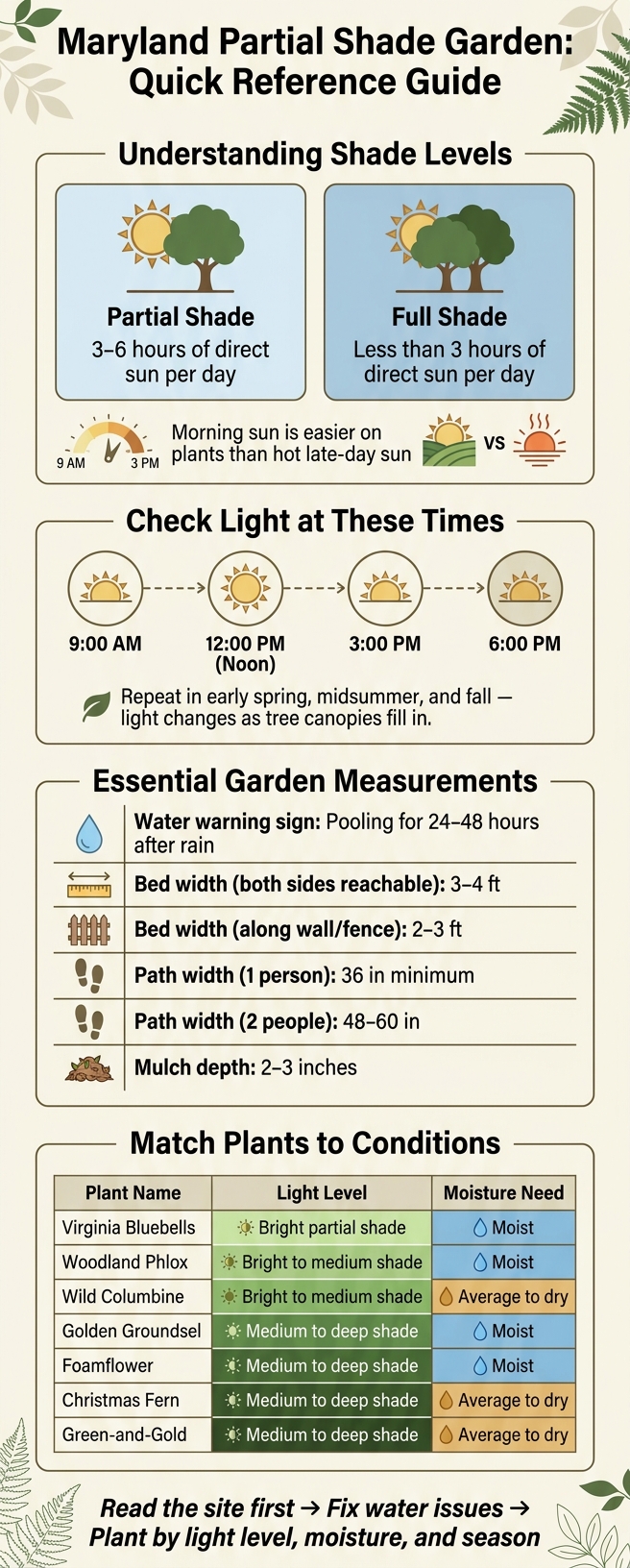
Maryland Partial Shade Garden: Quick Reference Guide
Read the site before planting
Before you plant anything, watch how light and water move through the yard over the course of the year.
Map sun and shade across the seasons
Start with a simple sketch of your yard. Mark the house, fences, large trees, sheds, and any beds that are already there. Then check each area at about 9 a.m., noon, 3 p.m., and 6 p.m. Note whether each spot is in full sun, dappled light, or shade, and mark that on your sketch with colors or short labels.
Do this in at least three seasons: early spring, midsummer, and fall. That part matters more than most people think. A spot that looks bright in spring can turn much darker by midsummer once trees leaf out. It also helps to note whether the area gets morning sun or late-day sun, since those can feel very different in the garden. Walls, driveways, and patios can throw off extra heat too. Once you understand the light, move on to water.
Check soil moisture, drainage, and slope
After a normal rain, walk the yard and look for puddles. If water sits for more than 24–48 hours, take that as a warning sign. It often points to compacted soil, poor grading, or blocked runoff. Planting in wet soil increases root rot and disease.[1]
If you want a closer read, dig a small hole 4–6 inches deep in a few spots the day after rain. Sticky, wet soil marks a moist zone. Soil that feels damp but not soggy is usually the sweet spot. If it crumbles and dries out fast, you’re looking at a dry zone. That often shows up under large tree canopies or near roof eaves.
Add those dry and moist spots to your light map. At that point, the yard starts to make a lot more sense, and so do your planting choices.
For drainage or grading issues that don’t go away, Pro Landscapes MD handles drainage, grading, French drains, dry riverbeds, and stormwater management across central Maryland. Fix drainage before planting.
Match the garden style to the site
Use your light and moisture map to choose the bed style that fits the space.
- A woodland edge bed along a tree line works well in dappled light and with natural leaf litter. It usually relies on layers of shrubs, ferns, and groundcovers.
- A foundation planting along the house has to deal with shadows from the building, heat bouncing off walls, and shifting moisture from roof runoff. That calls for shrubs and perennials that can handle small site changes.
- A path border needs plants that stay neat, hold a clear edge, and can take a little foot traffic.
- A patio-side garden has to deal with heat from paving, shifting moisture at the edges, and the need for privacy or a frame around a seating area.
This is where function matters. A bed beside a path should work for movement. A bed near a patio should feel good to sit next to. A border you mostly see from indoors should look good from that angle. Matching the style to how the area is used keeps the garden useful, not just pretty.
With the site mapped, choose plants that fit each light and moisture zone. With the site mapped, the next step is choosing plants for bright to medium shade.
sbb-itb-843f8be
Choose plants that fit Maryland partial shade
Once you know where the light lands and which areas stay wet or dry, you can start matching plants to the conditions they like.
Perennials, groundcovers, and ferns for bright to medium shade
Bright partial shade – areas with morning sun or dappled light under a high canopy – can handle a good mix of flowering natives. Virginia bluebells (Mertensia virginica) are a strong fit for moist, bright shade, but they go dormant by early summer.[9] That makes them a good match with woodland phlox (Phlox divaricata) and wild columbine (Aquilegia canadensis), which both do well in bright to medium shade. If you have the brighter edge of the bed, woodland sunflower (Helianthus divaricatus) and white wood aster (Eurybia divaricata) belong there.
For medium to deep shade, or places that stay evenly moist, golden groundsel (Packera aurea) and foamflower (Tiarella cordifolia) are solid groundcover picks. Christmas fern (Polystichum acrostichoides) works well in average to dry shade, even on slopes.[4][7] Green-and-gold (Chrysogonum virginianum) does a similar job in dry shade, spreading slowly into a low mat that helps block weeds.[5]
| Plant | Light | Moisture |
|---|---|---|
| Virginia bluebells | Bright partial shade | Moist |
| Woodland phlox | Bright to medium shade | Moist |
| Wild columbine | Bright to medium shade | Average to dry |
| Golden groundsel | Medium to deep shade | Moist |
| Foamflower | Medium to deep shade | Moist |
| Christmas fern | Medium to deep shade | Average to dry |
| Green-and-gold | Medium to deep shade | Average to dry |
A simple way to place them: put brighter-shade plants near open lawn or paving, and shift moisture-loving plants toward lower spots.
Shrubs that hold structure in partial shade
Shrubs give the bed height, screening, and shape through the year. For average to dry shade, use spicebush (Lindera benzoin) and common witch hazel (Hamamelis virginiana). In moist areas, go with winterberry holly (Ilex verticillata) and elderberry (Sambucus canadensis). For average conditions, serviceberry (Amelanchier spp.) and arrowwood viburnum (Viburnum dentatum) are good options.[6][10][11][12]
Set taller shrubs at the back of the bed or along edges where you want screening.
Plant in layers instead of flat rows
Flat rows may look neat at first, but they tend to make a bed feel stiff and thin. A layered layout usually works better.
Use low groundcovers like Christmas fern, green-and-gold, and foamflower at the front and around the base. Fill the middle with mid-height perennials and ferns such as Virginia bluebells, woodland phlox, and white wood aster. Then use shrubs like spicebush, witch hazel, and viburnum to anchor the back and sides.[2][3]
It also helps to repeat the same plant in groups of three or more instead of dotting single plants all over the bed. That gives the planting a cleaner look and makes upkeep easier.[8]
With plants picked out, the next move is to shape the bed around light pockets, foot traffic, and hardscape.
Design the bed and connect it to hardscape
Shape beds around light pockets and foot traffic
After you pick plants for each light zone, shape the bed to fit those same zones. In plain terms: let the light map guide the bed lines.
Use your light map to trace the partial-shade pockets that stay pretty steady through the day. Then sketch the bed edge with a garden hose or a piece of string. Curved lines usually work better here than stiff, straight edges because they follow the way light actually falls across the yard. That keeps shrubs, perennials, and groundcovers in the spots that fit them best instead of forcing everything into a fixed grid.
Bed width matters too. Beds you can reach from both sides should usually stay around 3–4 ft. wide. Beds along a fence, wall, or other structure are often easier to care for at about 2–3 ft. wide.[20][21][22] For paths, allow at least 36 in. for one person to walk through, and 48–60 in. where two people may walk side by side.[13][15]
That spacing does more than make the yard look neat. It also keeps the bed edge out of the main traffic lane, which helps limit soil compaction and makes the space easier to move through.
Use patios, walkways, and walls as clean transitions
Once the bed shape is in place, use hardscape edges to give it a clean frame. Plantings can soften patios, walkways, and walls so those areas don’t feel too sharp or bare.
Along a patio, partial-shade perennials and low groundcovers can spill a bit over the edge to soften the line without crowding chairs or foot traffic. Along walkways, keep shorter plants near the path and place taller shrubs and ferns farther back so the route stays clear. Near retaining walls, garden walls, or seat walls, layer the planting from front to back:
- Groundcovers in front
- Medium perennials in the middle
- Shrubs at the back against the stone
In Maryland, paving and walls can make partial-shade areas hotter and drier. That’s one more reason to keep lower plants near the edge and taller plants behind them. Lighter hardscape materials – like pale pavers, cream or soft-gray flagstone, or lighter wall caps – can also help brighten spaces that get filtered sun or afternoon shade.
A narrow gravel or stone border between the patio edge and the bed helps in a practical way too. It gives the line a crisp finish and cuts down on soil splashing onto the paving.[18]
When to bring in professional drainage and hardscape help
If runoff or grading affects the planting area, deal with that first. Partial shade gardens often struggle when water movement and site structure are brushed aside.
Check the area during and after a heavy rain. If you see pooling water, mulch washing out, or soil that stays soggy, the site likely needs drainage or grading work before anything goes in. Patios and paths should slope gently away from the house and walls so runoff moves toward the lawn or another collection point.[14][16][19] Behind retaining walls, gravel backfill and relief drains help stop water pressure from building up over time.[17][19]
Pro Landscapes MD handles planting, drainage correction, grading, patios, walkways, retaining walls, and garden walls across central Maryland.
Seasonal care, shrub pruning, and next steps
Spring, summer, and fall maintenance
Once the bed is planted and mulched, the job isn’t over. Seasonal care helps keep partial-shade areas from sliding into plant stress.
In spring, check for frost heave and any water that lingers after heavy rain. Then refresh 2 to 3 inches of organic mulch, keeping it away from stems and trunks.[35][31][33]
Summer is mostly about water. As trees leaf out and heat builds, the bed can hold moisture very differently than it did earlier in the year. Use drip or soaker irrigation to water the root zone without wetting the leaves.[34][36][31][32]
Fall is the best time to plant or divide perennials, and new plants need steady water until they’re established.[30][31]
After watering, pruning does the next big job: it helps shrubs stay open to the light they need.
Prune shrubs by bloom time and natural form
Timing matters here. Spring-flowering shrubs should be pruned right after they finish blooming because they set buds on old wood. Summer-flowering shrubs can usually be pruned in late winter or very early spring because they bloom on new wood.[25][26][27]
For most shrubs, start simple:
- Remove dead, diseased, or damaged wood
- Thin a few of the oldest or most crowded stems at the base
- Let more light and air move through the plant
Skip heavy shearing and stiff, boxy shapes. Prune in a way that fits the shrub’s natural form. That approach keeps shrubs healthier and makes them a better fit for partial shade borders.[23][24][28][29]
Conclusion: Key steps for a successful Maryland partial shade garden
A successful Maryland partial shade garden follows a clear sequence: match plants to seasonal light and moisture, fix drainage before planting, build beds in layers, and keep them going with seasonal watering and bloom-timed pruning. Start with the site, then adjust care as light and moisture shift through the year.
FAQs
How do I tell partial shade from full shade?
Watch how much direct sun the area gets during the day. Partial shade usually means 4 to 6 hours of direct sunlight. Full shade means fewer than 4 hours.
Light can shift a lot as trees leaf out and canopies thicken. So don’t judge the spot just once. Check your yard at different points in the growing season to map these areas with more accuracy.
What should I fix before planting a wet shade bed?
Check your soil’s texture, pH, and organic matter first. That gives you a clear read on what you’re working with.
In Maryland, soils often lean heavy on clay. That can mean slow drainage and packed-down ground that’s tough on roots. A simple fix is to work in compost, aged manure, or leaf mold to help loosen the soil and improve how water moves. If the compaction is severe, gypsum may help.
It also helps to watch your yard during a heavy rain. You’ll see pretty fast where water runs off and where it sits. Those trouble spots can point to drainage issues that need more than a soil amendment. For chronic problems, you may need grading, land leveling, or French drains.
Which plants work best in dry shade under trees?
Choose plants that fit woodland conditions and drier soil. Wild ginger (Asarum canadense) is a strong pick because it spreads into thick colonies and fills the ground with heart-shaped leaves.
Coral bells (Heuchera) also grow well here, especially in the cooler, slightly damper pockets you often get under tree canopies. Together, these plants form a tough, low-maintenance ground layer for tricky dry shade.
Chat with Us